Clarified Milk Punch · Volume 1
Vol 1 — Punch Before the Cocktail
Mixed Drinks — Clarified Milk Punch. Where punch came from, what the word probably means and why the popular answer is shaky, how a sailors’ drink became the social centre of the English-speaking world for a century and a half, and why all of that has to come first before the milk makes any sense.
1.1.1 A note on where this dive stands
⚠ This series is written from the record, not from a bar. The Old Fashioned dive in this section is written around a drink made hundreds of times; this one is not. No clarified milk punch has been made or tasted here yet. What follows is research and genuine anticipation, and where a judgement would need a glass in hand to make honestly, it is left unmade.
That is worth stating at the top rather than burying, because a great deal of what is written about this drink online reads as first-hand and is plainly assembled from the same three articles. This dive at least tells you which it is.
1.1.2 The cocktail is the child, not the parent
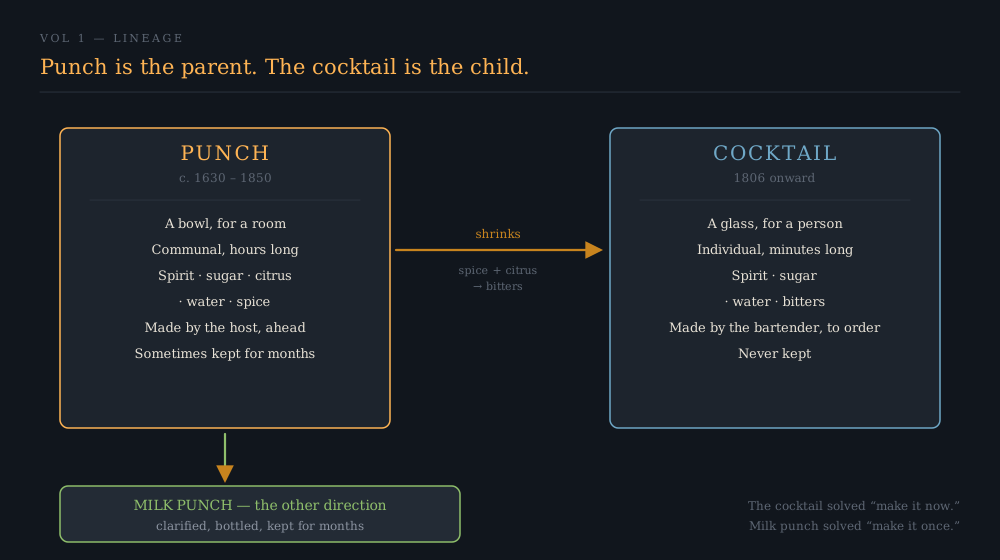
The Old Fashioned dive opens with a definition printed in 1806. Punch is roughly two hundred years older, and for most of that span it was not a category of drink — it was the drink. The cocktail, when it appeared, was in an important sense a punch shrunk to a single serving and stripped of most of its parts.
The lineage matters because it explains the shape of everything downstream:
Table 1 — The lineage matters because it explains the shape of everything downstream
| Punch (c. 1630–1850) | Cocktail (1806 onward) | |
|---|---|---|
| Scale | A bowl, for a room | A glass, for a person |
| Occasion | Communal, hours long | Individual, minutes long |
| Parts | Spirit, sugar, citrus, water, spice | Spirit, sugar, water, bitters |
| Made by | The host, in advance | The bartender, to order |
| Kept | Sometimes for months | Never |
⭐ Read the two ingredient lists side by side and the descent is obvious. Swap citrus and spice for bitters, shrink the bowl to a tumbler, and you have the 1806 definition. Punch is the cocktail’s parent, and the milk punch is the branch of the family that went in a completely different direction — toward the bottle rather than the glass.
1.1.3 Where the word comes from, and why nobody actually knows
Two explanations. One is repeated everywhere; the other is probably right.
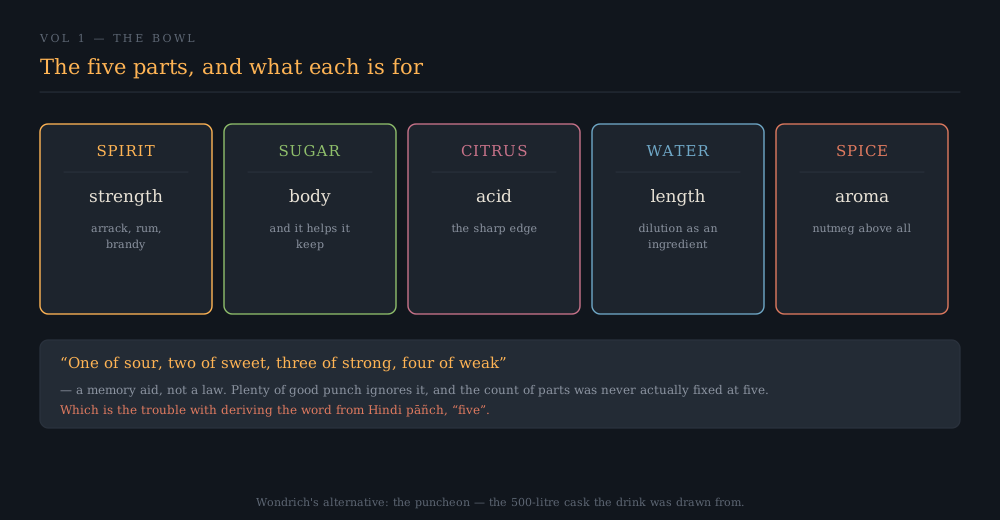
The five-ingredient story. Punch is said to come from Hindi pāñch, “five” — for spirit, sugar, citrus, water and spice. It is tidy, it is memorable, it appears in most dictionaries, and it fits the East India Company route neatly.
🔴 The problem is that punches routinely have four ingredients, or six, or eight, and always did. A derivation built on a fixed count of five sits badly against a drink whose recipes have never agreed on five of anything. If the name meant “five,” the count ought to have stayed fixed for at least a little while. It never was.
The puncheon story. David Wondrich — whose Punch (2010) is the standard modern history — argues the word more likely comes from the puncheon, a large cask. Sailors drew their allowance from it; a “puncheon” of liquor became a “punch.” The cask is still called a puncheon today, and it is still roughly 500 litres.
⚠ The honest verdict: unsettled, with the cask ahead on points. The five-ingredient story is not disproved, it is merely convenient — and it has the same shape as the coquetier story the Old Fashioned dive dismantles: a satisfying explanation that survives because it is fun to tell and nobody checks whether the drink actually behaves that way.
1.1.4 The East India route
Punch arrives in English through the East India Company in the first half of the 17th century. English sailors and factors in India encountered a mixed drink of spirit, sugar, citrus, water and spice, took to it thoroughly, and brought the habit home. English references appear from the 1630s.
The founding spirit was not rum, gin or brandy — it was arrack. Specifically Batavia arrack, distilled in Java from sugarcane and fermented red rice, funky and aromatic and unlike anything then made in Europe. It is still made, it is still in the same style, and it remains the most historically correct base for a punch of this period. Rum and brandy came later and largely because they were nearer.
The other imported necessity was citrus — expensive, seasonal and, on a ship, medically consequential. And the third was sugar, which in the 17th century meant the Caribbean plantation economy. ⚠ It is worth saying plainly that punch is a drink of empire. Its ingredients are a map of the trade routes and the labour that moved along them, and a history of the drink that leaves that out is telling half a story.
1.1.5 The bowl as a social object
For roughly a century and a half punch was how people drank together in Britain, its colonies and its ships. Not a drink you ordered — a drink somebody made, in quantity, for the room, and then everybody sat around for the rest of the evening.
The consequences are worth spelling out because they are so unlike modern drinking:
- The host was the bartender. Making good punch was a domestic accomplishment, discussed and judged the way a roast might be.
- It was slow. A bowl was an evening, not a round. The drink was long, relatively weak by the glass, and designed to be drunk steadily for hours.
- The recipe was personal. There was no canonical punch; there were your proportions. The famous rhyme — one of sour, two of sweet, three of strong, four of weak — is a memory aid, not a law, and plenty of good punches ignore it.
- Ritual and equipment grew around it. Bowls, ladles, strainers, nutmeg graters, and the oleo saccharum step (peel and sugar, left to draw out the oil) that the Old Fashioned dive borrows in Vol 3.
1.1.6 Why punch died
The decline is quick and it has three causes, none of them about taste.
- The cocktail. A drink made to order in a glass suits a commercial bar; a bowl made for a room does not. As drinking moved out of the house and into the public bar through the 19th century, the format that could be sold by the glass won.
- Ice. Punch is built around dilution by water because it predates reliable cold. Once ice was cheap, chilling and dilution could be done at the moment of service, which is exactly what the cocktail does.
- Time. Punch takes hours of preparation and hours of drinking. Neither survived industrial working patterns well.
Milk punch is the exception that proves the rule — because it is the one branch of the family that went the other way. Where the cocktail solved “make it now, in a glass,” clarified milk punch solved “make it once, keep it for months, pour it whenever.” That is a completely different problem, and it produced a completely different drink. Vol 2 picks it up.
1.1.7 What this series covers
Table 2 — What this series covers
| Vol | Subject |
|---|---|
| 2 | The milk turn — Behn, Rockett, Franklin, Dickens, and the bottled trade |
| 3 | What curdling actually does — casein, acid, and the curd as a filter |
| 4 | The method, step by step |
| 5 | Ingredients — spirits, acids, tea, spice, and what each contributes |
| 6 | Filtering and clarity |
| 7 | Keeping it — shelf life, and an honest look at the safety claims |
| 8 | The other milk punch — New Orleans, unclarified, and a different drink entirely |
| 9 | Beyond punch — milk-washing as a general technique |
| 10 | Building a first batch |
1.1.8 Sources and further reading
- David Wondrich, Punch: The Delights (and Dangers) of the Flowing Bowl (2010) — the standard modern history, and the source for the puncheon argument.
- The Oxford Companion to Spirits & Cocktails, entries for punch and milk punch.
- The Distilling deep dive on this site for arrack, rum and brandy as products.
- The Old Fashioned — Vol 1 for the cocktail’s own 1806 birth certificate, and Vol 3 for oleo saccharum, the punch technique the cocktail kept.
Comments (0)