Clarified Milk Punch · Volume 9
Vol 9 — Beyond Punch: Milk-Washing as a General Technique
Mixed Drinks — Clarified Milk Punch. Once you understand that casein strips tannin and colour, the technique stops being a recipe and becomes a tool. Milk-washing a single spirit, the clarified drinks the method has produced, and an honest comparison with agar and the centrifuge.
9.1.1 Punch was the first application, not the only one
Vols 3 and 6 established the mechanism: acid collapses casein; the curd binds polyphenols and physically traps everything else; you filter and discard. Nothing in that sentence is specific to punch. It applies to any liquid with an acid in it and something worth stripping out.
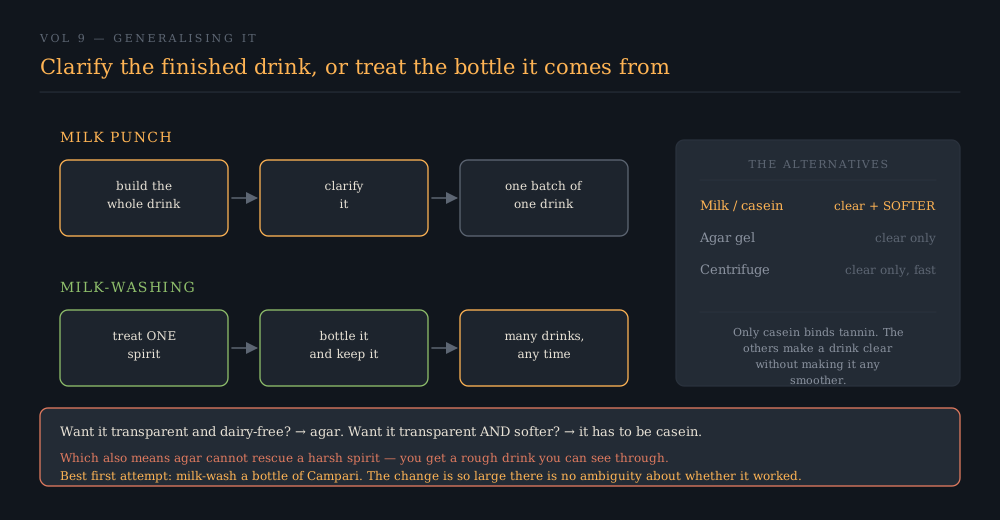
Modern bars took the point and generalised it, and the vocabulary split in two:
- Milk punch — you build a whole drink and clarify the finished thing.
- Milk-washing — you treat one ingredient, usually a spirit, and then build drinks from it afterwards.
⭐ Milk-washing is the more useful idea for a home bar, because one afternoon’s work produces a bottle you can make many different drinks from, rather than a batch of one drink.
9.1.2 Milk-washing a spirit
The method is the punch method with the drink taken out of it: warm milk, an acid, the spirit, curdle, rest, filter through the bed.
The acid still has to be there — casein will not collapse without it — so a milk-washed spirit picks up a small amount of citric character. That is usually welcome and occasionally has to be planned around.
What it is good for:
- Softening a young or aggressive spirit. A hot, grainy craft whiskey comes out noticeably rounder. This is the original 18th-century purpose (Vol 2) applied to a modern problem.
- Taking colour out. A milk-washed dark rum is pale and behaves like a much lighter one while keeping its aroma.
- Taming bitterness. ⭐ Campari is the spectacular case. Milk-washed Campari loses most of its red colour and a great deal of its aggressive bitterness while keeping the orange-and-rhubarb aroma — and a Negroni built from it is a genuinely different, softer drink that still tastes like a Negroni.
- Building a house ingredient. A milk-washed base you keep on the shelf.
9.1.3 The clarified drinks the technique produced
Clarified piña colada is the modern flagship, and it is the drink that sold milk-washing to a generation of bartenders. All the pineapple, rum and coconut aroma; none of the opacity, none of the heaviness; served cold and clear in a small glass. It reads as a completely different drink to anyone who thinks they know what a piña colada is.
Clarified margarita, clarified daiquiri, clarified Negroni — all work, all for the same reason: they are already acidic, so the reaction is free, and they all carry aroma that survives.
Non-alcoholic uses. Clarified lemonade, clarified fruit juices and clear iced teas all work by exactly the same route, and there is no reason the technique should be confined to drinks with spirit in them. ⚠ Without alcohol you lose the main preservative (Vol 7), so a clarified non-alcoholic drink is a fridge item with a short life, not a bottled one.
🔴 The one class that does not work: anything you want to stay dark and tannic. A clarified Old Fashioned is a real thing people make, and it is instructive to try once — but the technique removes exactly the barrel tannin and colour that Vol 5 of the Old Fashioned dive spends its length explaining the value of. It makes a pleasant clear drink and it throws away the point.
9.1.4 The alternatives, compared honestly
Table 1 — The alternatives, compared honestly
| Milk / casein | Agar gel | Centrifuge | |
|---|---|---|---|
| Mechanism | Protein binding + physical trapping | Physical trapping only | Density separation only |
| Removes tannin & harshness | Yes | No | No |
| Removes colour | Yes, substantially | Little | Little |
| Dairy-free | No | Yes | Yes |
| Needs acid | Yes | No | No |
| Speed | Hours to days | Hours | Minutes |
| Cost | Nothing | A few pounds of agar | Hundreds to thousands |
| Adds flavour | Slight lactose sweetness, silky body | Essentially none | None |
Agar clarification in outline: dissolve a small quantity of agar in a little hot water, stir it into the liquid, let it set to a weak gel, then break the gel up and let it drain through a sieve — or freeze and thaw it, which does the same job. It clarifies well, it works on anything, and it is the right answer if dairy is off the table.
The centrifuge is what a well-funded bar uses. It is fast and it is very effective and it is not a kitchen tool.
🔴 The honest headline: agar and the centrifuge make a drink CLEAR. Milk makes a drink clear AND takes the tannin, the colour and the roughness with it. They are not interchangeable, and choosing between them is a question of what you actually want:
- Want it transparent, dairy-free? Agar.
- Want it transparent and softer? It has to be casein. Nothing else does the chemistry.
⚠ Which also means agar cannot rescue a harsh spirit. If the reason you are clarifying is that the base is rough, agar will give you a rough drink you can see through.
9.1.5 Where to start
If this dive has made the technique sound worth trying but a full punch sounds like a commitment, milk-wash a bottle of something instead. It is the same afternoon, the same equipment, a smaller batch, and the result is an ingredient rather than a finished drink — so a failure costs you one bottle and teaches you the whole method.
Campari is the most rewarding first attempt, because the change is so large and so obvious that there is no ambiguity about whether it worked.
9.1.6 Sources and further reading
- Dave Arnold, Liquid Intelligence (2014) — the standard reference for milk-washing, agar clarification and centrifuge work, with the physics attached.
- David Wondrich, Punch (2010) — for the historical technique the modern one generalises.
- Vol 3 for the chemistry; Vol 6 for filtration; Vol 7 for what clarification means for keeping.
Comments (0)