Clarified Milk Punch · Volume 6
Vol 6 — Filtering and Clarity
Mixed Drinks — Clarified Milk Punch. Why the curd is the filter and the cloth is only scaffolding, the media compared, why squeezing ruins it, how many passes it really takes, and what to do when a batch simply refuses to clear.
6.1.1 The thing to understand before choosing equipment
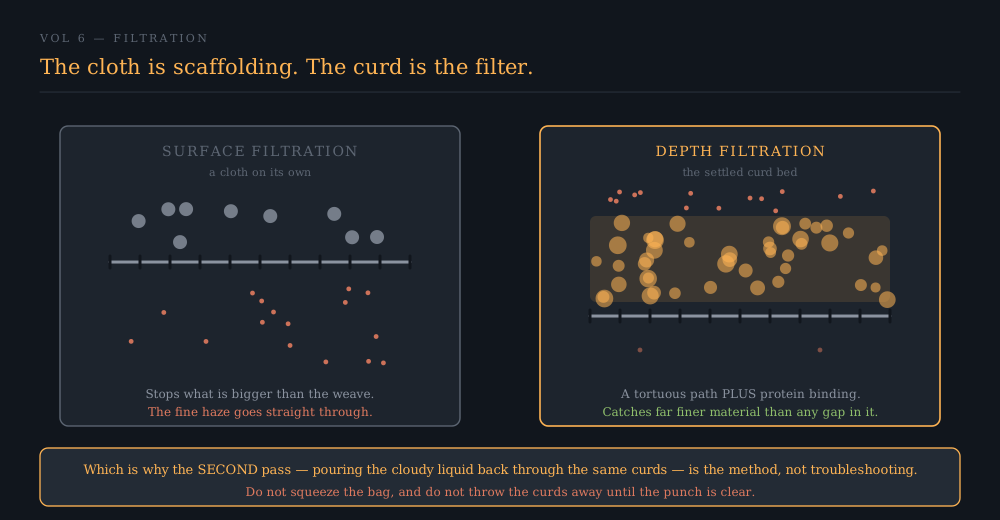
You are not straining solids out of a liquid. You are passing a liquid through a bed of solids.
That distinction decides everything else in this volume. A sieve lined with cloth is a surface filter — it stops anything bigger than its holes and passes everything else, which for a fine haze means passing nearly all of it. The curd bed is a depth filter: a thick, tortuous, chemically active layer that catches particles far smaller than any gap in it, partly by physical entrapment and partly by the protein binding described in Vol 3.
⭐ The cheesecloth’s only job is to hold the curd in place. It contributes almost nothing to clarity on its own. Once you see it that way, the second and third passes stop feeling like troubleshooting and start being the actual method.
6.1.2 The media, compared
Table 1 — The media, compared
| Medium | Speed | Clarity reached | Notes |
|---|---|---|---|
| Cheesecloth, 4+ layers | Fast | Moderate alone; excellent as a curd support | The standard. Dampen it first |
| Jelly bag / nut-milk bag | Medium | Good | Holds the bed well; easy to handle |
| Superbag (fine mesh, 100–250 µm) | Medium | Very good | The professional choice; reusable and worth it if you do this often |
| Coffee filter (paper) | Very slow | Excellent | For the final polish only. Will clog if used early |
| Muslin / flour sack towel | Medium | Good | Cheap, washable, works |
| Sieve alone | Fast | Poor | Removes curds, not haze. Not sufficient |
A practical combination: cheesecloth or a jelly bag for passes one and two, then a coffee filter for a final polish if you want the last of it. ⚠ Do not start with a coffee filter. It will blind within a minute against a full load of curd and you will spend an evening watching it drip.
6.1.3 Squeezing
🔴 Do not squeeze the bag. Ever.
It is the most tempting mistake in the whole process, because filtration is slow and there is visibly liquid still in there. Squeezing:
- forces fine solids straight through the cloth into your clear punch;
- compacts the curd bed, destroying the open structure that makes depth filtration work;
- undoes the previous passes, so a punch that had cleared goes cloudy again.
⚠ You are trading 5% more yield for the clarity you spent two days getting. Let gravity finish. If a bag has genuinely stopped dripping, lift it and let it re-settle rather than pressing.
6.1.4 How many passes
Two is the working minimum. Three is common. More is fine.
- First pass — everything goes through, curds and all. Output is cloudy, sometimes very. This is normal.
- Second pass — pour that cloudy liquid back through the same curd bed. This is where clarity arrives, usually dramatically.
- Third pass — for the last of the haze. Diminishing returns, but cheap.
- Polish — a coffee filter, if you want it optically clear.
⭐ Do not throw the curds away until the punch is clear. They are the filter. Discarding them after the first pass is the commonest way a batch ends up permanently hazy, and it is an easy mistake because they look like waste.
6.1.5 Time, temperature and patience
Cold filters slower. A punch straight from the fridge is more viscous and drips noticeably more slowly than one at room temperature. Let a rested batch come up to room temperature before filtering — you lose nothing and it halves the wait.
A long rest before filtering is worth more than any equipment. The curd knits and settles; the clearer the separation before you start, the less work the cloth has to do. Overnight is the sweet spot, and there is no penalty for two nights.
Budget hours, not minutes. A 1.5-litre batch through cheesecloth is a couple of hours per pass, unattended. Through a coffee filter it can be overnight. This is a drink you set up and walk away from — which, as Vol 2 pointed out, is exactly the shape of the household preparation it originally was.
6.1.6 When it will not clear
Work down this list in order.
- Have you actually done a second pass through the bed? Most “it won’t clear” is a first pass mistaken for a finished one.
- Did the milk go into the punch instead of the punch into the milk? (Vol 3.) If so you have a fine precipitate rather than a curd, and it may never fully clear. Re-filtering through what curd there is will improve it; a coffee-filter polish will improve it further.
- Was the curd stirred or shaken after forming? Agitation breaks it into fine particles. Let it re-settle for several hours and try again.
- Was there enough acid? A batch that did not get below pH 4.6 curdled only partially, so half the casein is still in suspension and it is that, not dirt, that you are looking at. Add more citrus and let it work.
- Was there enough tannin? A punch built with no tea has less for the curd to bind (Vol 5) and tends to finish slightly hazier. Not fixable after the fact; note it for next time.
- Give it another day. Some batches clear in the bottle as fines settle. Decant off the top.
⚠ And a haze is a cosmetic problem, not a spoiled drink. It tastes the same. The tannin-stripping — the part that actually changes how the punch drinks — happened at the moment of curdling, not at the filter.
6.1.7 A note on the modern alternatives
Two other clarification routes exist and Vol 9 compares them properly. In brief:
- Agar clarification — set a weak agar gel with the liquid in it, break it, and let it drain. Works on anything, dairy-free, but slower and it does not strip tannin, because there is no protein doing any binding. It clarifies without softening.
- Centrifuge — fast and extremely effective, and priced for a bar rather than a kitchen. Also purely physical.
🔴 Neither is a substitute for milk clarification, because neither does the chemistry. They make a drink clear. Milk makes a drink clear and takes the tannin, colour and harshness out with it. If all you want is transparency, agar is easier. If you want what this dive is about, it has to be casein.
6.1.8 Sources and further reading
- Dave Arnold, Liquid Intelligence (2014) — the standard modern treatment of clarification, filtration media and the agar and centrifuge methods.
- Vol 3 for the chemistry the bed is performing; Vol 4 for where these steps sit in the sequence.
Comments (0)