The Old Fashioned · Volume 2
Vol 2 — Anatomy: The Four Parts and What Each One Controls
Mixed Drinks — the Old Fashioned. This volume takes the 1806 definition apart into its four controls, gives each one a working range rather than a single number, and shows what happens at the edges. It is the volume to read before arguing with anybody about ratios.
2.1.1 Four knobs, not four ingredients
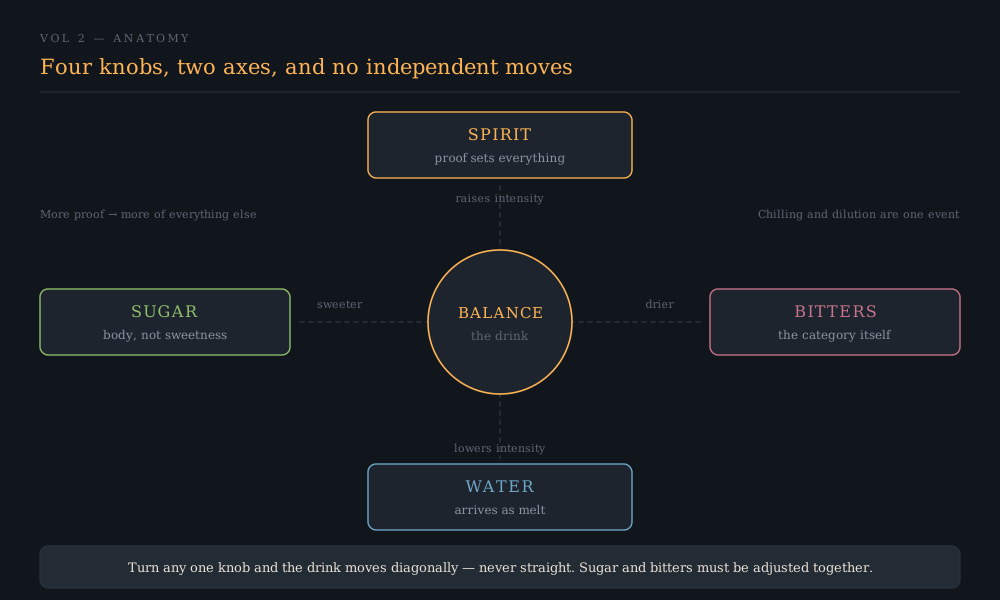
The useful way to hold the Old Fashioned in your head is not as a list but as a control panel with four knobs, three of which are in tension with the fourth.
- Spirit — the thing being served. Everything else exists to present it.
- Sugar — reduces perceived burn and bitterness, adds body, raises the drink’s centre of gravity.
- Water — reduces alcoholic intensity, opens aroma, and is contributed almost entirely by ice, which means it is a function of time.
- Bitters — adds aromatic complexity and a bitter edge that cuts the sugar. The category-defining term.
Change one and you have changed the drink’s relationship to the other three. That is why “the recipe” is unanswerable in the abstract and completely answerable once you name the bottle: a 100-proof, high-rye bourbon and an 86-proof wheated bourbon want measurably different amounts of sugar to land in the same place.
2.1.2 The working ranges
Published specifications vary more than their confident tone suggests. Laid side by side, the spread is the interesting part:
Table 1 — Published specifications vary more than their confident tone suggests. Laid side by side, the spread is the interesting part
| Source | Spirit | Sugar | Bitters | Notes |
|---|---|---|---|---|
| Croswell, 1806 | ”spirits of any kind” | unstated | unstated | The definition, not a recipe |
| Jerry Thomas, 1862 (Whiskey Cocktail) | 1 wine-glass whiskey | 3–4 dashes gum syrup | 1–2 dashes bitters | Lemon twist; small drink by modern standards |
| IBA official | 45 ml bourbon or rye | 1 sugar cube | few dashes Angostura | Few dashes plain water; orange zest and cherry |
| Common modern bar spec | 2 oz | 0.25 oz rich syrup (2:1) | 2–3 dashes | Large-format ice, expressed orange |
| Spirit-forward house spec | 2 oz | 1/3 oz 1:1 syrup | 3 + 3 dashes (aromatic + orange) | The spec this series is written around |
Read down the sugar column and the modern drift is visible: the drink has been getting drier and the bitters have been getting heavier for twenty years. A 19th-century Old Fashioned was a small, sweet, intensely aromatic thing in a 4-ounce glass. The modern one is a larger, drier, colder drink. Both are correct by the definition. Only one of them is what a bar will hand you today.
2.1.2.1 The house spec, stated as a preference
This series is written around a specific build, and the honest thing is to label it as a preference rather than a finding:
- 2 oz bourbon (Vol 5 for which ones and why)
- 1/3 oz simple syrup, 1:1, homemade — never bottled, never an undissolved cube (Vol 3)
- 3 dashes aromatic bitters + 3 dashes orange bitters (Vol 4)
- One large clear cube (Vol 9)
- Orange peel and lemon peel expressed over the surface, then dropped in (Vol 8)
- A real cocktail cherry — Luxardo, Maraska or Fabbri. Not a bright-red maraschino (Vol 8)
- Smoked or not; smoke is a variation, not a requirement (Vol 10)
- Optionally, 2 drops of 20% saline — a modern addition, not a historical one, and the easiest single upgrade to a drink that already tastes correct
🔴 Six dashes of bitters is above the common spec and it is deliberate. At two dashes the bitters are seasoning. At six they are a structural element, and the drink can carry more sugar without reading as sweet. If you cut the bitters back toward the IBA’s “few dashes,” cut the syrup with them or the balance falls apart. The dashes and the sugar move together. That is the single most useful thing in this volume.
2.1.3 Spirit: what the base is doing
The base is 85–90% of the finished drink by volume and effectively 100% of what it tastes like. The other three knobs are presentation controls for the whiskey, and that framing settles a lot of arguments: any technique that obscures the base is wrong for this drink by construction, whatever it does for another one.
Proof is the variable that matters most and gets discussed least. Ethanol carries aroma, contributes perceived sweetness of its own, and produces the burn that sugar is there to soften. Moving from 80 proof to 100 proof changes every other setting:
Table 2 — Proof is the variable that matters most and gets discussed least. Ethanol carries aroma, contributes perceived sweetness of its own, and produces the burn that sugar is there to soften. Moving from 80 proof to 100 proof changes every other setting
| Base proof | Character in the glass | Sugar | Dilution |
|---|---|---|---|
| 80–86 | Gentle; risks being washed out by ice | Less — the spirit cannot carry it | Shorter stir; watch it |
| 90–94 | The comfortable middle; most bottles live here | Standard | Standard |
| 100 (bottled-in-bond) | Loud, aromatic, holds up all night | More — it has the structure for it | Longer stir; wants the water |
| 110+ (barrel/cask strength) | Can dominate; also can be magnificent | More again | Substantially more; treat water as a real ingredient |
⭐ A cask-strength Old Fashioned is not a stunt, it is a different dilution problem. The classic failure is to build it exactly as an 90-proof drink and serve it too strong and too tight; the fix is patience with the ice, not less whiskey.
2.1.4 Sugar: the balance control
Sugar’s job is not “to make the drink sweet.” Its job is to round the ethanol’s edge and give the drink body, and sweetness is the side effect you tolerate to get those. A correctly sugared Old Fashioned does not read as a sweet drink; it reads as a whiskey that has stopped being sharp.
The controls available are the quantity, the concentration (1:1 vs 2:1 syrup), and the sugar itself (white, demerara, maple, agave, honey). Vol 3 is entirely about this. The one point that belongs here is structural:
Sugar and water are not independent knobs when you use syrup. A 1:1 syrup is half water; a 2:1 rich syrup is roughly a third. Switching from 1:1 to 2:1 at the same volume both raises the sugar and lowers the pre-ice dilution — two changes at once, in the same direction, and the reason a drink that was balanced yesterday tastes sweet and hot today when the syrup bottle got refilled to a different ratio.
2.1.5 Water: the ingredient nobody measures
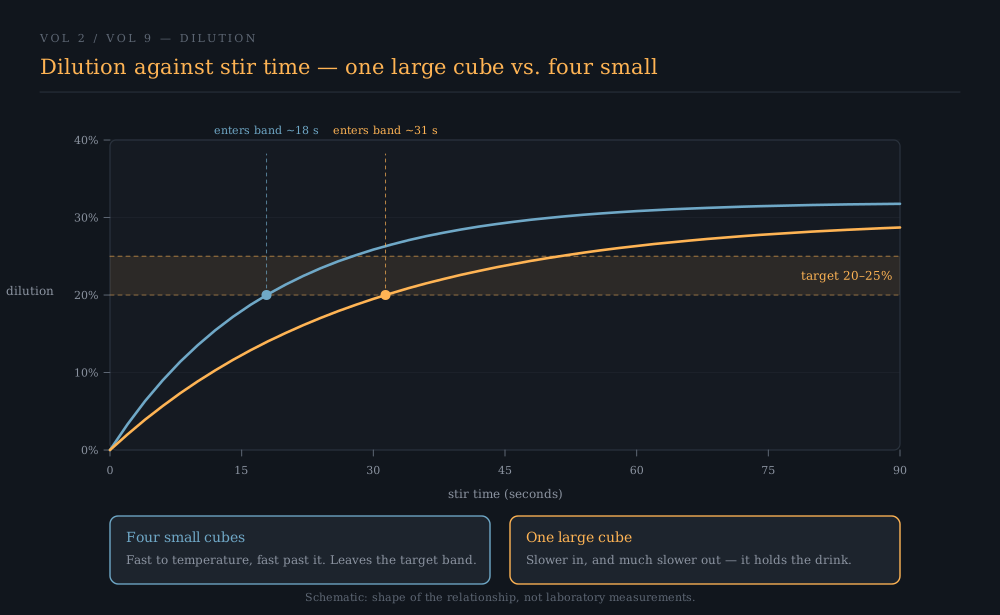
The 1806 definition lists water as an ingredient, and it should be treated as one. In a modern build it arrives almost entirely from the ice, which means the quantity is set by surface area and time rather than by a jigger.
Rules of thumb for a stirred drink over ice:
- A properly stirred and served Old Fashioned finishes around 20–25% dilution by volume. A 2 oz pour arrives at roughly 2.5 oz in the glass.
- Serving temperature lands near −3 to 0 °C. Cold suppresses volatility, which mutes aroma; the drink opens up as it warms, which is a feature of a large cube and an argument against crushed ice.
- Dilution is not optional. An undiluted Old Fashioned is unpleasant — hot, tight, aromatically closed. The people who say they want it “strong” almost always mean they want it cold and open, which is what dilution delivers.
- ⚠ Under-dilution is the most common home fault, and it is almost always caused by ice that is too cold, too dry, and too small at once: straight-from-the-freezer cubes chill fast but give up little water, so the drinker gets cold without dilution and reads the result as “harsh whiskey.”
Vol 9 covers the mechanics — cube size, clear ice, stir counts, and why shaking this drink is wrong.
2.1.6 Bitters: the term that makes it a cocktail
Bitters are dosed in dashes, which is the least precise unit in the bar and worth pinning down: a dash from a standard dasher-top bottle is roughly 0.6–1 ml, varying with the bottle, the fill level, and how hard the wrist snaps. Six dashes is therefore somewhere between a teaspoon and a bit more — a real volume, not a rounding error.
What they contribute:
- Aromatic lift. Most of what a bitters bottle does happens in the nose, above the glass, before the first sip.
- Bitterness that opposes the sugar. This is what lets the drink carry sweetness without tasting sweet.
- Complexity the base cannot supply alone — gentian, cinnamon, clove, cardamom, bitter orange.
Aromatic and orange bitters do different jobs. Aromatic bitters (Angostura and its relatives) sit in the same register as barrel-aged whiskey: baking spice, wood, a bass note. Orange bitters sit above the whiskey and brighten it. Running both is not redundancy; it is putting a floor and a ceiling on the aroma. Vol 4 covers the bottles, their history, and how to choose.
🔴 A whiskey, sugar and water with no bitters in it is a sling, not a cocktail. This is not pedantry — it is the 1806 definition, and it is the one place where this series takes a hard line.
2.1.7 The fifth knob, which is not in the definition
Croswell’s 1806 sentence has four terms and this series has been faithful to them. There is a fifth control that is not in it, that almost nobody lists, and that a great many working bartenders now keep in a dropper bottle beside the bitters.
Salt.
Not a pinch of it, and not on the rim — a 20% saline solution, dosed in drops.
2.1.7.1 What salt actually does to a drink
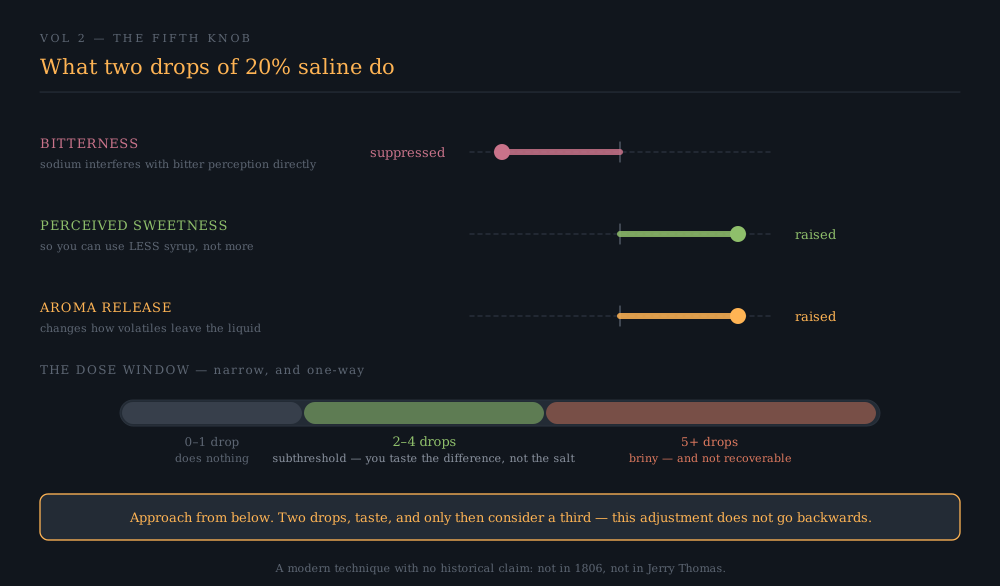
It is not there to make the drink taste salty, and at the doses used it cannot. Sodium works on the palate in three ways that all happen well below the threshold at which you would identify it as salt:
- 🔴 It suppresses bitterness. This is the big one and it is a well-established effect — sodium ions interfere with bitter perception directly. In a drink carrying six dashes of bitters and a lot of oak tannin, that is a real lever.
- ⭐ It raises perceived sweetness. The same sugar reads as more present. Which means salt lets you reduce the syrup while keeping the drink’s roundness — the opposite trade from every other adjustment in this volume.
- It lifts aroma. Salt changes how volatiles partition out of the liquid, so the nose gets more.
Dave Arnold’s framing in Liquid Intelligence is the useful one: salt is a subthreshold enhancer. You should not be able to taste it. You should be able to taste the difference, and the difference is that everything else gets louder and rounder.
⭐ The A/B test is the whole argument, and it takes ninety seconds. Build two identical Old Fashioneds. Put two drops of saline in one. Taste them side by side. Most people cannot say what changed and can say instantly which one they prefer — which is exactly what “subthreshold” means.
2.1.7.2 The solution, and why it is a solution
20% saline: 20 g of salt dissolved in 80 g of water, by weight. Hot water dissolves it; distilled or filtered water avoids anything chlorinated coming along.
Why bother making a solution instead of adding a pinch? Three reasons, and they are the same reasons syrup beats a sugar cube (Vol 3):
- A pinch is not a measurement. Salt crystals vary enormously by grind; a pinch of flake salt and a pinch of table salt differ by a factor of several.
- Salt dissolves badly in cold, low-water, high-ethanol liquid — precisely the description of an Old Fashioned. Undissolved crystals sit at the bottom and the last sip is briny.
- Drops are repeatable. Two drops is two drops tomorrow as well.
Dose: 2–4 drops in a 2 oz build. Start at two. If you can taste salt, you have gone too far and the drink is not recoverable — this is a one-way adjustment, so approach from below.
⚠ Keep it in a small dark dropper bottle, 1 oz or so, labelled. Amber glass is the convention for the same reason it is used for bitters — light degrades very little in a salt solution, but a shelf of identical clear droppers is how you eventually put saline in something that wanted orange bitters. Label it.
The recipe, with the ratio and the bottle: Saline Solution, 20%.
⭐ And this is where the dive got answered. Jeff wrote his own house spec after this volume went up, and it puts 2 drops of the 80/20 saline straight into the build alongside a teaspoon of rich demerara — the two arguments this series made, taken up and used: Old Fashioned - Best. It also answers the spirit question with a bottle this series never mentioned at all — and a one-line defence attached: Jack is underrated. That omission was a real gap, and Vol 5 now covers Tennessee whiskey.
2.1.7.3 Where it helps most, and where it does not
Most: anything bitter or bitter-adjacent — a heavily bittered Old Fashioned, a Negroni, grapefruit drinks, coffee and chocolate drinks. Also anything that tastes almost right but slightly hollow in the middle.
Least: a drink that is already balanced and delicate. Salt does not improve everything, and a light, aromatic, low-bitterness drink can be flattened by it.
🔴 And the honest caveat: this is a modern technique with no historical claim whatsoever. It is not in the 1806 definition, not in Jerry Thomas, not in the 19th-century record. It is a contemporary insight from food science applied backwards onto a classic — which this series is happy to endorse, but should not dress up as heritage. Vol 1 spends its length dismantling invented pedigrees; it would be poor form to invent one here.
2.1.8 Failure modes, and what each one tells you
Diagnosis is faster if you know which knob a given fault points at.
Table 3 — Failure modes, and what each one tells you
| What is wrong | The knob | The fix |
|---|---|---|
| Tastes sweet, syrupy | Sugar too high, or bitters too low | Cut syrup or raise bitters — either restores the opposition |
| Harsh, hot, closed nose | Under-diluted | Bigger stir, or ice that is not straight off the freezer’s coldest shelf |
| Thin, watery, flat | Over-diluted; small or wet ice | Larger single cube; shorter stir; check the freezer |
| Tastes like fruit punch | Muddled fruit, or the cherry syrup got in | Vol 8 — express the peel, do not crush the flesh |
| Tastes of nothing in particular | Base too low-proof for the build | Vol 5 — go to 100 proof and re-balance |
| Grainy, sweet sediment at the bottom | An undissolved sugar cube | Vol 3 — use syrup |
| Correct on paper, but hollow in the middle | Nothing wrong — it wants salt | 2 drops of 20% saline; see above |
| Faintly briny, and it will not go away | Too much saline, or undissolved salt crystals | Not recoverable. Start again from two drops |
| Cloudy, breaks apart as it sits | Shaken, not stirred | Vol 9 — stir; shaking aerates and over-chills a spirit-only drink |
⭐ The two faults that account for most bad Old Fashioneds are the sugar cube that never dissolved and the ice that never melted. Both are failures to respect a term of the 1806 definition — the sugar and the water. Neither has anything to do with the whiskey, which is where drinkers reliably look first.
2.1.9 Building it: the order of operations
The order matters less than the arguments about it suggest, but there is a defensible sequence and a reason for each step.
- Bitters and syrup into the mixing glass or the serving glass first, and stirred together briefly. They are the two smallest volumes and the two most likely to end up unmixed at the bottom; combining them while there is nothing else in the way is free insurance.
- Whiskey in. Stir to combine before ice — a couple of turns, no more.
- Ice in, and stir to temperature. With a large cube in the serving glass, 20–30 seconds; in a mixing glass with several cubes, less. Taste it. The stir is the only step with a variable outcome.
- Express the orange peel over the surface, skin-side down, so the oils spray across the drink; wipe the rim; drop it in.
- Lemon peel the same way if you use one — it brightens what the orange makes round.
- Cherry last, so it sits where it can be seen and eaten at the end, not muddled at the start.
⚠ Build-in-glass versus mixing-glass is a real choice, not a style point. Building in the serving glass over one large cube gives less dilution and a colder-for-longer drink; mixing separately and straining over fresh ice gives more control and a more consistent result across a round of several. For one drink at home, build in the glass.
2.1.10 Sources and further reading
- International Bartenders Association, official cocktail specifications (Old Fashioned).
- Jerry Thomas, How to Mix Drinks (1862) — for the original proportions and the “wine-glass” measure.
- Dave Arnold, Liquid Intelligence (2014) — the standard modern treatment of dilution, temperature and the physics of chilling.
- Vol 3 (sugar), Vol 4 (bitters), Vol 9 (ice and technique) expand each control in turn.
Comments (0)