The Old Fashioned · Volume 8
Vol 8 — Garnish: Cherries, Citrus, and the Muddled-Fruit Schism
Mixed Drinks — the Old Fashioned. What a real cocktail cherry is and how the bright red one came to exist, the regulatory clock now running on its dye, the cherries worth buying, how to express citrus oil and whether flaming it does anything, and a full hearing for the muddled-fruit question.
8.1.1 The garnish is not decoration
In a drink with four ingredients, the garnish is a fifth. Expressed orange oil is a genuine aromatic contribution — it lands on the surface of the drink and is the first thing the nose meets on every sip — and the cherry is the last thing tasted, which gives it a disproportionate share of the memory of the drink.
Treating either as ornament is how you end up with a plastic-tasting cherry in an otherwise careful drink, which is a specific and avoidable form of self-sabotage.
8.1.2 What a maraschino cherry actually was
The original is a specific fruit preserved in a specific liqueur.
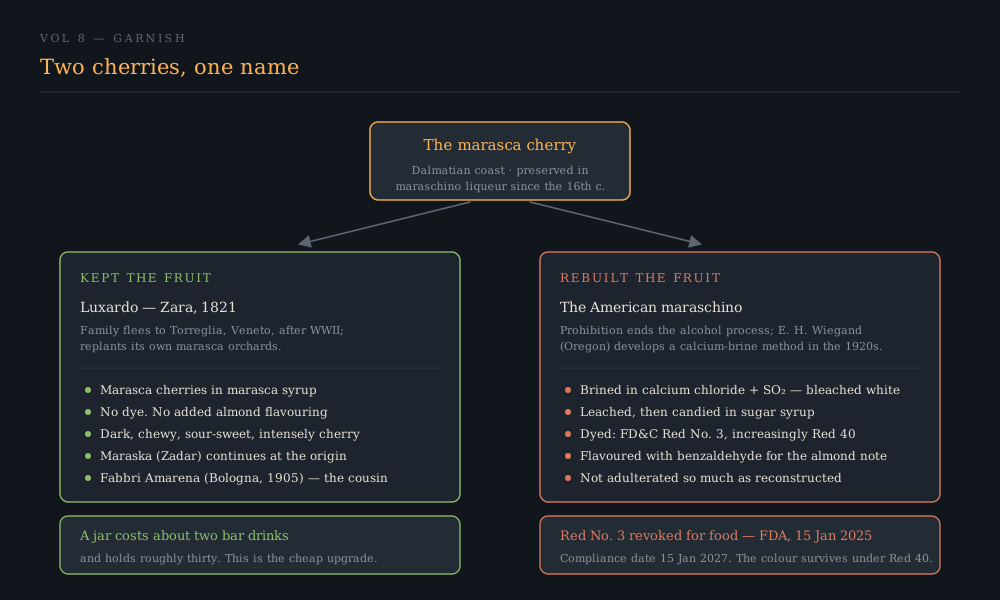
The marasca (Prunus cerasus var. marasca) is a small, dark, sour cherry from the Dalmatian coast. Maraschino liqueur is distilled from the whole fruit — flesh, pits and all, which is where its distinctive almond-adjacent note comes from — and has been made around Zadar (Italian: Zara) since the 16th century. A maraschino cherry, properly, is a marasca cherry preserved in that liqueur or in a syrup made from the same fruit.
Luxardo is the surviving name. Girolamo Luxardo founded the firm in Zara in 1821. After the Second World War, with Zara devastated and the region absorbed into Yugoslavia, the surviving family rebuilt at Torreglia, in the Veneto, where they planted their own marasca orchards. The Gourmet Maraschino Cherries in the squat jar are marasca cherries in marasca syrup — no dye, no added almond flavouring — and they are dark, chewy, sour-sweet and intensely cherry.
Maraska, in Zadar, is the Croatian continuation of the same tradition at the original location, and its cherries are a genuine and less expensive alternative.
8.1.3 How the bright red one happened
The American industrial maraschino cherry is a different product that inherited the name, and its origin is a piece of food-science history worth knowing.
By the early 20th century American producers were preserving light-coloured cherries — Royal Ann and similar — for the confectionery trade, using alcohol-based methods. Prohibition made an alcohol-based process untenable. The solution came from Ernest H. Wiegand, a horticulturist at what is now Oregon State University, who in the 1920s worked out a brine process using calcium salts in place of alcohol, firming the fruit chemically rather than with spirit.
The modern process, in outline:
- Brine in calcium chloride and sulphur dioxide. This firms the cell walls and bleaches the fruit essentially white.
- Leach out the brine over days.
- Soak in sugar syrup, repeatedly and at increasing concentration, until the fruit is candied.
- Dye — historically FD&C Red No. 3 (erythrosine), increasingly Red 40.
- Flavour — usually benzaldehyde, giving the almond note the real product gets from the pits.
⭐ It is not an adulterated cherry so much as a reconstructed one: stripped to a colourless, flavourless substrate and rebuilt to a spec. Understood that way, its uniformity is an achievement. It is simply not a thing you want in a whiskey drink.
🔴 Red No. 3 is on a clock. On 15 January 2025 the FDA revoked the authorisation for FD&C Red No. 3 in food, acting under the Delaney Clause after evidence of cancer in male laboratory rats. Manufacturers have until 15 January 2027 to reformulate foods. Many maraschino cherry producers had already moved to Red 40. The practical consequence for a drinker: the bright red cherry is being reformulated, not withdrawn — the colour is going to persist under a different dye, and “no Red 3” on a jar in 2027 will not make it a cocktail cherry.
8.1.4 The cherries worth buying
Table 1 — The cherries worth buying
| Cherry | What it is | Notes |
|---|---|---|
| Luxardo Gourmet Maraschino | Marasca cherries in marasca syrup | The reference. Dark, chewy, sour-sweet. Expensive per cherry and cheap per drink |
| Maraska | Zadar-made, the original region | Close cousin, generally less expensive |
| Fabbri Amarena | Amarena (sour) cherries in syrup, Bologna, since 1905 | Softer, jammier, in the famous blue-and-white jar. Excellent and different |
| Jubilee / Tillen Farms | Whole light cherries, firm, no artificial colour | The “looks like a cherry, tastes clean” option; good for people who dislike the Luxardo texture |
| Woodford Reserve Bourbon Cherries | Cherries in a bourbon syrup | Obvious pairing; sweeter than Luxardo |
| Traverse City Whiskey Co. | Northern Michigan cherries in whiskey | 🍒 The local answer. Michigan is cherry country, and this is the regional bottle worth having on the shelf next to the Italian one |
| Filthy Black Cherry | Modern American producer, no artificial dye | Widely available; a reasonable middle |
🔴 The house position, stated as a firm preference: a real cocktail cherry — Luxardo, Maraska or Fabbri — and never a bright-red maraschino. This is not a small point in the build. A jar of Luxardo cherries costs about the same as two drinks in a bar and holds enough for thirty, and the difference between the two cherries is the difference between the drink tasting finished and tasting like it came with a toy.
⚠ The syrup in the jar is an ingredient, and it is not the drink’s syrup. A bar spoon of Luxardo syrup in an Old Fashioned is a legitimate move and a pleasant one; adding it in addition to the full measure of simple syrup is how the drink becomes cloying. If you use it, cut the simple syrup accordingly (Vol 3).
⚠ Store an opened jar in the refrigerator. These are high-sugar preserves, not shelf-stable-forever pickles, and a jar left in a warm cupboard for a year will ferment quietly.
8.1.5 Citrus: the part that is actually aromatic
Expressing a peel is the single highest-return five seconds in the whole build.
The technique: cut a wide strip of peel with as little white pith as possible — a vegetable peeler or a sharp paring knife, not a zester. Hold it skin-side down over the surface of the drink, a couple of inches up, and pinch it sharply in half lengthwise. The oil glands rupture and spray a visible mist of citrus oil across the surface. Wipe the strip around the rim of the glass, then drop it in.
What is happening chemically: citrus peel oil is largely limonene with a supporting cast of aldehydes and esters, all of it highly volatile and all of it sitting in glands in the coloured outer layer — the flavedo. The pith contains none of it and does contain bitter flavonoids, which is why a peel cut thick and white makes the drink coarse.
⭐ Orange oil on the surface plus orange bitters in the liquid is the doubling described in Vol 4 — the same aroma arriving through two routes, one immediate and one integrated. It is why the house spec runs orange bitters even though there is already an orange garnish.
Adding a lemon peel as well — the house practice — brightens what the orange makes round. Lemon oil is sharper and higher-pitched; the two together give the nose more range than either alone. It is a small refinement and a real one.
8.1.5.1 Flaming the peel
Squeeze the peel through a lit match or lighter flame and the atomised oil ignites in a brief orange flash. Dale DeGroff did more than anyone to popularise it, and it is the signature move of the Oaxaca Old Fashioned (Vol 7).
⚠ Whether it improves the drink is genuinely contested. The case for: the flame caramelises some of the oil, producing a toasted, slightly bitter aromatic that the raw oil does not have. The case against: it burns off much of the delicate volatile fraction you just went to the trouble of expressing, trading brightness for char, and the visible difference is mostly theatre.
The honest position: it is a different aroma, not a better one. It suits smoky and agave drinks. On a bourbon Old Fashioned with a careful bitters build, the unflamed peel is usually the better choice — try both side by side once and decide for yourself, because this one really is a matter of taste rather than a matter of fact.
⚠ Do not do it over a full glass with a long lighter and a loose grip. It is a small flame and a short one, but hot citrus oil on the back of the hand is a genuine burn.
8.1.6 The muddled-fruit schism
Here is the argument, both sides, honestly.
The case against, which is this series’ position for the house build:
- Fruit juice is not one of the four terms. It adds acid and sugar the build was not designed around, and the balance struck in Vols 2–4 stops applying.
- Crushed pith is coarsely bitter, in a register unlike the bitters’ aromatic bitterness — it flattens rather than lifts.
- The drink goes cloudy and develops a sediment layer.
- It buries the whiskey, which is the thing the drink exists to present. Vol 5’s entire argument is that the base is the drink; the muddle contradicts it.
- It is frequently a cover. A bar that muddles heavily is often a bar with an indifferent well whiskey, and the technique’s mid-century spread coincides with American whiskey’s worst period.
The case for, which deserves to be stated properly rather than sneered at:
- It makes a different drink, not a worse one. Vol 7’s Wisconsin build is coherent on its own terms — a long, sweet-sour, low-intensity drink — and the muddle is structural to it, not a corruption of it.
- It is the majority tradition by volume and by decades. The spirit-forward build is a revival position (Vol 7), recovered from books in the last twenty-five years. Calling the older, more widespread practice “wrong” is a defensible aesthetic judgement and a poor historical one.
- Done well it is good. A fresh orange, a real cherry, a properly dissolved sugar cube and a decent brandy make a drink people have loved for eighty years for reasons that are not stupid.
- 🔴 The “invented to hide bad Prohibition whiskey” story is not supported (Vol 1). If you are going to argue against muddled fruit, argue against it on taste, which is honest, rather than on a folk etymology that does not hold up.
The resolution this series adopts: the spirit-forward build is the house drink and the one everything else in these volumes is calibrated to. The muddled build is a legitimate regional tradition with its own internal logic. What is not defensible is the middle — a spirit-forward build with a decorative slice of orange crushed into it by habit, so that the drink gets the fruit’s damage without the Wisconsin drink’s compensating structure. That is the version most bars actually serve, and it is the worst of both.
8.1.7 The house finish, in order
- Taste the drink before garnishing (Vol 3 — the orange oil makes judging the sugar harder).
- Express the orange peel over the surface, skin down, pinched sharply. Wipe the rim. Drop it in.
- Express the lemon peel the same way. Drop it in.
- One cherry, whole, added last so it sits where it can be seen and eaten at the end.
- Do not stir again.
8.1.8 Sources and further reading
- Oregon State University’s published history of Ernest Wiegand and the brine-cured cherry process.
- U.S. Food and Drug Administration, order revoking the authorisation for FD&C Red No. 3 in food, 15 January 2025 (compliance date 15 January 2027).
- Luxardo’s published company history, for the Zara-to-Torreglia relocation.
- Vol 3 for oleo saccharum, the other and better way to get orange into the drink.
- The house recipe, which specifies the cherry: Old Fashioned, Smoked.
Comments (0)