The Old Fashioned · Volume 4
Vol 4 — Bitters: Patent Medicine to Bar Staple
Mixed Drinks — the Old Fashioned. This volume covers what bitters are, where they came from, how they nearly disappeared, what the surviving and revived bottles taste like, how much to use, and why the mandatory ingredient of the 1806 definition is the one most people treat as optional.
4.1.1 The category-defining ingredient
Vol 1 made the point and it bears repeating at the head of the volume that belongs to it: a cocktail is a bittered sling. Spirit, sugar and water is a sling. Add bitters and it becomes a cocktail. That is not a flourish of 1806 prose; it is the whole definition of the category, and it makes bitters the only ingredient in an Old Fashioned that cannot be omitted without changing what the drink is.
So it is a small irony of the modern bar that bitters are the ingredient customers most often wave off, and the one a careless bartender is most likely to under-pour.
4.1.2 What bitters actually are
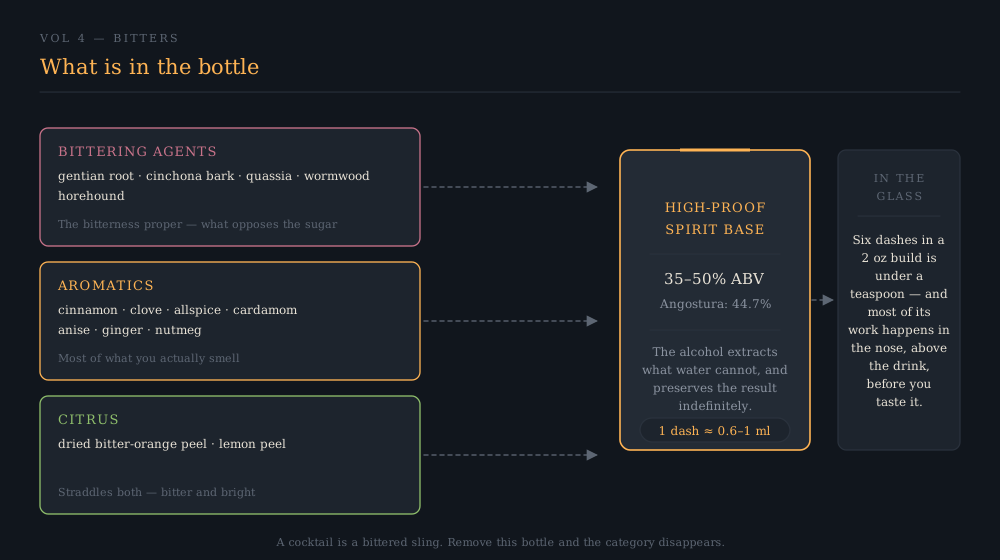
A bitters is a high-proof alcoholic infusion of botanicals, weighted toward genuinely bitter ones, bottled at a concentration meant to be used in drops rather than ounces. Angostura is 44.7% ABV; most others sit between 35% and 50%. The alcohol is doing two jobs: it extracts compounds that water will not, and it preserves the result indefinitely.
The botanical bill divides into three groups:
- Bittering agents — gentian root above all; also cinchona bark (the quinine plant), quassia, wormwood, angostura bark, horehound. These supply the bitterness proper.
- Aromatics — cinnamon, clove, allspice, cardamom, anise, star anise, ginger, nutmeg, vanilla. These supply most of what you actually smell.
- Citrus — dried bitter-orange peel especially, which straddles both groups.
⭐ Most of a bitters’ contribution happens in the nose, not on the tongue. Six dashes in a two-ounce drink is well under a teaspoon in about three ounces of finished liquid — enough bitterness to oppose the sugar, but the reason the drink smells of baking spice and orange is aromatic, and it is doing its work in the headspace above the glass before the drink reaches your mouth. This is also why the order matters less than the stirring: bitters that stay in a layer at the bottom are wasted.
4.1.3 Patent medicine, and how the bar inherited it
Bitters entered the bar from the pharmacy, not the other way round. Through the 18th and 19th centuries, alcoholic botanical tinctures were medicine — for digestion, for “biliousness,” for seasickness, for malaria, for whatever the label claimed. The category was enormous, unregulated, and largely fraudulent, and the American patent-medicine industry produced hundreds of branded bitters, many of them essentially flavoured spirits sold as cures.
Two survivors define the modern bar.
Angostura. Created in 1824 by Johann Gottlieb Benjamin Siegert, a German-born surgeon serving with Simón Bolívar’s army in Venezuela, in the town of Angostura — now Ciudad Bolívar. It was made as a medicine for soldiers with digestive complaints. The business moved to Trinidad in 1875, where it remains. The recipe is a genuine trade secret held by a handful of people.
⭐ The oversized label is a mistake nobody corrected. The label is famously too big for the bottle and overlaps the neck. The standard account is that in preparing the product for an international exhibition, the label and the bottle were commissioned separately and did not match; by the time anybody noticed it was already recognisable, and it stayed. The bottle is a monument to not fixing something.
⚠ The bark is not in the bottle. Angostura bitters contains no angostura bark — the name is the town, not the botanical. This trips up people reading the historical literature, where “angostura bark” is a real and separate ingredient used in other preparations.
Peychaud’s. Antoine Amédée Peychaud, a Creole apothecary in New Orleans, produced a bitters from the 1830s that is lighter, sweeter and markedly anise-forward compared with Angostura, with a distinctive cherry-red colour. It is the defining bitters of the Sazerac, and it makes a recognisably different, brighter Old Fashioned. Vol 1’s dismissal of the coquetier etymology does not touch Peychaud’s real contribution, which is this bottle.
4.1.4 The collapse, and the revival
Prohibition and the mid-century between them nearly wiped the category out. Bitters were not primarily a legal casualty — some were sold through as medicinal preparations — but their market was the American bar, and the American bar closed. When it reopened, the drinks it made were sweeter and simpler and needed fewer bottles.
By the 1970s the practical American bitters shelf was Angostura, Peychaud’s, and Fee Brothers, and in a great many bars it was Angostura alone. Orange bitters — an absolutely standard 19th-century ingredient, called for in dozens of classic specs — became so scarce that reprinted cocktail books quietly dropped it from recipes, which is how a whole generation learned Martinis and Old Fashioneds without it.
The revival tracks the cocktail revival exactly:
Table 1 — The revival tracks the cocktail revival exactly
| Bottle | Arrived | What it is |
|---|---|---|
| Regans’ Orange Bitters No. 6 | 2005 | Gary Regan’s answer to the orange-bitters drought; assertive, cardamom-forward |
| Fee Brothers West Indian Orange | long-running | Sweeter, softer, more marmalade than peel |
| The Bitter Truth (range) | 2006 | German revivalist house; their orange and aromatic are both bar standards |
| Bittermens (Xocolatl Mole, Hellfire) | 2007 | The house that made “a bitters can be a flavour idea” respectable |
| Angostura Orange | 2007 | The incumbent’s own orange, brighter and drier than Fee’s |
| Scrappy’s | 2008 | Small-batch, notably clean; the cardamom and lavender are worth knowing |
| Dale DeGroff’s Pimento | 2010s | Allspice-led; a genuinely different aromatic register |
🔴 The gap in the record is why so many “classic” recipes are wrong. A cocktail book printed between roughly 1935 and 1995 may have removed the orange bitters from a spec because the ingredient could not be bought — not because the drink was better without it. When a modern reconstruction restores it and the drink improves dramatically, that is usually what happened.
4.1.5 Choosing, for this drink
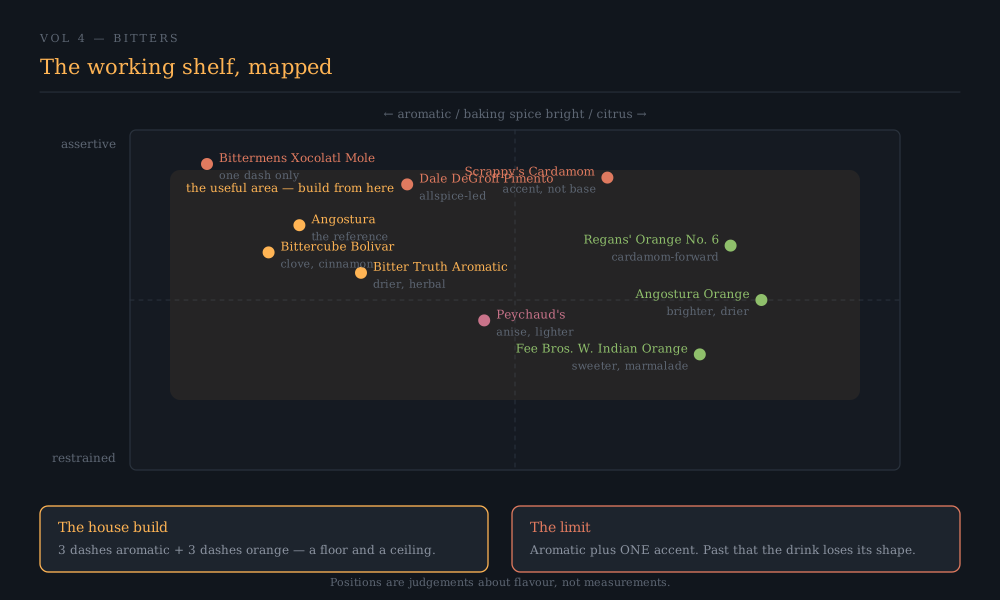
Aromatic bitters are the floor. They sit in the same register as barrel-aged whiskey — wood, baking spice, a bass note — and they anchor the drink. Angostura is the default for good reason: it is the reference flavour, it is what the drink tastes like in most people’s memory, and it is difficult to make an Old Fashioned worse with it. The Bitter Truth Aromatic is drier and a shade more herbal; Bittercube Bolivar brings more clove and cinnamon.
Orange bitters are the ceiling. They brighten the top of the drink and pick up the expressed orange peel from the garnish, so the citrus arrives twice — once as oil on the surface, once dissolved in the liquid. This doubling is the single easiest upgrade available to a home Old Fashioned.
Running both is the house position, at three dashes each. It is above the common spec and it is deliberate: at that dose the bitters stop being seasoning and become structure, and the drink will carry the sugar without reading sweet. If you cut the bitters back, cut the syrup with them (Vol 2).
Worth knowing, and worth trying once each:
- Peychaud’s in place of some of the Angostura pushes the drink toward New Orleans and toward anise. Half and half is a good experiment.
- A single dash of a mole or chocolate bitters alongside the aromatic is remarkably good with a high-rye bourbon. Two dashes is too many.
- Black walnut bitters with a wheated bourbon is the most underrated combination in the volume.
- ⚠ Do not stack four different bitters because each is interesting on its own. Aromatic plus one accent is the working limit; past that the drink stops having a shape.
4.1.6 Dashes, dosing, and the dasher top
A dash is roughly 0.6–1 ml from a standard dasher-top bottle, and it varies with the bottle’s design, how full it is, and how hard the wrist snaps. That is a factor-of-nearly-two uncertainty on the ingredient that defines the category, which is worth knowing before treating a published dash count as precise.
Practical consequences:
- A nearly empty bottle dashes smaller. If a drink you have made a hundred times suddenly reads sweet, check the bitters level before you blame anything else.
- Angostura’s bottle has no dasher insert — it pours through the narrow neck, and its “dash” is generally larger and less consistent than a proper dasher top. Some bars decant. It is a reasonable thing to do and a slightly unreasonable thing to be smug about.
- For repeatability, measure once. Dash six times into a measuring spoon, see what it is in ml, and thereafter you know what your bottle does. This is a two-minute exercise that ends a whole class of argument.
⭐ Bitters do not go off, and they do not need refrigerating. At 35–45% ABV with a heavy botanical load, a bottle is stable for years. What it does do is slowly lose top-end aroma once opened, so a bottle that has been open for a decade is not spoiled but is duller than a new one. Buy small bottles.
4.1.7 Making your own
A house bitters is a genuinely satisfying project and a poor first project, for one reason: it is very easy to make something aggressively, unpleasantly bitter, because gentian is far stronger than intuition suggests.
The method in outline — individual tinctures of each botanical in high-proof neutral spirit, macerated separately for one to three weeks, strained, then blended by drops at the end. Blending at the end rather than macerating everything together is the whole technique: it lets you adjust proportions by tasting instead of by hoping, and it means one over-extracted ingredient does not ruin the batch.
⚠ Two safety notes, both real. Some traditional bittering botanicals are not benign in quantity — wormwood and its thujone content is the well-known case, and several historical patent-medicine botanicals are frankly toxic. Stick to the culinary and well-documented list. And source from a herb supplier that sells for consumption, not a garden centre.
The Historical Library on this site holds a good deal of the 19th-century pharmacy and distilling literature that these formulas came out of, if you want to work from the period sources rather than a modern reconstruction.
4.1.8 Sources and further reading
- Brad Thomas Parsons, Bitters (2011) — the standard modern book on the category, its history and its revival.
- David Wondrich, Imbibe! (2007) — for the 19th-century bitters shelf and what the classic specs actually called for.
- The House of Angostura’s own published history, read with the usual allowance for a company telling its own story.
- Vol 2 for how the bitters dose and the sugar dose move together; Vol 7 for Peychaud’s and the New Orleans line.
Comments (0)