Distilling · Volume 6
Vol 6 — The Tier-4 Dual-Mode Hybrid: Whiskey OR Neutral From One Dedicated Rig
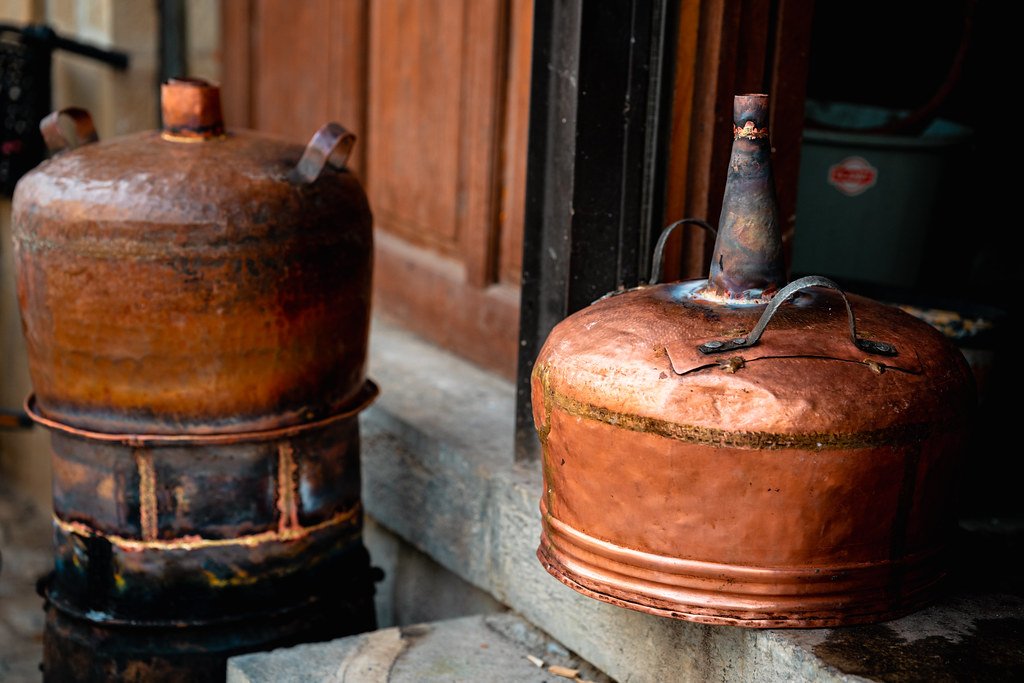
Phase 3 — Distilling deep-dive series. This volume covers the Tier-4 dedicated pot+column hybrid: a 5–8 gallon rig designed from the ground up to switch physically between character-spirit (pot/thumper) and neutral-spirit (column/reflux) modes via removable sections, valves, or quick-change tri-clamp swaps. This is not the same as Tier-3’s “tune the dephlegmator” mode-switching — Tier-4 changes the actual vapor path. The volume covers the dual-mode philosophy, four vendor paths, the hardware switching mechanics, mode-specific cleaning to prevent cross-contamination, and procedure guides for both modes on the same equipment.
6.1.1 What Tier-4 Means
The Tier-4 dual-mode hybrid is defined by:
- Scale: 5–8 US gallon kettle (intentionally smaller than Tier-2/3’s 10–15 gallons)
- Equipment cost: $499–$3,500 for the still depending on path; complete setup $1,200–$5,000
- Energy source: electric heating element with PID control — same as Tier-2/3
- Skill level: intermediate-advanced; you’ve run both pot stills (Tier-1/2) and reflux columns (Tier-3) and want one dedicated rig that does both well rather than a compromise that does each adequately
- Spirit output per run: 1–3 liters of finished spirit at either 60–75% ABV (whiskey-character mode) or 90–95% ABV (neutral mode), depending on configuration
- Defining feature: physical reconfiguration between modes — removing or installing column sections, swapping heads, opening or closing mode-specific valves, or repacking column internals
6.1.1.1 Tier-4 is a different philosophy, not a bigger Tier-3
Vol 5 covered “same hardware, two modes via control variables” — back off the dephlegmator on a Tier-3 column and you get whiskey-character output; engage full reflux and you get neutral spirit. That works, but with compromises in both directions: the column-tuned-for-neutral is too rectifying for true whiskey character (you strip out the very congeners that give whiskey personality), and the column-tuned-for-character can’t reach true neutral ABV (the tall packed column always does some rectification, even at minimum reflux).
Tier-4 takes a different approach: commit to dual-mode capability at the hardware level. A Tier-4 rig has two distinct distillation paths physically wired into the same kettle:
- Whiskey-character path: kettle → short pot-still head OR thumper section → main condenser → parrot. Minimal rectification. Preserves congeners. Output 60–75% ABV with full character.
- Neutral-spirit path: kettle → tall packed column → dephlegmator → main condenser → parrot. Full rectification. Strips congeners. Output 90–95% ABV.
Switching between paths is a 10–30 minute physical operation (depending on the specific design) — remove the column, install the pot-still head; or pack the column, install the dephlegmator; or open/close mode-specific valves. The kettle is the same; the heating is the same; everything below the lid is the same. Only the vapor-path hardware above the kettle changes.
6.1.1.2 Why a smaller scale at Tier-4?
Counterintuitively, Tier-4 is smaller than Tier-2/3, not bigger. The reasoning:
- Spirit volume isn’t the constraint at Tier-4. You’re not trying to maximize per-run output — you’re trying to maximize flexibility per run. A 5–8 gal kettle gives you 1–3 liters of finished spirit per run, which is plenty for tasting and refinement work between modes.
- Mode-switching is most useful at small scale. Running a 15-gallon kettle in whiskey mode this Saturday and neutral mode next Saturday requires producing and storing two separate batches of low-wines or wash. At 5–8 gallon scale, you can mash and ferment a single batch, distill it both ways back-to-back, and compare directly.
- Cleaning between modes is much easier at smaller scale. Cross-contamination between whiskey runs and neutral runs is a real concern (see §6.9). A 5-gallon kettle scrubs in 10 minutes; a 15-gallon kettle takes an hour.
- Dedicated hybrid hardware costs less at smaller scale. Two paths’ worth of plumbing at 8-gallon scale is much cheaper than at 15-gallon scale; you get genuine dual-mode capability for the price of one Tier-3 system.
6.1.1.3 What stays the same from Tier-2/3
- Wash and fermentation chemistry (Vol 2)
- Stripping runs (Vol 4 §4.7) when applicable — though at 5–8 gal scale, single-pass distillation is also viable for many spirit types
- Electric heating element and PID (Vol 4 §4.3)
- Cuts methodology and Pearson’s-square dilution (Vol 4 §4.8)
- Legal posture — same federal felony exposure as Tiers 1–3
6.1.1.4 What’s new at Tier-4
- Physical mode-switching of the vapor path
- Mode-specific cleaning discipline to prevent character bleed-through (§6.9)
- The “single-batch, two-run comparison” workflow — distill the same wash both ways to directly compare character vs neutral output from identical input
- Smaller scale → tighter feedback loop — you can iterate on cut decisions and column configuration much faster than at Tier-2/3 because each run is shorter
6.1.2 The Dual-Mode Philosophy: Physical Reconfiguration vs Control Tuning
Why physical mode-switching is materially different from control-variable mode-switching:
6.1.2.1 The Tier-3 “tune the dephlegmator” approach (Vol 5)
In Tier-3, you have one column with packing or plates. By varying dephlegmator coolant flow, you change the reflux ratio:
- High reflux → high rectification → 90–95% ABV neutral
- Low reflux → low rectification → 75–85% ABV character
This works mechanically but the column geometry stays the same. Even at minimum reflux, a 4-foot packed column does some rectification that you can’t turn off. The packing is a fixed surface area; vapor contacts it regardless. The result: even “character mode” Tier-3 output is more rectified than a true pot still would produce, stripping out congeners that whiskey enthusiasts specifically want preserved.
This is why many Tier-3 owners who want to make both whiskey AND vodka end up running their Tier-3 column with all packing removed for whiskey runs, then re-packing for neutral runs. That’s physical reconfiguration — and it’s the Tier-4 mindset showing up inside a Tier-3 system.
6.1.2.2 The Tier-4 “swap the path” approach
A Tier-4 hybrid commits to physical reconfiguration as the design philosophy:
- Mode A (character): A short pot-still head (no column packing), or a thumper section instead of a column. Vapor path is straight from kettle to condenser with minimal intermediate hardware. No rectification beyond what happens passively in the head/thumper. Output is 60–75% ABV with full congener character.
- Mode B (neutral): A tall packed column (or column with plates) with a dephlegmator at the top. Maximum rectification. Output is 90–95% ABV neutral.
Switching modes means physically swapping the head section, or opening/closing valves that redirect vapor to one path or the other. Some Tier-4 designs use removable internal packing in a single column (pack it for neutral; pull packing for character). Others use truly separate vapor-path hardware on the same kettle with tri-clamp swap-points.
6.1.2.3 Why this matters for spirit quality
The chemistry: each whiskey, rum, or brandy has a desired congener profile. Acetaldehyde (apple), ethyl acetate (pear/banana), isoamyl acetate (banana), various higher alcohols (mouthfeel and complexity) — these define the character of the spirit. A well-tuned pot-still run preserves these compounds in carefully balanced ratios. A reflux column, by its nature, separates these compounds — and you can’t put them back in exactly right ratios afterward.
Conversely, vodka is defined by the absence of these compounds. The neutral-spirit standard is essentially “ethanol and water, nothing else detectable on the tongue.” That requires real rectification — multiple theoretical plates, controlled reflux, the full Tier-3 toolkit.
A single piece of hardware that’s been tuned to produce excellent whiskey will not produce excellent vodka (and vice versa) without significant changes. Tier-4 acknowledges this and makes the changes physical and easy.
6.1.2.4 The “two runs from one batch” workflow
The killer Tier-4 workflow: mash, ferment, and split your wash into two halves. Distill one half in whiskey-character mode; distill the other half in neutral mode. Now you have a direct comparison — same starting wash, two distillation paths, two finished products. You can taste the difference between character and neutral on the same underlying fermentation, which is a far better learning experience than comparing your whiskey to someone else’s vodka.
This workflow is only practical at Tier-4 scale: 5–8 gallon wash splits into two ~3-gallon distillation runs, each producing 1–1.5 liters of finished spirit, both done in a single afternoon. At Tier-2 scale (15-gal wash), splitting into two runs means twice the labor and a much longer day.
6.1.3 The Vendor Landscape: Four Paths to a Tier-4 Hybrid
These four paths span $499 (Brewhaus budget entry) to $3,500 (StillDragon professional modular). All four support genuine dual-mode operation via physical reconfiguration. The quality-copper lean from Vol 3 §3.2.4 continues here — copper content varies meaningfully between paths and affects spirit character (especially in whiskey mode where sulfur scrubbing matters most).
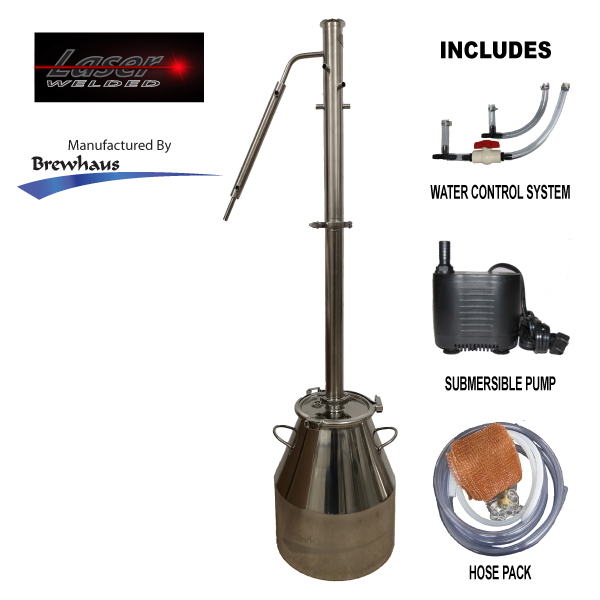
6.1.3.1 Path A — Brewhaus Essential Extractor Pro Series II 8-Gallon ($499.99)
- Vendor: Brewhaus America (Fort Worth, TX, USA) —
https://brewhaus.com/product/8-gallon-essential-extractor-pro-series-ii-complete-moonshine-still/ - Price: $499.99 (frequently — consistent base price)
- Capacity: 8 US gallon stainless steel kettle
- Column: 2-inch diameter, 2-piece reflux column (the upper section is removable for pot-mode operation)
- Includes: 8-gal stainless kettle, 2-piece 2” reflux column, copper-mesh or Raschig-ring packing (your choice), submersible water pump, complete hose kit, thermometer, diffuser plate, tri-clamps and gaskets, all fittings
- Heating element NOT included — Brewhaus recommends 1500W–3000W internal element with PID, budget $150–$250
- Country of origin: Brewhaus assembles in Texas; some component sourcing offshore
- Lead time: 1–5 business days standard
Why this is the budget Tier-4 entry:
- Cheapest genuine dual-mode rig on the market. $500 for a complete kettle + dual-mode column + accessories is hard to beat anywhere.
- Mode-switching is simple and physical. Remove the upper column section (tri-clamp release) and you have a short pot-still head; reinstall it and you have a 2-piece reflux column. Two configurations, one decision.
- Brewhaus is an established US vendor with phone support (817-750-2739) and an Essential Extractor product line that’s been refined across multiple generations.
- Diffuser plate included — a perforated plate at the kettle-to-column transition that helps even out vapor flow into the column; surprisingly important for clean rectification and not always included at this price point.
Trade-offs vs. higher-end Tier-4 paths:
- Stainless construction throughout — no copper in the vapor path. Sulfur scrubbing is minimal; whiskey-character runs through this rig will have noticeable sulfur notes vs. the same wash through an all-copper hybrid (Path C). Brewhaus addresses this by recommending you load the column packing with copper mesh (rather than stainless or ceramic), which provides sulfur scrubbing on both modes. Take that recommendation.
- No dephlegmator included — the column does passive rectification with whatever cooling-water condensation happens at the top condenser. You can add a dephlegmator as a separate component for $250–$400 if you want active reflux control.
- Sizing for the smaller wash batch — 8-gallon kettle is appropriate for Tier-4 split-batch workflows, but if you ever want to scale up to 12+ gallon runs you’ll outgrow this kettle.
Setup before first run:
- Pack column with copper mesh (not stainless or ceramic) — this is the kit’s only path to copper-vapor contact. Use 99.9% copper mesh, not the copper-coated steel scrubbers sold for kitchen use.
- Install heating element (1500W for slow runs, 3000W for fast)
- Vinegar pre-clean (1 gal vinegar in 7 gal water, run as standard stripping run, discard output) — passivates copper mesh, removes machining residues
- Practice mode-switching with the kettle empty before any wash-based work: remove upper column section, reinstall, repeat 3–4 times to develop the muscle memory
6.1.3.2 Path B — Clawhammer Supply 8-Gallon Stainless/Copper ($999)
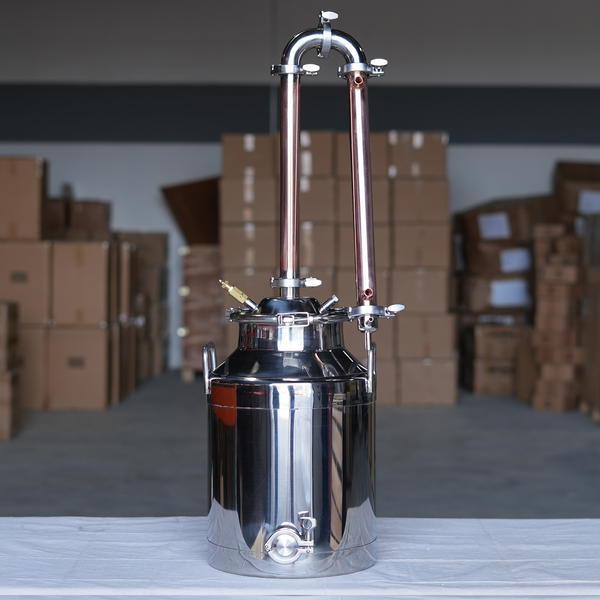
- Vendor: Clawhammer Supply (NC, USA) —
https://www.clawhammersupply.com/products/8-gallon-stainless-copper-distiller - Price: $999 (consistent — not a sale price)
- Capacity: 8 US gallon, pre-built (unlike Clawhammer’s 5-gal kit which requires self-assembly)
- Construction: 304 stainless steel boiler + heavy-duty food-grade copper column (pre-built and integrated)
- Includes: 304 stainless boiler, copper distillation column, built-in 5-PSI pressure relief valve, 1/2” NPT thermometer port, 1/4” bung for optional pressure gauge, 1.5” ferrule for optional controller kit integration
- Heating element NOT included — Clawhammer sells a matching controller kit ($150 approx) and recommends a 5500W internal element ($30)
- Mode-switching: column packed (with copper mesh) = reflux mode; column unpacked = pot mode
- Country of origin: not stated explicitly; Clawhammer is a NC-based vendor; some components may be sourced
- Lead time: ships within 1–2 weeks
Why this is the mid-tier upgrade pick:
- Heavy-duty food-grade copper column — real copper, not just copper-mesh-inside-stainless. Vapor contacts solid copper walls throughout the column, dramatically improving sulfur scrubbing on both modes.
- Pre-built, no soldering — unlike Clawhammer’s 5-gal kit (Vol 3 §3.2.5 D2), the 8-gal arrives ready to run. The brand’s reputation for quality applies; you skip the assembly time.
- Built-in pressure relief valve at 5 PSI — important safety feature; many cheaper Tier-4 stills omit this and rely on the lid gasket to fail in overpressure scenarios (which is unsafe and unpredictable). The Clawhammer valve releases at a known pressure.
- Controller-kit-ready ferrule — the 1.5” ferrule on the boiler is sized for Clawhammer’s matching controller kit, which integrates a 5500W element with PID control. Buy the kit and the kettle together and you have a turnkey Tier-4 system for ~$1,200–$1,250.
- Doubles down on Clawhammer’s reputation — same builder as the Vol 3 5-gal kit, same C-110 grade copper, same brand support and video tutorials
Trade-offs vs. Path A (Brewhaus) and Path C (NG Still):
- 2× the cost of Brewhaus for the copper-column upgrade. Worth it if whiskey character matters to you.
- Stainless kettle (not full copper like Path C) — the boiler is where vapor first meets metal, and pure copper boilers deliver more sulfur scrubbing than stainless boilers + copper column. NG Still Co Path C is the upgrade beyond Clawhammer if you want full-copper.
- No included thumper or dephlegmator — the column does the rectification work in reflux mode; nothing fancy beyond that
Setup:
- Inspect for shipping damage (NC-shipped, generally arrives clean)
- Install element via the 1.5” ferrule and matching Clawhammer controller, OR a generic 5500W element with PID
- Pack column with copper mesh for reflux mode (or use Clawhammer’s recommended copper-scrubbers; both work)
- Vinegar pre-clean
- Practice mode-switching: copper-mesh-in for reflux mode, copper-mesh-out for pot mode. The mesh removes/reinstalls in 5 minutes once you’ve done it a few times.
6.1.3.3 Path C — North Georgia Still Company 7.5-Gallon Distillers Kit ($1,544)
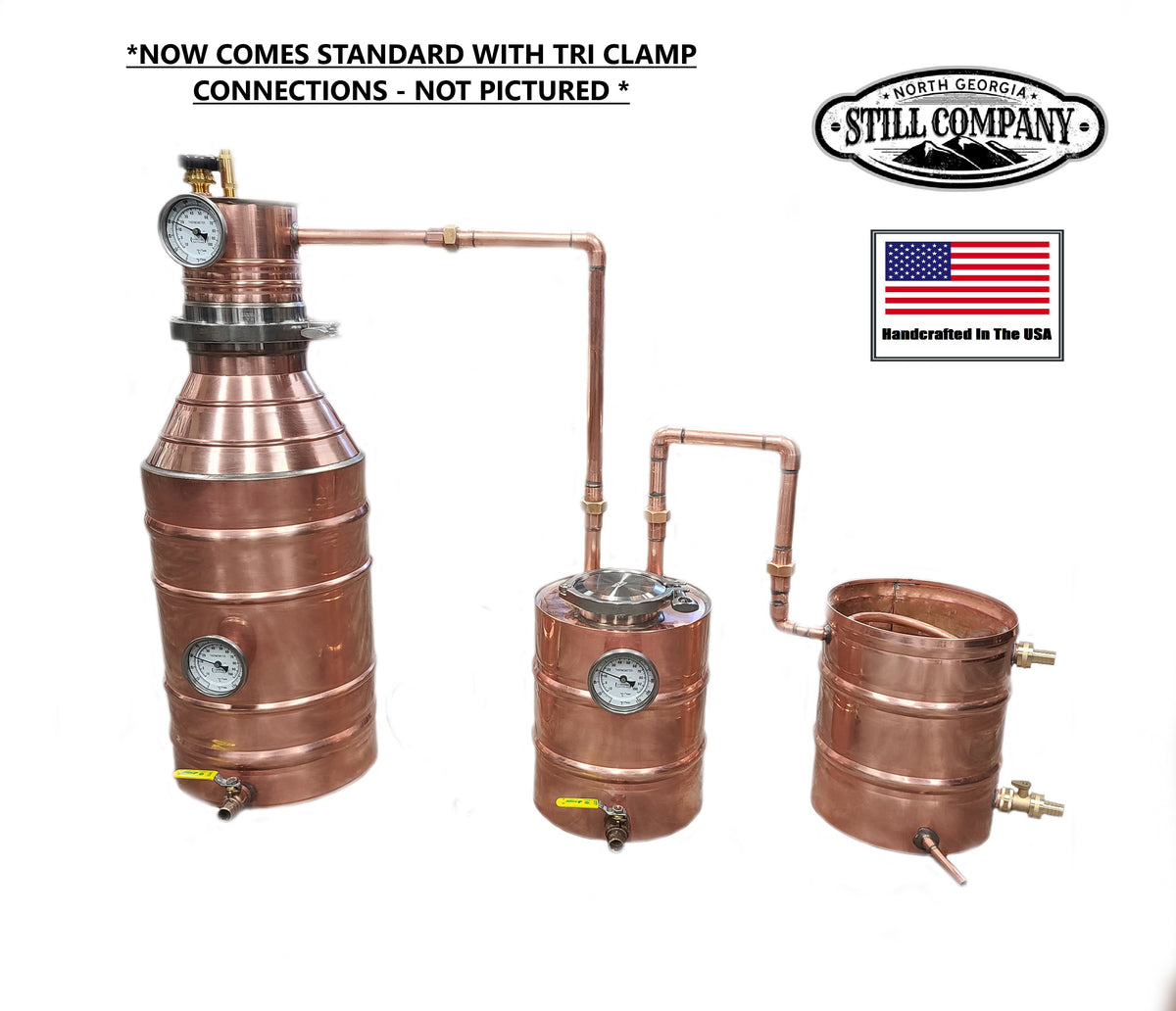
- Vendor: North Georgia Still Company (Dahlonega, GA, USA) —
https://north-georgia-still-company.myshopify.com/products/7-5-gallon-distillers-kit - Price: $1,544 (consistent — not a sale price)
- Capacity: 7.5 US gallon still + proportionally-sized thumper + worm condenser
- Material: 20 oz / 22-gauge copper throughout — same grade as their 5-gal and 15-gal kits
- Includes: Tri-clamp-capped still pot, thumper with 4” fruit port (for botanicals or fruit additions between stages), worm condenser with 15 ft of 5/8” OD copper tubing braced on the sides, submersible water pump, vinyl tubing, 1/2 NPT thermometer port
- Heating element NOT included — propane burner recommended at this scale, or 3000W internal electric with PID
- Mode-switching: default configuration is thumper-design for character spirit; add a separate packed reflux column section between the kettle and the lyne arm for neutral-mode operation
- Country of origin: hand-built one at a time in Dahlonega, GA
- Lead time: 1–2 additional days on top of standard processing
Why this is the quality-copper Tier-4 pick (and the natural Tier-4 for a Vol 3/4 NG Still owner):
- 20 oz / 22-gauge copper throughout the entire vapor path — boiler, thumper, worm. Maximum copper-vapor contact in both modes. The whiskey-character output from this rig is markedly better than any stainless-boiler-with-copper-column hybrid.
- Thumper-design as the default is character-mode-native — most other Tier-4 rigs default to column-mode and add a head for pot mode. NG Still defaults to thumper (which is itself a passive rectification stage) and you add a column for neutral mode. The “rich whiskey” output of the default configuration is a real selling point.
- Same builder, same construction philosophy as Vol 3 D3 (5-gal) and Vol 4 Path C (15-gal). If you’ve used either of those, the 7.5-gal is the bridge between them — perfect for split-batch dual-mode work.
- Fruit port on the thumper lets you add botanicals or fruit between the stripping and spirit phases, useful for fruit-based whiskey, brandy, gin, or rum infusions
- Hand-built copper at this gauge is generational — same as the 5/15-gal NG Still kits; treated reasonably, this is a lifetime tool.
Trade-offs vs. Path B (Clawhammer):
- ~50% more expensive ($1,544 vs $999) for the full-copper upgrade
- Mode-switching requires the additional column section — you’ll need to buy a separate packed reflux column (compatible with the 4” thumper port) to run neutral mode. NG Still sells column sections as separate components; budget $300–$500 for the add-on column.
- Worm-condenser design (rather than tube-in-tube) is excellent for whiskey character but slightly less efficient at neutral-mode high-rate vapor cooling; in summer you may need more cooling water flow
Setup:
- Unbox carefully; 22-gauge copper can dent if handled roughly
- Install heating element OR set up propane burner with proper kettle support
- Vinegar pre-clean at 7.5-gal scale (1.5 gal vinegar in 6 gal water)
- Confirm thumper dip-tube is properly installed — NG Still includes it correctly out of the box, but verify before first run (vapor inlet should extend below the thumper liquid level)
- For neutral-mode capability: order the matching packed-column section separately when you’re ready; install between kettle lid and the existing lyne arm via tri-clamp swap
6.1.3.4 Path D — StillDragon 8-Gal Modular Hybrid Build ($2,000–$3,500+)
- Vendor: StillDragon (Sebastian, FL, USA) —
https://stilldragon.com/ - Product: assembled from modular components — 8-gallon kettle + multiple swappable head/column configurations
- Price: $2,000–$3,500 for a Tier-4 hybrid build (kettle + multiple swappable top configurations) — varies significantly by exact specification
- Capacity: 8-gallon kettle (typical Tier-4 size for this vendor); 14-gal and larger also available
- Material: stainless steel kettle with copper plates/columns/dephlegmators as ordered; full-copper kettles available at significant upcharge
- Mode-switching: tri-clamp swap between multiple top configurations — e.g., short pot-still head for character mode, plate column with dephlegmator for neutral mode, or column-with-gin-basket for gin mode. More mode options than any other Tier-4 path.
- Country of origin: USA-designed; some components manufactured to spec overseas
- Lead time: 1–2 weeks per component
Why StillDragon is the professional-modular Tier-4 pick:
- Multi-mode capability beyond just whiskey/neutral. A typical StillDragon Tier-4 build supports: short pot head (whiskey/rum/brandy), 2-plate sight-glass column with dephlegmator (vodka), 4-plate column (high-purity vodka or gin base), column-with-gin-basket (gin). Four configurations from one kettle.
- Tri-clamp standard throughout — every top swap is intuitive: release the clamp, lift off one configuration, install another. Practiced operators can switch configurations in 5–10 minutes.
- Commercial-grade engineering — same component quality used in actual TTB-licensed craft distilleries scaled down to 8-gallon hobbyist size
- Future-proof upgrade path — StillDragon’s modular philosophy means the kettle you buy today is compatible with any Tier-5 or Tier-6 upgrade you might want later (Vols 7–8). Components from 8-gallon Tier-4 builds bolt directly onto 25-gallon Tier-5 builds.
- Forum support and documentation at
stilldragon.orgis extensive; thousands of Tier-4 build posts and configuration discussions
Trade-offs:
- You build the spec sheet. First-time StillDragon buyers find the component catalog overwhelming. Spend the research time — read their sizing guide, post a configuration question on their forum, get the spec right before ordering.
- Higher total cost than Path A/B/C for equivalent capability — modular flexibility costs money
- Multi-component shipping — different configurations may ship on different days
- Stainless kettle default — copper-kettle variants exist at notable upcharge
When to choose StillDragon Path D:
- You want true multi-mode capability (not just dual-mode) — whiskey AND vodka AND gin AND brandy all from one kettle
- You’re committed to staying in distillation for the long term and want hardware that scales with you
- You came from Vol 4 Path D (StillDragon Tier-2) and want to extend that modular ecosystem to a dedicated dual-mode 8-gal rig
- You’re comfortable with the configuration research time investment
Setup:
- Spend 2–4 hours on the research before ordering; read StillDragon’s documentation
- Confirm power (240V available for 5500W elements at 8-gal scale) and water (recirculating chiller helpful for multi-mode runs in summer)
- Assemble each configuration once with the kettle empty; practice the tri-clamp swap-out between configurations
- Vinegar pre-clean
- Catalog your swap-time per configuration; ideal target is <10 minutes per swap once you’re practiced
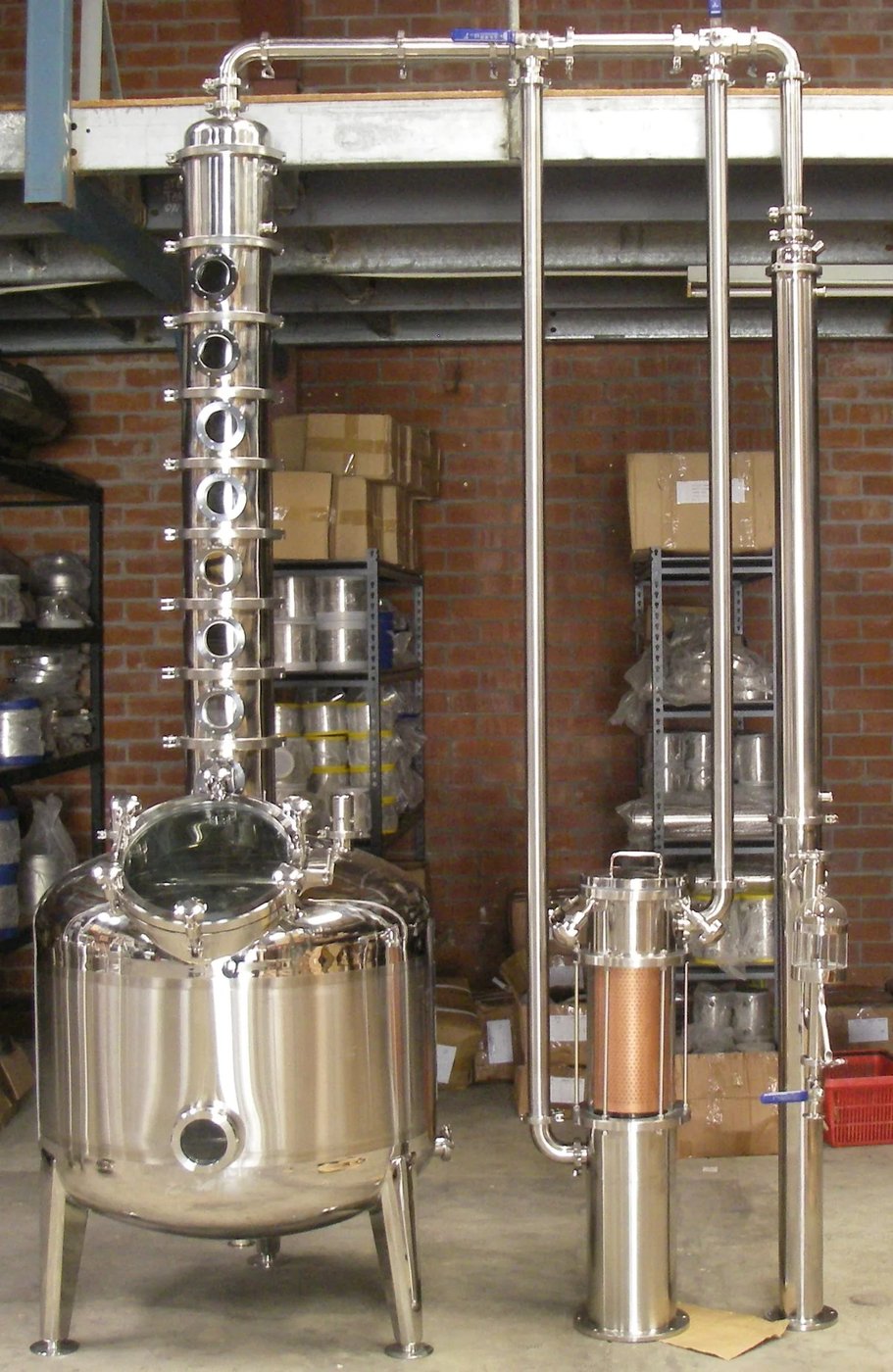
6.1.4 The Hardware Switching: Valves, Tri-Clamps, Quick-Change Discipline
Mode-switching is the central new operation at Tier-4. Doing it cleanly and reliably matters.
6.1.4.1 Tri-clamp connections are the standard
All four Tier-4 paths above use tri-clamp (also called “sanitary clamp”) connections at the kettle-to-column interface and other major swap points. A tri-clamp connection consists of:
- Two ferrules (one on each piece being joined) — short flanged tubes welded to the components
- One gasket (EPDM, silicone, or PTFE) between the ferrule faces
- One clamp that compresses the two ferrules together against the gasket
To make a tri-clamp connection:
- Inspect both ferrule faces for cleanliness (any debris → bad seal)
- Place gasket on one ferrule face
- Bring the other ferrule face together against the gasket
- Position the clamp around both ferrules, tighten the wing-nut until snug
- Done — instantly gas-tight at distillation temperatures, instantly removable for cleaning
Standard sizes for hobbyist Tier-4 hardware: 2” tri-clamp (most common at this scale) and 3” tri-clamp (StillDragon 4” column builds). Gaskets and clamps are universal across vendors; you can mix-and-match components from different makers as long as the ferrule size matches.
6.1.4.2 Mode-specific valves (some Tier-4 designs)
Higher-end Tier-4 builds (typical of StillDragon configurations) include mode-specific shutoff valves that let you direct vapor down one path or another without physically swapping hardware. For example:
- A vapor manifold with a 3-way ball valve at the kettle top: position A sends vapor up to the column, position B sends vapor through a side port to a pot-mode head
- A bypass valve around the dephlegmator: open valve = bypass = no reflux; closed valve = engage dephlegmator = active reflux
These valve-switched designs are faster to operate (10 seconds to throw a valve vs 10 minutes to swap a component) but more expensive to build and require absolutely reliable valves (a stuck valve mid-run is a real failure mode). For hobbyist Tier-4 use, the tri-clamp swap approach is usually more practical.
6.1.4.3 Quick-change discipline
Whether you’re tri-clamp swapping or valve-throwing, the discipline is the same:
- Document your configurations. Write down which components go together for each mode (whiskey: kettle + pot head + condenser; neutral: kettle + packed column + dephlegmator + condenser). Tape the list inside your workshop cabinet.
- Photograph each fully-assembled mode with your phone — refer back to the photo when reassembling.
- Store mode-specific components together. When you remove the pot-still head, put it in its dedicated bin or shelf next to its dedicated gaskets. Don’t mix gaskets between configurations (gasket wear patterns matter — a gasket that’s been used in neutral mode 50 times has a different compression profile than a fresh one).
- Inspect every tri-clamp seal before every run. Look at the gasket face for nicks, debris, or compression damage. Replace at any sign of wear. Gaskets are $2 each; a failed seal mid-run is a much more expensive failure.
- Tighten clamps consistently. Snug but not overtightened — overtightening crushes the gasket and shortens its life; undertightening leaks. Develop a feel for the right torque after 10–20 connections.
6.1.5 The Choice: Tier-4 Path Recommendation by Use Case
Table 1 — 6.5 The Choice: Tier-4 Path Recommendation by Use Case
| Use case | Recommended path | Why |
|---|---|---|
| Cheapest genuine dual-mode entry | A: Brewhaus PSII ($499.99) | Half the price of the next-cheapest dual-mode rig; pack copper mesh in column for sulfur scrubbing. |
| Mid-tier with real copper column | B: Clawhammer 8-gal SS/Cu ($999) | Heavy-duty copper column delivers proper sulfur scrubbing on both modes; pre-built, no soldering. |
| Quality copper throughout; whiskey-character primary | C: NG Still 7.5-gal ($1,544) | Full 20 oz copper through boiler/thumper/worm; thumper-default design is character-native. |
| Multi-mode (more than just whiskey/neutral) | D: StillDragon modular ($2,000–$3,500+) | Four-plus configurations from one kettle; future-proof upgrade path. |
| Already on NG Still Co Vol 3 D3 or Vol 4 Path C | C: NG Still 7.5-gal | Bridges your existing 5-gal and 15-gal kits; identical operating skills transfer; same brand support. |
| Already on StillDragon Vol 4 D or Vol 5 D | D: StillDragon Tier-4 | Components remain compatible across the ecosystem; mix-and-match with existing tri-clamp hardware. |
| Want to split a single ferment into whiskey vs neutral comparison runs | Any path | The two-runs-from-one-wash workflow works on all four; 5–8 gal scale is ideal for it. |
The honest recommendation by commitment level:
- You want to try dual-mode at the lowest possible spend → Path A (Brewhaus PSII, $499.99). Add a copper mesh pack ($25), heating element + controller ($150–$250). Total ~$700 for a working dual-mode rig. The stainless construction means whiskey-character output will have some sulfur notes, but you’ll learn the dual-mode workflow without breaking the bank.
- You’re sure dual-mode capability matters to you long-term → Path B (Clawhammer 8-gal SS/Cu, $999) or Path C (NG Still 7.5-gal, $1,544) depending on whether the stainless kettle bothers you. Both are excellent; the cost difference is real copper everywhere vs. real copper in the column only.
- You came to distillation through whiskey specifically and you’d rather have a slightly smaller all-copper rig than a slightly larger compromise → Path C — the 7.5-gal NG Still produces whiskey character that simply isn’t achievable from a stainless-kettle rig at any price.
- You want maximum flexibility and you can afford it → Path D (StillDragon modular) — multi-mode beyond dual-mode, with no scaling ceiling
The quality-copper lean continues: at Tier-4, the case for copper is strongest in whiskey mode (where copper-sulfur scrubbing defines spirit quality) and least urgent in neutral mode (where carbon-polish post-processing can clean up residual sulfur). If your Tier-4 use case is 80% whiskey and 20% vodka, prioritize full-copper construction (Path C). If it’s 50/50 whiskey/vodka or vodka-leaning, Path B (copper column on stainless kettle) is defensible because the column does most of the sulfur scrubbing in whiskey mode and the kettle’s stainless construction matters less in neutral mode.
6.1.6 The Tier-4 BOM
Assuming Path B (Clawhammer 8-gal Stainless/Copper) as the still — the most commonly-chosen “good enough for most use cases” Tier-4 path:
Table 2 — Assuming Path B (Clawhammer 8-gal Stainless/Copper) as the still — the most commonly-chosen "good enough for most use cases" Tier-4 path
| Item | Spec / source | Price |
|---|---|---|
| Still | Clawhammer 8-gal Stainless/Copper, pre-built | $999 |
| Heating element + 5500W controller kit | Clawhammer matching controller + 5500W element | $200 |
| 240V GFCI circuit installation | If not already available; electrician | $300–$600 (one-time) |
| Column packing | Copper mesh for reflux mode (purchased separately) | $25 |
| Mode-specific spare gaskets | EPDM 2” tri-clamp gaskets, ×6 (3 per mode + 3 spares) | $20 |
| Parrot with alcoholmeter | Glass parrot + 0–100% ABV alcoholmeter | $80 |
| Hydrometer + test jar | Triple-scale brewing hydrometer + 250mL plastic test jar | $25 |
| Digital thermometers (×2) | One in boiler, one at column output | $50 |
| Cooling water setup | Submersible pump + 5-gal reservoir + tubing | $40 |
| Fermenter | 6-gal Speidel plastic or stainless fermenter | $150 |
| Wash recipe ingredients (per 7-gal batch) | Sugar wash or all-grain mash | $30 |
| Mode-specific cleaning supplies | PBW, citric acid, brushes (see §6.9) | $40 |
| Safety: ABC fire extinguisher, GFCI tester | Hardware store | $50 |
| Total — complete Tier-4 setup | ~$1,709–$2,309 |
Notes:
- If you chose Path A (Brewhaus PSII): subtract ~$500 from still line; total drops to ~$1,200–$1,800.
- If you chose Path C (NG Still 7.5-gal): add ~$545 to still line; total ~$2,250–$2,850. Add another $300–$500 if you want the optional reflux column section for neutral-mode capability.
- If you chose Path D (StillDragon Tier-4): still line jumps to $2,000–$3,500; total $2,700–$4,500.
- A complete Tier-4 setup is genuinely cheaper than Tier-2 (which was $2,979–$3,659 in Vol 4 §4.6) for most paths. The smaller kettle saves money on the still itself, the heating element, the fermenter, the cooling system, the ingredients — but you get more capability per dollar via dual-mode operation.
6.1.7 Whiskey-Character Mode Run Procedure
The Tier-4 whiskey-character run uses the kettle-to-pot-head-to-condenser path (Path A: upper column section removed; Path B: column unpacked; Path C: default thumper configuration; Path D: pot-still head installed). Procedure is essentially a Tier-1/2 pot-still run scaled to 7–8 gallons:
6.1.7.1 Pre-run setup
- Confirm mode-switching is complete. Visually verify the pot-still configuration is installed: upper column section off (Path A), column packing removed (Path B), thumper as default (Path C), or pot head installed (Path D). Take a phone photo to compare against your reference photo.
- Inspect tri-clamp seals. Every connection — fresh gasket, snug clamp.
- Wash check. Verify fermentation is complete (Vol 2 §2.10 troubleshooting), hydrometer reading stable.
- Stage materials: small jars (100 mL each, 6–8 of them) for foreshots/heads; pint jars (3–4 of them) for hearts; quart jug for tails.
6.1.7.2 Loading and heat-up
- Rack 6–7 gallons of wash from fermenter to kettle, leaving sediment behind.
- Verify wash level is 4”+ above the heating element.
- Seal kettle tri-clamp.
- Start cooling water to condenser.
- Energize element at 100% to first vapor (~20–30 min on 8-gal at 5500W).
6.1.7.3 The run
- First vapor at ~78°C wash temperature. Throttle to ~60–70% power once vapor is established.
- Foreshots: collect first ~80 mL, DISCARD. Smell: harsh, solvent. Methanol territory.
- Heads: next ~300–500 mL. Smell: sharp solvent, transitions to “clean alcohol” at the heads-to-hearts boundary. Discard, OR save for next stripping run.
- Hearts: the main collection. Parrot ABV starts at ~75–80%; drops slowly through the run. Collection rate ~150–200 mL/min. Collect in pint jars for taste-evaluation.
- Hearts-to-tails transition: parrot drops below ~50% ABV, OR smell shifts from “clean whiskey character” to “wet cardboard / fusel.”
- Tails: collect separately for next stripping run. Continue until parrot drops below ~15% ABV.
6.1.7.4 End-of-run
- De-energize element; keep cooling water flowing 10 minutes.
- Cool kettle; drain backset.
- Total run time: 4–5 hours (faster than Tier-2 spirit run because no equilibration period; no reflux to maintain).
- Total hearts output: ~1–2 liters of 55–70% ABV character spirit (whiskey, rum, brandy depending on wash recipe).
6.1.7.5 Post-run
For whiskey: dilute hearts to ~63% ABV (barrel-entry proof) using distilled water; transfer to oak (toasted, charred, or used) for aging. For rum/brandy: same dilution or use as-is depending on style.
6.1.8 Neutral-Spirit Mode Run Procedure
The Tier-4 neutral mode is essentially a Tier-3 reflux run (Vol 5 §5.8) scaled to 7–8 gallon kettle. Brief procedure:
- Reconfigure to neutral mode: install reflux column (Path A: upper column section in place; Path B: column packed with copper mesh; Path C: install optional reflux column section between kettle and lyne arm; Path D: install plate column + dephlegmator).
- Take a phone photo of the configuration before starting; refer to reference photo if uncertain.
- Run procedure follows Vol 5 §5.8 with adjustments for smaller scale:
- Equilibration period: 30–45 min (shorter than Tier-3’s 45–90 min because column is shorter)
- Foreshots: 40 mL per gallon of charge = ~280–320 mL for 7-gal kettle
- Reflux ratio during hearts: 4:1 to 8:1 (slightly lower than Tier-3 because column is shorter)
- Hearts ABV: 88–93% (slightly lower than Tier-3 maximum because column is shorter; carbon-polish for vodka use to compensate)
- Total run time: 5–7 hours
- Total hearts output: 1.5–3 liters of 88–93% ABV neutral spirit
For full procedural detail on reflux runs, see Vol 5 §5.8 (Neutral-Spirit Spirit Run with Reflux).
6.1.9 Mode-Switching Discipline: Cleaning and Cross-Contamination Avoidance
The single biggest failure mode unique to Tier-4 is character bleed-through — running a neutral-spirit batch on a kettle/column that still has whiskey residue from the previous run, and getting subtle whiskey character in what should be clean neutral spirit. This is invisible to your eye and obvious to your taste buds at the worst possible time.
6.1.9.1 The cross-contamination chemistry
Whiskey, rum, brandy, and other character spirits leave behind:
- Congener residues on copper surfaces (fatty acid esters, higher alcohols) — these wash off but not with plain water
- Fusel oil films in the boiler, on the lid, in the lyne arm — oily, persistent
- Trace botanicals in gin runs that adhere to copper for many subsequent runs unless properly removed
When you reconfigure for neutral-spirit mode and run a fresh batch, vapor passing through the equipment picks up these residues and carries them into your “neutral” spirit. The result: vodka that has subtle whiskey notes, gin with a faint of-last-month’s-juniper, neutral spirit that isn’t actually neutral.
6.1.9.2 The cleaning protocol between modes
A standard between-modes cleaning protocol:
- Drain backset from the previous run as soon as kettle is cool enough to handle
- Rinse kettle with hot water to remove residual liquid
- PBW (Powdered Brewery Wash) soak: dissolve 2 tablespoons PBW in 2 gallons hot water; fill kettle to the column-mount line; install whatever column configuration you’re about to use; run as a complete dummy distillation (heat the PBW solution, let vapor circulate through the whole system, condense and collect, discard). This cleans every surface vapor will touch in the next real run.
- Rinse the kettle and column with clean hot water; pour through the column to flush
- Vinegar polish (optional but recommended when switching from whiskey to neutral): 1 gal white vinegar in 4 gal water; run as dummy distillation. Vinegar cuts through fusel oil films and brightens copper surfaces.
- Final fresh-water rinse
This protocol takes 3–4 hours of dummy-distillation time. Worth it. The alternative — running your neutral batch and discovering the contamination on first taste — wastes a full wash, fermentation, and distillation effort plus your time.
6.1.9.3 The mode-specific approach: dedicated hardware where possible
A higher-discipline approach used by serious dual-mode operators: keep mode-specific hardware for some components:
- Two parrots: one for whiskey runs (which may accumulate persistent whiskey character), one for neutral runs (kept pristine)
- Two sets of collection vessels: clearly labeled by mode
- Two sets of column packing: copper mesh that’s been used in many whiskey runs goes into a “whiskey-mode” bin; fresh or neutral-only-used mesh stays “neutral-mode” only
- Single shared kettle and column, but cleaned thoroughly between modes per §6.9.2
This is more rigorous than necessary for the casual dual-mode user but worth knowing about if you find character bleed-through despite cleaning.
6.1.9.4 Gin-mode is particularly contaminating
If you make gin (Vol 5 §5.9), the botanicals leave especially persistent residue — juniper oil, citrus terpenes, coriander oils. These compounds adhere to copper for many runs after a gin batch. Best practice:
- Run gin batches in dedicated equipment if possible (separate gin basket, separate column packing for gin mode)
- If sharing equipment, run gin only after deep-cleaning, AND only directly before a stripping run (where character doesn’t matter), never directly before a neutral-spirit spirit run
- Don’t make gin and then vodka back-to-back on the same hardware without a 2-day cleaning intermission
6.1.10 Common Tier-4 Pitfalls and How to Avoid Them
1. Wrong configuration installed (most common Tier-4 mistake). You think you’re in neutral mode but you’re actually in pot mode, or vice versa. Result: confusing run behavior, wasted batch. Prevention: photograph each configuration; cross-check before every run; develop a verbal pre-run checklist (“pot head installed: yes/no; column packed: yes/no; dephlegmator engaged: yes/no”).
2. Skipped between-modes cleaning. Character bleed-through into neutral runs; vice versa less critical but still present. Prevention: always do the §6.9.2 cleaning protocol when switching modes. Build it into your workflow as non-negotiable.
3. Bad tri-clamp seal. Snug-but-not-overtightened is harder than it sounds. Result: vapor leaks during runs, lost product, potential fire hazard. Prevention: always inspect gasket faces for damage before assembly; replace gaskets at any sign of wear; tighten consistently (develop the feel after 20+ connections).
4. Forgetting that the same wash distilled both ways needs different cut decisions. Pot-mode hearts boundaries are at higher ABV and shift faster than neutral-mode equivalents. Prevention: keep separate run logs for each mode; reference the mode-appropriate log before making cuts.
5. Underestimating gin-mode contamination persistence. You make gin one weekend, vodka the next, taste juniper in the vodka. Prevention: see §6.9.4.
6. Mode-specific gaskets/clamps swapped during reassembly. Each tri-clamp connection prefers a consistent gasket type and clamp; mixing them causes seal problems. Prevention: keep mode-specific gaskets in mode-specific bins; don’t share.
7. Trying to switch modes mid-run. Some operators think they can run pot-mode for hearts and switch to reflux-mode for tails recovery. Don’t — the reconfiguration requires the kettle to be at room temperature, and partial-batch switching produces inconsistent product. Prevention: commit to one mode per batch; do mode-switching only between batches.
8. Tri-clamp gasket material mismatch. EPDM is the standard for distillation gaskets (heat-resistant to ~150°C, ethanol-compatible). Silicone is OK but less durable. PTFE is overkill and brittle at temperature. NBR/Buna is wrong (degrades in ethanol). Prevention: use EPDM unless there’s a specific reason otherwise; verify gasket material when buying replacements.
9. Pressure relief valve neglect. Path B (Clawhammer) and Path D (StillDragon) builds typically include a pressure relief valve at 5–10 PSI. Don’t paint over it or let it get gunked up — a stuck relief valve is dangerous in an overpressure scenario. Prevention: manually actuate the relief valve monthly; clean and lubricate (food-grade lubricant) annually.
10. Same Tier-2/3 electrical hazards still apply. GFCI, grounding, fire extinguisher within reach (Vol 4 §4.9, Vol 5 §5.10). The smaller scale doesn’t reduce the electrical or fire risk.
6.1.11 Where Tier-4 Leaves You; What Tier-5 Adds
A well-run Tier-4 hybrid produces excellent character spirit (1–2 L per whiskey/rum/brandy run) and excellent neutral spirit (1.5–3 L per neutral run) from the same 8-gallon kettle, with mode-switching that takes 10–30 minutes between runs. The single-batch dual-mode comparison workflow (§6.2.4) is uniquely powerful at this scale — you learn faster about your wash recipes and your cuts by direct comparison than you ever do at single-mode scales.
Tier-4’s natural limits:
- Output volume per session: 1–3 liters of finished spirit per run, 6–10 mode-switched runs per year = 10–30 L of finished spirit per year. Enough for serious gifting and personal use; insufficient for any commercial activity.
- Wash batch size: 6–7 gallon practical ferment; small for an established homebrewer who’s used to 10–15 gallon batches.
- Multi-mode capability ceiling: dual-mode (Paths A/B/C) or multi-mode (Path D) — but you’re still limited to what the column hardware can physically support. Specialty distillations (essential oil hydrosols, fractional distillation of specific compound classes) need different hardware.
Vol 7 (Tier-5) introduces the dedicated single-purpose larger-scale rig — 15–25 gallon dedicated equipment optimized for one spirit type (a whiskey-specific rig, or a neutral-spirit-specific rig), with mash tuns sized for the kettle, pump transfers between vessels, and the operational cadence to actually fill bottles regularly. This is the “I’m done compromising; this hardware does one thing exceptionally well” tier.
Vol 8 (Tier-6) addresses the small craft distillery floor at 50–100+ gallon scale — equipment, infrastructure, TTB DSP licensing, and the legal/operational reality of distilling at volumes that the federal government considers a commercial operation regardless of your intent.
End of Vol 6. Next: Vol 7 — Tier-5 Small-Batch Dedicated Rig.
Comments (0)