Distilling · Volume 7
Vol 7 — The Tier-5 Dedicated Single-Purpose Rig: 15–25 Gallon, One Spirit Done Exceptionally
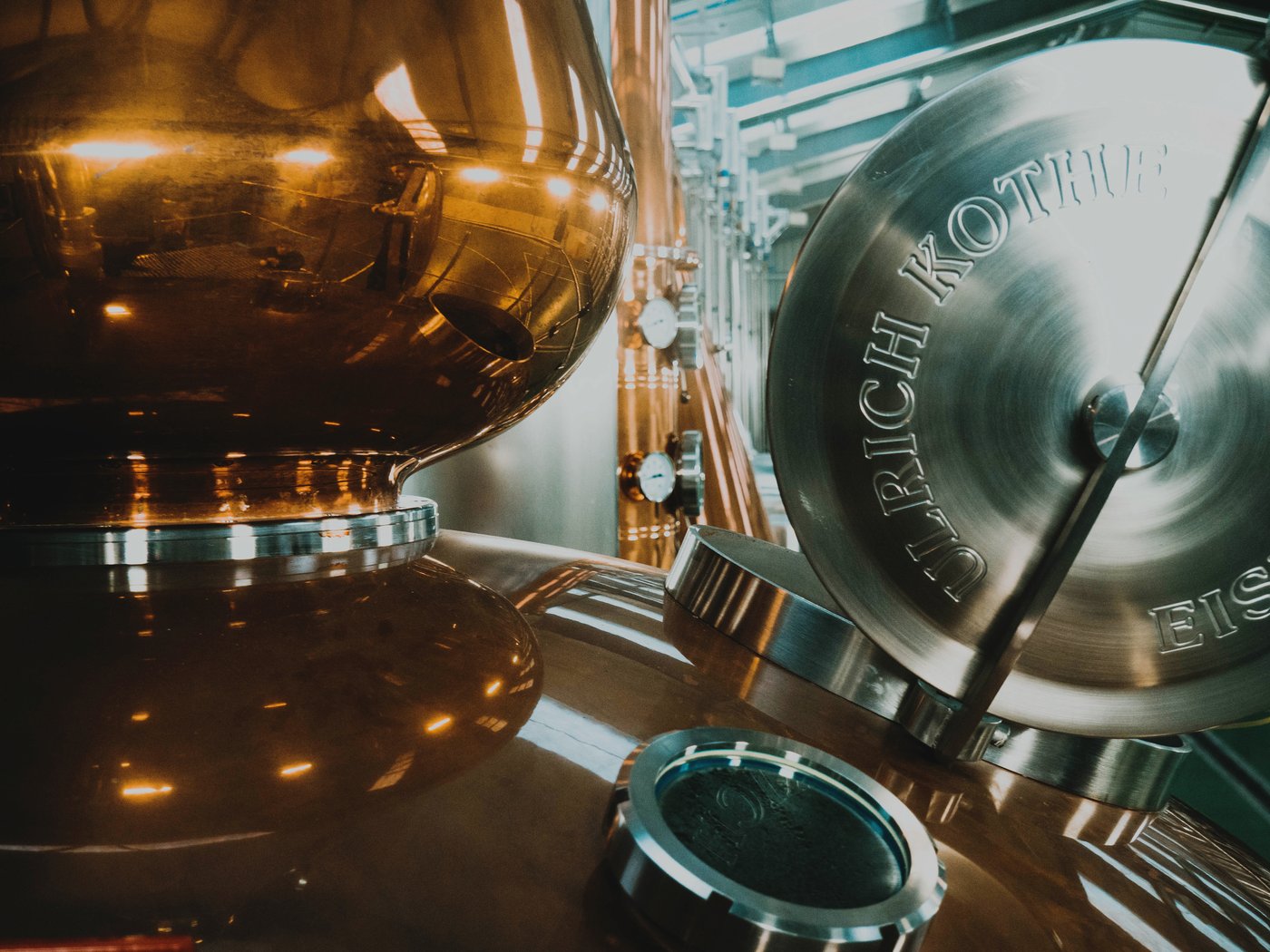
Phase 3 — Distilling deep-dive series. This volume covers the Tier-5 dedicated single-purpose rig: a 15–25 gallon scale build optimized for one specific spirit category (a whiskey-dedicated rig or a neutral-spirit-dedicated rig) with no dual-mode compromises. We cover the dedicated-specialist philosophy, two parallel build paths (whiskey-dedicated and neutral-dedicated), the mash-tun infrastructure that becomes necessary at this scale, pump transfers between vessels, workshop infrastructure (electric, water, drainage, ventilation), the production-cadence workflow that fills bottles regularly, and the shifting legal posture as you move toward the TTB’s enforcement envelope.
7.1.1 What Tier-5 Means
The Tier-5 dedicated single-purpose rig is defined by:
- Scale: 15–25 US gallon kettle (back up from Tier-4’s 5–8 gal — but unlike Tier-2’s 10–15 gal generic upgrade, Tier-5 is dedicated)
- Equipment cost: $4,000–$15,000+ for the still + mash tun + pump system + infrastructure; complete fermentation-to-bottle setup $7,000–$25,000
- Energy source: dedicated electric heating element with PID, 240V (often dual elements for redundancy and trim control), 5500–9000W total
- Skill level: advanced; you’ve completed 30+ runs at Tiers 1–4, you know which spirit type(s) you want to commit to long-term, and you’ve outgrown dual-mode compromises
- Spirit output per session: 4–8 liters of finished spirit per spirit run; production cadence supports 12–30+ liters per month of dedicated single-spirit output
- Defining feature: single-purpose specialization — this rig does one thing exceptionally well, not five things adequately. A whiskey rig produces excellent whiskey and would be a poor vodka rig. A vodka/gin rig produces excellent neutral spirit and would be a poor whiskey rig.
7.1.1.1 Tier-5 is the “I’m done compromising” tier
Tiers 1–4 all sat at intersections of capability vs. cost compromise:
- Tier-1 (stovetop): entry-level capability at minimum cost; compromises everywhere (small batch, single-pass, basic equipment)
- Tier-2 (bench rig): real capacity at moderate cost; compromises remain (one column, one operating mode, optimized for neither character nor neutral)
- Tier-3 (reflux): active reflux control but still on a multi-purpose column; “good vodka, mediocre whiskey” compromise
- Tier-4 (dual-mode): physical reconfiguration between modes; better than Tier-3 at both but still compromised by the need to switch
- Tier-5 (dedicated): no compromise. Build the whiskey rig for whiskey. Build the vodka rig for vodka. Run each one as the manufacturer of that spirit type intended.
The cost reflects this: a Tier-5 setup is essentially two complete systems’ worth of cost split between equipment specialized for one purpose. The output, however, is qualitatively better than any Tier-4 rig at the chosen specialty, often by a substantial margin.
7.1.1.2 Tier-5 is also the production-cadence tier
At Tier-5 scale, you stop running batches as one-off experiments and start running them as scheduled production:
- Mash on Saturday → ferment until Friday (sugar wash) or 2 weeks later (all-grain) → stripping runs Saturday → spirit run Sunday → barrel-entry dilution and storage → next mash starts → repeat
- A Tier-5 whiskey rig running this cadence produces 4–8 L of finished spirit per spirit run × 1–2 spirit runs per month = 50–200 L per year of dedicated whiskey
- That’s enough to start an actual barrel aging program (Vol 8 §8.X — barrels are 5–30 gal typically), enough to gift meaningful amounts, enough to taste a year’s worth of cuts experiments to refine your house style
Below Tier-5, the cadence supports refinement and learning but not really “production.” At Tier-5, you’re operating like a small commercial distillery in everything except the legal status and the bottling/labeling.
7.1.1.3 What stays the same from Tier-4
- Wash chemistry, fermentation (Vol 2) — though batch sizes scale up to 15–20 gallon ferments
- Cuts methodology (Vol 4 §4.8) — same compounds, same markers, scaled up
- Electric heating with PID (Vol 4 §4.3, scaled to 5500–9000W)
- Cleaning discipline (Vol 6 §6.9) — even more important at Tier-5 because the equipment is more specialized and harder to deep-clean
- Federal felony exposure — same legal category as Tiers 1–4 in the US, though the visibility and enforcement priority shifts (§7.10)
7.1.1.4 What’s new at Tier-5
- Dedicated mash tun infrastructure (§7.5) — a proper insulated mash tun with false bottom for grain bills > 20 lb; HLT (hot liquor tank) for sparge water
- Pump transfers (§7.6) — moving 15–25 gallons of hot wash between vessels by gravity is impractical; sanitary food-grade pumps become standard
- Workshop infrastructure (§7.7) — dedicated electrical circuits (often a 50A subpanel for the whole rig), water plumbing, floor drainage, ventilation/exhaust for the stripping-run steam
- Single-spirit operational expertise — you become the world’s expert on your wash recipe and your equipment producing your specific spirit; depth replaces breadth
- Shifting legal posture (§7.10) — at 15–25 gallon batches with regular cadence, you’re producing volumes that would require TTB DSP licensing if anyone external came to inspect
7.1.2 The Dedicated-Specialist Philosophy: Why Single-Purpose Wins at Scale
The case for dedication rests on equipment-design tradeoffs that don’t go away even with the best dual-mode hardware.
7.1.2.1 The whiskey-rig design point
A whiskey-dedicated rig is built around preserving congeners and copper character:
- All-copper construction throughout the vapor path — boiler, head, lyne arm, thumper (if present), worm. Maximum copper-vapor contact. Maximum sulfur scrubbing. The whiskey is the spirit equivalent of a wood-fired oven for bread — the material the spirit was made in contributes to the final character.
- Pot still or thumper design, not a column. No packing to strip congeners. No reflux to over-rectify. Single-pass character preservation.
- Wide vapor path (4”–6” lyne arm at this scale) — slow vapor velocity = less entrainment of carryover, cleaner separation by volatility
- Worm condenser preferred over tube-in-tube — slower cooling, smoother condensation, preserves volatile aromatics that fast-cooling tube-condensers would shock-condense too quickly
- Direct fire (gas burner) is traditional and arguably produces slightly different character than electric due to the “scorch character” at the boiler bottom — though this is debated and most modern whiskey rigs use electric for control reasons
The result: spirit with full flavor character — every ester, every appropriate-level fusel, every sulfur compound moderated (not eliminated) by copper contact. This is whiskey, rum, brandy, eau-de-vie territory.
7.1.2.2 The neutral-spirit-rig design point
A neutral-spirit-dedicated rig is built around maximum rectification and purity:
- Tall packed column or multi-plate bubble column — 6+ feet tall, 4” diameter, 6–12 actual plates or equivalent packed-column rectification. Maximum theoretical-plate count.
- Active dephlegmator with PID-controlled reflux ratio — precise control of the rectification gradient throughout the run
- Stainless kettle is acceptable — copper sulfur scrubbing happens in the column (which is copper-clad or has copper packing); the kettle itself need not contribute character because there is no character to preserve
- Tube-in-tube or shell-and-tube condenser — fast, efficient, no character-preservation requirement
- Optional gin basket port (between kettle and column) — converts the neutral rig to a gin rig for botanical infusion runs
The result: spirit with maximum purity — 95%+ ABV, near-zero congener content, ideal for vodka after carbon polishing or for gin after botanical re-distillation.
7.1.2.3 Why these design points genuinely conflict
You cannot optimize for both simultaneously:
- An all-copper boiler is expensive and adds character — wrong for neutral spirit production
- A tall packed column strips character — wrong for whiskey production
- A worm condenser cools slowly — fine for whiskey, suboptimal for high-rate neutral runs
- A dephlegmator adds rectification — wrong for whiskey’s preserved character
- A 6+ foot column requires ceiling height — different workshop layout from a compact pot still
A dual-mode rig (Vol 6 Tier-4) attempts compromise — and the compromises are real. A Tier-4 whiskey-mode run on a stainless kettle produces noticeably more sulfury whiskey than the same wash through a copper-boiler rig. A Tier-4 neutral-mode run with a 4-plate column tops out at 93–94% ABV vs. a dedicated 8+ plate column’s 95%+. The compromises are small enough to live with at Tier-4 scale; at Tier-5 you’ve earned the right to refuse compromise.
7.1.2.4 The economic case for dedication
A Tier-5 dedicated whiskey rig costs less than a Tier-5 dual-mode rig of equivalent capability — because you’re not paying for the dual-mode hardware (swappable heads, multiple columns, dual valve manifolds). A Tier-5 dedicated neutral-spirit rig similarly costs less than a Tier-5 dual-mode rig. The dual-mode rig at Tier-5 scale is a $15,000–$25,000+ build because you’re paying twice for the kettle-and-controls plus the dual-mode integration premium.
The economic answer: if you can only afford one Tier-5 rig, dedicate it to the spirit you’ll make most. If you want to make both whiskey AND vodka at Tier-5 scale, build two dedicated rigs rather than one dual-mode rig — same total cost, materially better output from each, can run them simultaneously (whiskey ferment while vodka runs, etc.) for higher total production cadence.
7.1.3 The Whiskey-Dedicated Build
The standard Tier-5 whiskey-dedicated build at 20-gallon scale:
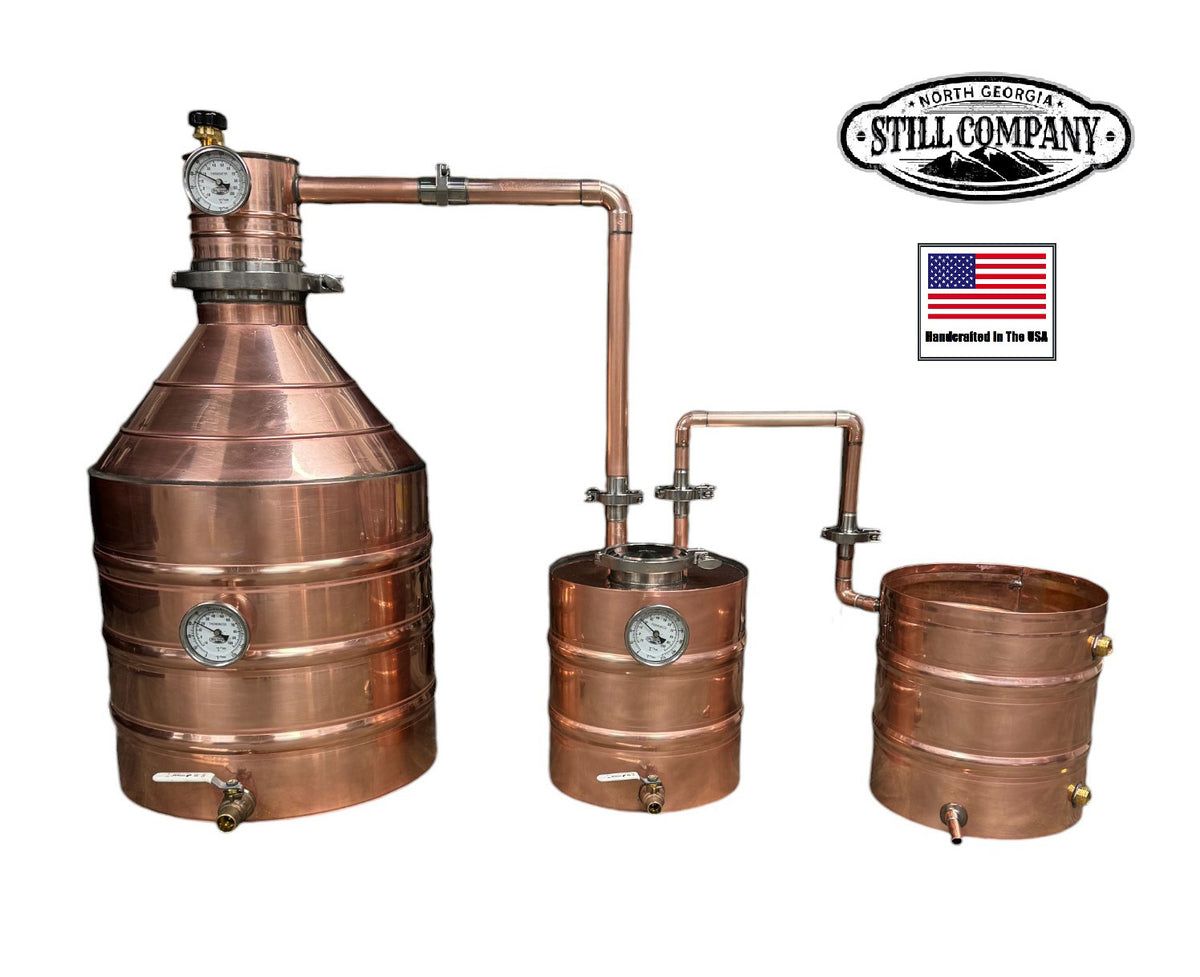
7.1.3.1 The recommended pick — North Georgia Still Company 20-Gallon Distillers Kit ($2,139)
- Vendor: North Georgia Still Company (Dahlonega, GA, USA) —
https://north-georgia-still-company.myshopify.com/products/20-gallon-distillers-kit - Price: $2,139 with free shipping (consistent)
- Capacity: 20-gallon still + 5-gallon thumper + 5-gallon worm
- Construction: 20 oz / 22-gauge copper throughout — same grade as the Vol 3/4/6 NG Still kits at smaller scales
- Dimensions: Still 18.5” diameter × 35” tall; thumper 11.5” × 12”; worm 11.5” × 12” with 15 ft copper coil
- Includes: 3/4” ball valve drain on still, temperature gauge, tri-clamp cap, lyne arm, 4” fruit port on thumper with 1/2” ball valve drain, three thermometers, submersible water pump, 10 ft clear vinyl tubing
- Heating element NOT included — at 20-gal scale, recommended is a 5500W internal element (Camco screw-in or equivalent) with PID controller, OR a propane burner if you prefer traditional direct fire
- Lead time: 1–2 days additional on standard processing; electric system installations need 4–6 weeks if ordered through NG Still
- Output: 2–4 gallons of finished spirit from 10–20% ABV wash (per NG Still’s spec)
Why this is the natural Tier-5 whiskey pick for NG Still upgraders:
This is the same construction philosophy, same builder, same operating characteristics as the Vol 3 D3 5-gal, Vol 4 Path C 15-gal, and Vol 6 Path C 7.5-gal kits. If you’ve used any of those, the 20-gallon is the production-scale extension of skills you already have. Whiskey character is the same; volume is meaningfully higher.
Trade-offs vs. other Tier-5 whiskey options:
- No upgrade path to neutral mode — if you ever want to make vodka at Tier-5 scale, you’d need to build a separate neutral rig; this 20-gal kit is whiskey-only by design
- 5-gallon thumper is fixed in the configuration — not removable for column experimentation
- Stainless steel screw-in element threads — when you install the heating element, the kettle penetration is stainless even if the rest is copper; this is acceptable (the stainless contact area is small, well below the wash level, and doesn’t significantly affect character)
7.1.3.2 The alternative — OakStills 26-Gallon Jacketed Copper Pot Still ($2,499 entry, more for upgrades)
- Vendor: OakStills (Canada/US) —
https://oakstills.com/products/26-gallon-jacketed-copper-pot-still-whiskey-moonshine-distillery - Price: $2,499.95 for 4”-column entry configuration; higher for larger column diameters and additional features
- Capacity: 26 gallon (100 L) — slightly larger than NG Still 20-gal
- Construction: full-copper pot still with jacketed kettle design (allows steam heating or thermal-fluid heating in addition to electric)
- Includes: copper boiler with jacket, 4” pot-still head with onion dome, fittings — column and condenser sold separately at typical configurations
- Heating: jacket allows for steam (commercial-style indirect heat), oil-jacket (smooth controlled heat), or direct electric internal element
- Country of origin: Canadian manufacturing for OakStills core products
- Lead time: published 4–8 weeks for larger items
Why consider OakStills for a Tier-5 whiskey build:
- Jacketed design is the closest the hobbyist market comes to commercial-distillery construction. Steam jackets allow precise, scorch-free heat distribution along the boiler walls — the same heating approach used in TTB-licensed craft distilleries.
- Onion dome preserves vapor character — a wider lyne-arm-to-condenser transition that’s the traditional Scotch/Irish whiskey design choice
- Modular configuration — you specify column diameter (4” entry, 6”+ optional) and condenser type when ordering
- Larger capacity (26 gal vs NG Still’s 20 gal) — slightly more spirit per run, slightly more wash to manage
Trade-offs vs. NG Still 20-gal:
- More expensive ($2,499+ vs $2,139)
- More configuration choices to make — first-time Tier-5 buyers find OakStills’ modular options harder to navigate than NG Still’s pre-assembled kit
- Longer lead time (4–8 weeks vs ~1 week for NG Still)
- Jacket complexity — if you don’t use steam or jacketed-oil heating, the jacket is dead weight; the value is conditional on your willingness to invest in the heating infrastructure
7.1.3.3 The Hillbilly Stills option
Hillbilly Stills (https://www.hillbillystills.com/) sells 26-gallon pot stills with their “No.1 copper and only lead-free solder” construction. Pricing is not consistently published online — phone for a current quote (270-978-7068). Their reputation is strong in the craft-whiskey community; typical pricing for a complete 26-gal pot-still kit lands in the $2,000–$3,500 range depending on configuration and accessories. Worth a quote call if you’re committed to a Tier-5 whiskey rig and want to compare against NG Still and OakStills.
7.1.4 The Neutral-Spirit-Dedicated Build
The standard Tier-5 neutral-spirit-dedicated build:
7.1.4.1 The recommended pick — StillDragon 25-Gallon Modular Build ($4,000–$8,000+)
- Vendor: StillDragon (Sebastian, FL, USA) —
https://stilldragon.com/ - Kettle: StillDragon 25-gallon (100L) DoubleDragon kettle with Electric Element Jacket (SKU DD25EJA —
https://stilldragon.com/product/25g-doubledragon-kettle-electric-jacketed/) - Column: 4” multi-plate bubble column (typically 8 plates for neutral-spirit work), with full-size dephlegmator (DE4L Long version)
- Pricing: quote-based (StillDragon does not publish list prices for most components); typical Tier-5 dedicated neutral build lands $4,000–$8,000 depending on plate count, dephlegmator efficiency, and ancillary components
- Heating: electric jacket on kettle (built into the DD25EJA); separate PID controller
- Lead time: 4–8 weeks for assembled builds; faster if components are in stock
Why StillDragon for a Tier-5 neutral build:
- Commercial-distillery component quality at hobby scale — same engineering used in production TTB distilleries
- Modular plate count lets you tune for vodka (8 plates for maximum rectification) or gin (4 plates for botanical-friendly rectification)
- Active reflux control via dephlegmator — exactly what neutral-spirit production needs
- Tri-clamp standard throughout — components from a Tier-5 build remain compatible with future Tier-6 expansion
- Active forum (
stilldragon.org) has thousands of build threads at this scale; you’re not solving problems alone
Trade-offs:
- Quote-based pricing means budgeting requires direct communication with StillDragon. Don’t assume you can plan a build from public-facing information alone.
- Multi-component shipping — different parts arrive on different days
- Configuration overwhelm is real at Tier-5 scale; budget 4–8 hours of research and forum-conversation before committing to a build sheet
7.1.4.2 The alternative — Brewhaus 15-Gallon Complete Flute System ($1,599–$2,500)
- Vendor: Brewhaus America (Fort Worth, TX, USA) —
https://brewhaus.com/ - Product: 15-Gallon Complete Flute Moonshine Still with Copper Bubble Plates (6-section column) —
https://brewhaus.com/product/15-gallon-4-complete-flute-moonshine-still-with-copper-bubble-plates-6-section/ - Price: $1,599 sale / $2,500 list (sale price is reliable)
- Capacity: 15-gallon stainless kettle (slightly smaller than the StillDragon 25-gal pick)
- Configuration: 4” diameter, 6 sections each containing a copper bubble plate (6 plates total)
- Includes: kettle, 6-section sight-glass column with plates, dephlegmator, condenser, parrot, tri-clamps, hoses, pump
- Heating element separate
- Lead time: 1–5 business days
Why this is the budget Tier-5 neutral pick:
- 6 bubble plates with sight glasses = excellent rectification AND visual feedback during runs
- Plates removable for pot mode (but that’s outside the dedicated-neutral use case — if you want dual-mode, see Vol 6 Tier-4)
- Half the cost of the StillDragon build for similar functional capability at slightly smaller capacity
- Brewhaus US support (817-750-2739)
Trade-offs vs. StillDragon Path:
- 15-gal kettle is smaller than 25-gal StillDragon (less output per run, more runs per year for same total volume)
- Imported bubble plates (sourced from overseas; column hardware US-assembled)
- No upgrade path beyond ~95% ABV because the column is 6-plate-fixed; StillDragon lets you add plates later
7.1.4.3 Mile Hi Distilling — 25-Gallon Plate Column ($2,500–$4,000)
- Vendor: Mile Hi Distilling (Denver, CO, USA) —
https://milehidistilling.com/ - Product: Mile Hi flute stills at 15+ gallon scales (the 53-gal 8” Mile Hi Flute from earlier search results is one variant; 25-gal versions exist in their catalog)
- Price: approximately $2,500–$4,000 depending on configuration; not all configurations are listed with public pricing
- Capacity: 15, 25, 53 gallon options
- Configuration: copper bubble plates in stainless sight-glass column with dephlegmator
- Includes: kettle, column, dephlegmator, condenser, parrot, hoses
- Heating element separate (Mile Hi sells matching elements and controllers)
- Country of origin: Denver, CO
Why consider Mile Hi:
- Mid-tier US vendor between Brewhaus and StillDragon in cost and configurability
- YouTube channel with extensive setup and run videos at this scale — excellent learning resource
- Active community at homedistiller.org references Mile Hi rigs frequently in production-cadence discussions
7.1.5 The Mash Tun Setup
At Tier-1–4 scale, you could ferment in a 6–10 gallon plastic bucket or carboy with minimal infrastructure. At Tier-5 scale (15–25 gallon ferments), you need real fermentation and mash infrastructure.
7.1.5.1 What a mash tun does (and why you need a dedicated one at Tier-5)
For all-grain whiskey or grain-based vodka, you’re processing 15–40+ pounds of grain per batch. The mash tun is the vessel where:
- Mashing — grain is mixed with hot water at controlled temperatures (typically 148–158°F / 64–70°C for ~60 min) to convert starches to fermentable sugars via the grain’s natural enzymes
- Lautering — the converted wort is separated from the spent grain (the “grain bed”) via a false bottom or screen
- Sparging — additional hot water is rinsed through the grain bed to extract remaining sugars before the wash heads to the fermenter
At Tier-1–4 scales, you can mash in your kettle (single-vessel approach, simpler but less efficient). At Tier-5 scale with 15–25 lb grain bills, a dedicated insulated mash tun with a false bottom is the standard upgrade.
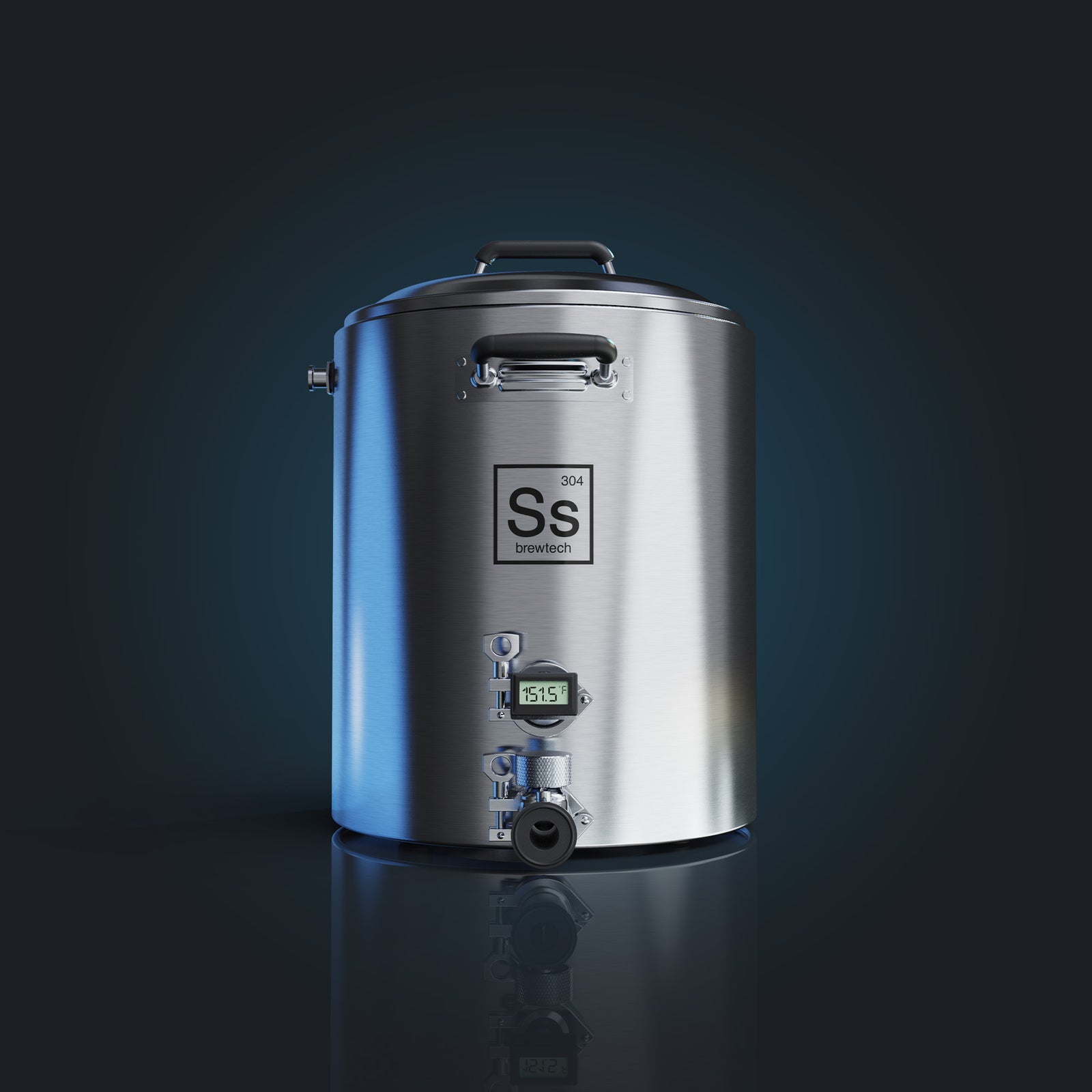
7.1.5.2 SS Brewtech 20-Gallon InfuSsion Mash Tun ($550–$750)
- Vendor: SS Brewtech —
https://www.ssbrewtech.com/collections/mash-tuns/20-gallon - Price: approximately $550–$750 (varies by retailer; KegOutlet, Homebrew Supply, and HBYOB all carry)
- Capacity: 20 gallon
- Construction: dual-wall foam-insulated 304 stainless steel
- Features: integrated 5° sloped bottom with center drain port (for vorlauf and transfer), gasketed false bottom with silicone gasket, precision LCD thermometer with thermowell, three-piece sanitary ball valve, foam-insulated lid, internal volume markings in both liters and gallons
- Insulation: drops only ~5°F across a 60-minute mash (vs. ~15°F for an uninsulated plastic cooler conversion)
Why this is the standard Tier-5 mash tun:
- Insulated — holds mash temperature steady without external heat input during the 60-minute conversion
- Center drain with slope — proper vorlauf (recirculation to clear the wort) and clean transfer to fermenter
- Gasketed false bottom — repeatable, doesn’t shift during mashing
- Built-in LCD thermometer — no separate temperature probe required
- Stainless construction — sanitary, durable, easy to clean (vs. plastic cooler conversions that build up sugar residue and harbor bacteria)
- Compatible with all standard sparge approaches — fly sparge, batch sparge, or no-sparge as you prefer
7.1.5.3 The full three-vessel approach: Spike Trio 20-Gallon ($2,500–$3,500)
- Vendor: Spike Brewing —
https://spikebrewing.com/products/spike-system-20-gallon - Price: approximately $2,500–$3,500 for the complete Trio system
- Capacity: 20 gallon per vessel
- Configuration: dedicated HLT (Hot Liquor Tank) + Mash Tun + Boil Kettle — three matched vessels
- System type: electric HERMS (Heat Exchange Recirculating Mash System) — a heat exchanger inside the HLT heats the mash tun via recirculating wort flow, giving precise mash temperature control and preventing scorching of grain at the heating element
- Features: pre-plumbed for pump transfers, sanitary fittings throughout, electric heating with PID control
Why the full three-vessel system at Tier-5:
- Heat-exchanger mash heating is the commercial-craft-distillery standard — precise temperature control across the full mash without scorching
- Dedicated HLT provides controlled-temperature sparge water on demand (vs. heating sparge water separately in the kettle when you’d rather be cleaning between mash and run)
- Matched vessel sizing means easier integration, pre-engineered pump runs, and consistent ergonomics
- Production-cadence-friendly — you can mash today, sparge tomorrow morning, ferment in a separate vessel, and mash again before the previous batch is done fermenting
Trade-offs vs. single-vessel mash tun + separate HLT:
- 3–5× the cost of just the SS Brewtech mash tun
- More floor space required — three vessels need their own footprints plus pump runs between them
- Recommended only if you’re doing all-grain mashes regularly — sugar-wash or molasses-wash distilling doesn’t need a mash tun at all; investing in a Trio for that use case is overkill
7.1.5.4 Sugar-wash and molasses-wash exception
If your Tier-5 production is dedicated to sugar-wash neutral spirit, rum (molasses), or any wash that doesn’t require grain conversion, you don’t need a mash tun at all. You ferment sugar/molasses directly in fermenters, then distill from fermenter to kettle. The mash-tun discussion above applies specifically to whiskey, all-grain vodka, or any grain-based spirit category.
For sugar-wash and molasses-wash Tier-5: skip §7.5.2/7.5.3, use a dedicated 25–30 gallon fermenter (Speidel plastic or stainless conical), and pump directly from fermenter to still kettle.
7.1.6 Pump Transfers
At 15–25 gallon volumes, gravity transfers between vessels are impractical. A 20-gallon kettle of hot wash weighs ~165 lb; lifting it to pour into a fermenter is physically dangerous and operationally clumsy. Pump transfers become standard.
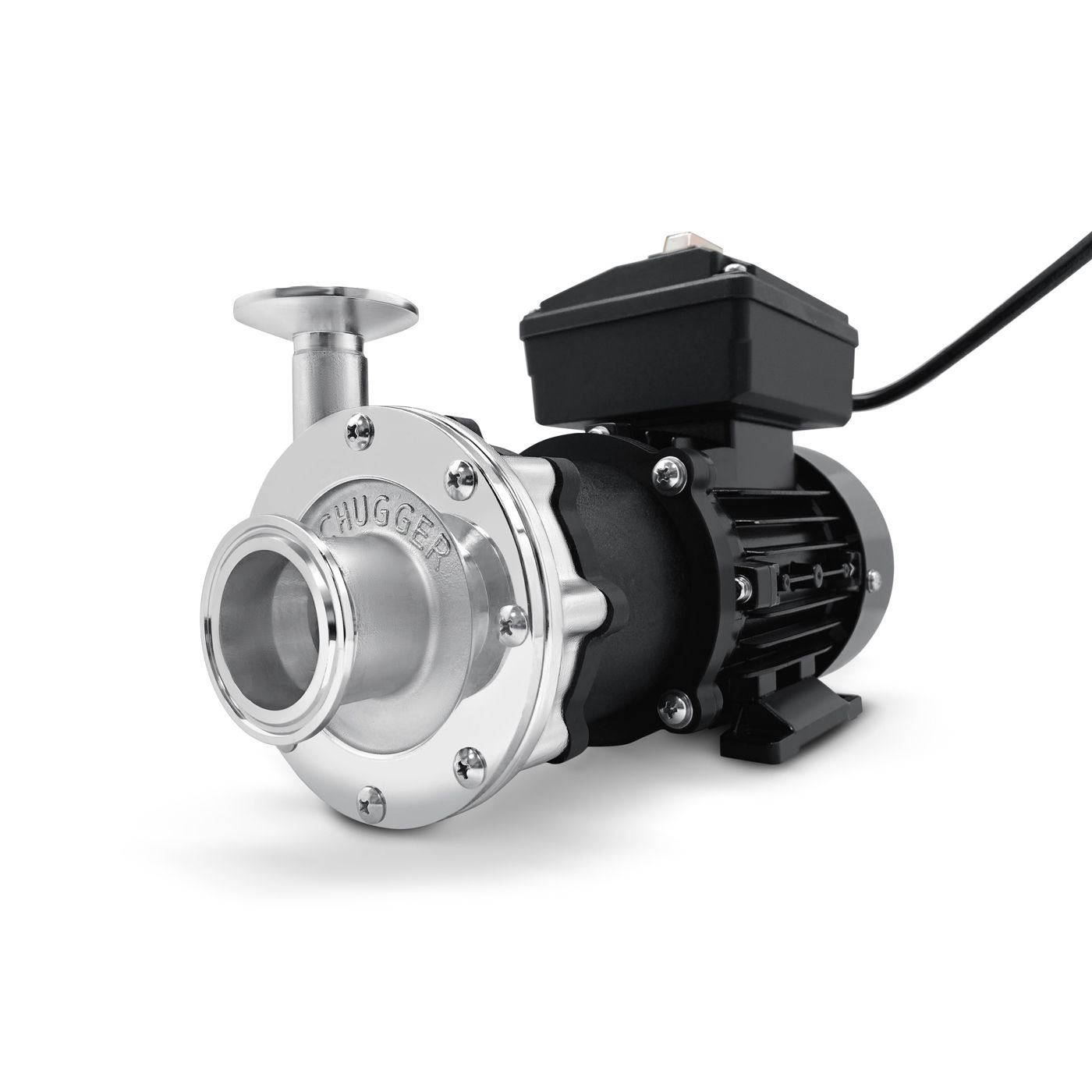
7.1.6.1 The Chugger pump ($90–$150)
- The home-distilling community’s standard sanitary pump
- Magnetic-drive centrifugal pump rated for food-contact and hot liquids (up to ~250°F)
- 1/2” or 3/4” inlet/outlet options; tri-clamp fittings available
- Materials: polypropylene or stainless steel head; stainless steel center boss; sealed magnetic coupling (no shaft seal to fail)
- Power: 120V AC, ~120W
- Flow rate: ~7 GPM at zero head; less under realistic plumbing resistance
Why Chugger is the standard hobbyist Tier-5 pump:
- Magnetic drive eliminates shaft seals — the most common pump-failure mode is removed entirely
- Food-grade rated — safe for direct wash, mash, or wort contact
- Affordable — $90–$150 puts it within reach of any Tier-5 build budget
- Drop-in compatible with sanitary tri-clamp plumbing standards
- Same pump used by tens of thousands of homebrewers — known failure modes, well-supported on forums
7.1.6.2 Blichmann Riptide ($250–$350)
- Variable-speed sanitary pump with built-in flow control
- Stainless steel construction throughout
- Self-priming (a real advantage over the Chugger, which is gravity-prime)
- Higher cost; higher build quality; longer expected lifespan
- Brewing/distilling industry standard for serious hobbyist and small-craft applications
7.1.6.3 Pump plumbing standards
At Tier-5, pump plumbing should be:
- Sanitary tri-clamp fittings throughout — same standard as the still itself
- 1/2” or 3/4” inner diameter silicone hose between vessels, sized appropriately for the pump
- Quick-disconnect tri-clamp connections at each vessel — disconnect and reconnect during cleaning without breaking sealed plumbing
- Inline strainer before the pump inlet — protects the pump from hop debris, grain particles, or wash sediment
- Three-way valve on the pump outlet — allows you to direct flow to either the destination vessel or back to the source (for vorlauf recirculation during mashing)
7.1.6.4 Hot transfer safety
Pump transfers at distillation scale involve hot liquids (90–212°F). Safety basics:
- PPE: chemical-resistant gloves rated for hot fluids; long-sleeve clothing; closed-toe shoes
- Hose routing: keep hose runs short and well-supported — a heated 6-foot silicone hose at full flow will whip if not anchored
- GFCI on pump power — wet environment + 120V pump motor is the standard electrical-shock failure path
- Containment: plan for the worst case (a hose disconnects mid-transfer) — have a containment plan for the contents of the source vessel
7.1.7 Workshop Infrastructure
A Tier-5 dedicated rig is no longer a kitchen-counter or basement-shelf operation. It needs dedicated workshop infrastructure.
7.1.7.1 Electrical
- Dedicated 50A 240V subpanel is the right approach — supports a 5500–9000W still element, a separate brewing/heating circuit for the HLT or mash tun, pump motors on 20A 120V circuits, lighting, and headroom for future upgrades
- GFCI protection on every wet-environment circuit (still, pumps, mash tun heating, lighting)
- Dedicated 30A 240V outlet at the still location for the heating element
- Dedicated 20A 120V outlets at the pump, mash tun, fermenter locations
- Run by a licensed electrician unless you’re certified yourself; non-DIY territory for safety and insurance reasons
7.1.7.2 Water
- Dedicated cold-water supply line to the still location with shut-off valve at the wall — separate from any kitchen or bathroom plumbing that might compete for water during a long run
- Recirculating chiller OR continuous cold-water supply — at Tier-5 scale, a typical spirit run uses 30–80 gallons of cooling water. A 30-gallon recirculating reservoir with a small chiller is more practical than continuously flowing tap water in most workshops.
- Drain — a floor drain or large utility sink at the workshop location for backset disposal, equipment rinse-water, and spill containment
- Hose bibs with quick-disconnects at multiple points
7.1.7.3 Ventilation
- Exhaust fan rated for the workshop volume — ethanol vapor and water vapor from stripping runs accumulates indoors and creates both an explosion hazard (rare at typical hobbyist concentrations but real) and a comfort/visibility issue
- Direct vent if possible — a 6” or 8” duct from the workshop to outdoors, with a fan rated for the duct length and bends
- CO detector if you’re using propane burner heat — natural gas or propane combustion in an enclosed space requires a working CO detector and well-functioning exhaust
7.1.7.4 Layout
- U-shape or L-shape typical for Tier-5 workspaces — mash/sparge area, fermentation area, still area arranged for natural workflow with pump runs between them
- Floor space: plan for 100–200 sq ft of dedicated workshop area for a complete Tier-5 setup
- Ceiling height: 8+ ft minimum; 10+ ft preferable if you’re running a tall plate column for neutral spirit production
- Storage for ingredients, packaging, and aging vessels (if you’re barrel-aging whiskey, allocate dedicated rack space for barrels — see Vol 8)
7.1.7.5 Insurance and risk management
- Notify your home or renters insurance carrier about the workshop and its uses — many policies have exclusions for “manufacturing” activities that include hobby distillation. Confirm coverage in writing.
- Fire suppression beyond a single ABC extinguisher — at Tier-5 scale, consider a dedicated 10-lb ABC unit in the workshop, plus a fire blanket near the still
- Detection: smoke detector, heat detector, and CO detector all wired or networked
7.1.8 The Tier-5 Costed BOM
Table 1 — 7.8 The Tier-5 Costed BOM
| Item | Whiskey-dedicated path (NG Still 20-gal) | Neutral-dedicated path (StillDragon 25-gal) |
|---|---|---|
| Still | $2,139 (NG Still 20-gal kit) | $4,000–$8,000 (StillDragon 25-gal modular) |
| Heating element + controller | $300 (5500W internal + PID) | included in StillDragon DD25EJA (electric jacket) + $150 PID |
| Mash tun (if grain-based) | $550 (SS Brewtech 20-gal) or $2,500 (Spike Trio) | $0 if sugar/molasses wash; $550–$2,500 if grain-based |
| Pumps + plumbing | $200 (1× Chugger + tri-clamp fittings + hose) | $200 (same) |
| Fermenter | $400 (25-gal Speidel stainless conical) | $400 (same) |
| Workshop electrical (one-time) | $1,500–$3,000 (50A subpanel + circuits, electrician) | same |
| Workshop water/drainage (one-time) | $500–$1,500 if not already present | same |
| Recirculating chiller | $400 (Penguin Chillers small recirculator) | $400 (same) |
| Cooling water reservoir | $150 (30-gal HDPE drum + plumbing) | $150 (same) |
| Parrot + alcoholmeter + hydrometer | $120 | $120 |
| Thermometers + temperature monitoring | $100 | $100 |
| Carbon polish equipment (neutral only) | n/a | $150 (carbon column + carbon) |
| Wash recipe ingredients (per batch) | $50–$150 (grain bill + yeast + nutrients) | $30 (sugar + yeast + nutrients) |
| Safety equipment | $150 (extinguisher, detectors, PPE) | $150 (same) |
| Subtotal — first complete Tier-5 setup | $6,559–$10,609 | $6,250–$11,070 |
Notes:
- Workshop infrastructure ($1,500–$4,500) is the wildcard — if your workshop is already set up for brewing or another shop activity with 240V power and water/drain, you can skip much of this. If you’re starting from a bare garage or basement, plan for the full cost.
- Running both a whiskey-dedicated AND a neutral-dedicated rig is roughly the sum of both column above ($13,000–$22,000), but the workshop infrastructure is shared and several components (mash tun, pumps, fermenters, chillers) can be shared between the two rigs. Realistic dual-Tier-5 total: $14,000–$18,000.
- First-year recurring costs (ingredients, gaskets, replacement column packing, propane if applicable, etc.) typically $500–$1,500/year depending on production volume.
7.1.9 The Production-Cadence Workflow
Tier-5 enables a scheduled production cadence rather than the “I’ll run a batch when I have time” approach of lower tiers. A typical whiskey-dedicated Tier-5 production schedule:
7.1.9.1 The bi-weekly cadence
Week 1:
- Saturday morning: mash + sparge (20 lb grain bill → ~15 gal of 1.060 wort)
- Saturday afternoon: pitch yeast in fermenter
- Sunday–Friday: fermentation (sugar-wash variants ferment faster; all-grain typically 7–10 days)
Week 2:
- Saturday morning: stripping run (15 gal wash → ~5 gal of 30% ABV low-wine) [4 hours]
- Saturday afternoon: clean stripping equipment; transfer low-wine to storage
- Sunday: spirit run on accumulated low-wines from 2–3 stripping batches → 4–8 L of finished spirit [6–8 hours]
- Sunday evening: dilute to barrel-entry proof (~63% ABV); transfer to barrel for aging
Repeat.
7.1.9.2 The throughput math
A bi-weekly cadence at this scale:
- 13 spirit runs per year
- 50–100 L of finished whiskey per year (post-dilution)
- After aging losses (~5%/year for small barrels), 45–95 L of aged whiskey per year available for bottling/gifting
- A 5-gallon (19 L) barrel takes 2–3 production cycles to fill; once filled, ages for 1–4 years
This is enough to maintain 4–6 active aging barrels at various ages, with 1–2 barrels being bottled each year and 1–2 freshly filled. The math works for personal use, gifting, and tasting experimentation but not for commercial volume (which is Tier-6 territory).
7.1.9.3 The discipline of batch tracking
At Tier-5 production scale, batch tracking becomes essential. The information you want to capture per batch:
- Batch number (sequential within the year, e.g., 2026-W12 for the 12th whiskey batch of 2026)
- Wash recipe (grain bill, mash schedule, yeast strain, fermentation temperature, total ferment time)
- Stripping run data (kettle charge, total run time, low-wine output volume and ABV)
- Spirit run data (combined low-wine input, run time, foreshots/heads/hearts/tails volumes and ABV at each transition, anomalies observed)
- Cuts notes (smell/taste markers at each transition, any back-cutting decisions)
- Post-distillation disposition (which barrel, what date, fill ABV, expected disgorge date)
A simple spreadsheet works for the first year. Beyond that, dedicated brewery/distillery software (BeerSmith for the brewing side, Spreadsheet of your design or commercial distillery management software for the distilling side) is worth the investment. The point is: at Tier-5 you’re producing enough volume that “I’ll remember what I did” stops being viable.
7.1.10 Legal Posture at Tier-5 Scale
This is where the federal felony exposure shifts from “technically true but unlikely enforced” to “genuinely visible to federal enforcement if observed.”
7.1.10.1 The relevant US federal law
26 U.S.C. § 5602: Distilling beverage alcohol without a Distilled Spirits Plant (DSP) permit is a federal felony, punishable by up to 5 years imprisonment and $10,000 fines per occurrence.
26 U.S.C. § 5179: Stills must be registered with the TTB (Alcohol and Tobacco Tax and Trade Bureau), with limited exceptions for non-beverage uses (essential oil distillation, water distillation, etc.)
26 U.S.C. § 5601: Operating an unregistered still is itself a felony, even if you never distill beverage alcohol — the existence of the unregistered still is the violation.
These laws apply regardless of quantity or whether you sell the product. The TTB does not enforce a “personal use” exemption for distilled spirits; this is different from beer (1 person can produce up to 100 gal/year; 2+ adults up to 200 gal/year) and wine (similar exemption).
7.1.10.2 The enforcement reality
At Tier-1 (kitchen stovetop) and Tier-2 (bench rig), federal enforcement is essentially nonexistent unless you’re (a) caught in the act by someone who reports you, (b) doing something else illegal that triggers a search, or (c) trying to sell the product (which is when TTB and state ABC enforcement actually engages). Thousands of hobbyists operate Tier-1–2 setups indefinitely without consequences.
At Tier-5 (15–25 gal production cadence), enforcement risk shifts in three ways:
- Volume is visible. A 25-gallon copper still in your garage is not a kitchen appliance. Anyone who sees it — utility worker, plumber, neighbor through an open garage door, contractor doing other work — may report it. The probability of observation is non-trivial across a multi-year hobby.
- Production-cadence creates more evidence. Regular bi-weekly grain purchases, regular spirit output, regular bottle storage. Trash audits (yes, this is a thing) reveal grain bags and fermenter cleanings.
- You may have something worth taking. Federal forfeiture law allows seizure of all equipment and aged spirit upon conviction. At Tier-5 scale with multiple aging barrels, that’s $20,000+ in equipment and product. The enforcement incentive shifts.
7.1.10.3 The state-by-state landscape (US)
State laws vary significantly:
- Federally legal: none — federal law preempts. Distilling beverage alcohol without a federal DSP permit is a federal felony in all 50 states.
- State-only-legal for personal use (varies): a handful of states (Missouri, for example) have removed state-level penalties for small-scale personal use, but federal law still applies. State-only protection is meaningless if federal authorities observe.
- Decriminalized states (some): small-scale personal distillation has been decriminalized at the state level but remains a federal felony
- Strictly enforced states: several states actively enforce state moonshine laws independently of federal action
This is not legal advice — consult a lawyer in your jurisdiction if you’re considering operating at any scale. The clearest path to legal Tier-5 distillation is obtaining a federal DSP permit (the topic of Vol 8 §8.X). For Tier-5 hobbyist operation in any US jurisdiction, you’re accepting genuine legal risk.
7.1.10.4 International posture
- New Zealand: fully legal for personal use at any reasonable hobby scale
- Several EU countries: legal with quantity caps (typically 50 L of pure alcohol per year for personal use)
- United Kingdom: illegal without a license
- Australia: legal for ownership of stills under 5 L; larger stills require a license
If you’re in a jurisdiction where Tier-5 personal distillation is legal, the legal-posture section is moot for you. If you’re in the US: understand the federal felony exposure before scaling up.
7.1.10.5 The discretion practice
For US Tier-5 operators not pursuing a DSP:
- Workshop discretion — don’t display the still where casual observers can see it
- Trash discretion — don’t put grain bags or fermenter cleanings in curbside trash; compost or dispose privately
- Social discretion — distinguish between “I’m into home brewing” (uncontroversial) and “I’m distilling whiskey” (federal felony admission); the former is what you discuss
- Sales discretion — never sell, never trade for value, never advertise. Sales is what triggers active TTB enforcement.
- Online discretion — don’t post photos of your operation on social media; don’t discuss specifics in identifiable public forums
These are operational realities of hobbyist distillation in the US. The cleanest path to peace of mind is Vol 8’s TTB DSP licensing track — making it legal rather than discreet.
7.1.11 Common Tier-5 Pitfalls
1. Scaling up wash recipes without proportional yeast and nutrient adjustment. A 5-gal sugar-wash recipe that fermented out cleanly may stall when scaled to 20 gal — yeast quantity, nutrient supplementation, and fermentation-temperature control all need to scale. Prevention: use a yeast calculator; pitch 1 packet of EC-1118 per 5 gallons; double the nutrient dose proportionally.
2. Heating element burnout from grain settling. All-grain washes leave settled grain on the kettle bottom that scorches onto the heating element during distillation. Prevention: either (a) use a separate brewing kettle for the boil so the wash reaches the still kettle clear, or (b) install a grain screen above the element, or (c) accept it and budget for element replacement every 10–20 runs.
3. Cross-contamination between dedicated whiskey and dedicated neutral rigs (if you run both). Even with separate dedicated equipment, shared workshop space and shared cleaning supplies can introduce trace cross-contamination. Prevention: dedicated cleaning supplies and tools per rig; physical separation in the workshop; never use the same hose, gasket, or brush between rigs.
4. Pump priming failures. Centrifugal pumps (Chugger, generic) need to be primed before use — they don’t pump air. Prevention: always fill the pump inlet line before energizing; if the pump runs dry, it’ll cavitate, overheat, and potentially burn out. Self-priming pumps (Blichmann Riptide) eliminate this failure mode.
5. Cooling water overheating during long runs. A 30-gallon cooling reservoir can heat to ineffective temperatures (>80°F) during a 6–8 hour spirit run. Prevention: recirculating chiller; or supplement with ice every 2–3 hours; or use a continuous cold-water supply with drain.
6. Insufficient electrical capacity at full operation. Running the still (5500W) + pump (120W) + mash tun heating (~3000W if used) + workshop lighting (~200W) + ventilation fan (~150W) can easily exceed a household 50A subpanel’s headroom if not planned. Prevention: electrician-sized subpanel and circuit planning; load-balance high-draw items to not run simultaneously.
7. Barrel-aging contamination from poor sanitation. Tier-5 whiskey production typically goes into aging barrels. A 5-gal oak barrel contaminated with bacteria from sloppy sanitation can ruin the entire batch over months of aging. Prevention: sulfite-rinse barrels before filling; never fill a barrel that’s been dry for more than a few weeks without re-conditioning; track storage temperature.
8. Production-cadence burnout. The bi-weekly schedule sounds sustainable until you’re 6 months in and tired of every-Saturday-and-Sunday distilling commitment. Prevention: be honest with yourself about production goals; don’t over-build production cadence beyond what’s enjoyable; the hobby should be sustainable, not exhausting.
9. Legal posture creep. You start with personal-use intent at Tier-5; you build up a stockpile; friends start asking for bottles; someone offers cash; suddenly you’re “selling small amounts to friends” and your legal posture has shifted from felony-with-low-enforcement-risk to felony-with-active-enforcement-target. Prevention: never accept money or trade-of-value for spirit; gifting only; if friends pressure you, the answer is “no, get a bottle from the store.”
10. The same Tier-2/3/4 electrical and fire hazards apply, at larger scale. GFCI, proper grounding, fire suppression, never run unattended. The hazards don’t decrease with experience; they multiply with batch size.
7.1.12 Where Tier-5 Leaves You; What Tier-6 Adds
A well-run Tier-5 dedicated whiskey rig produces 50–100+ L of finished whiskey per year, supporting 4–6 active aging barrels at various ages. A well-run Tier-5 dedicated neutral rig produces 30–80 L of finished neutral spirit per year for vodka, gin, or infusion bases. Combined, a dual-Tier-5 operator (one of each rig) produces serious volume by hobbyist standards.
Tier-5’s natural limits:
- Volume ceiling: ~150–200 L/year of finished spirit total across all rigs — significant by hobbyist standards but still well below the threshold where commercial economics make sense
- Legal ceiling: federal felony posture remains regardless of production discretion; the path to legal volume operation is licensing
- Time investment: bi-weekly production cadence is sustainable for many, but it’s a significant ongoing commitment
- Output is still a hobby, not income. Even at maximum Tier-5 cadence, you’re producing volume worth (at retail equivalent) a few thousand dollars per year — meaningful as gifts and personal use, immaterial as income.
Vol 8 (Tier-6) addresses the small craft distillery floor:
- 50–500+ gallon batch capacity
- Steam-jacketed kettles, automated controls, commercial cooling infrastructure
- TTB DSP licensing (the federal Distilled Spirits Plant permit) — making it legal
- State distillery licensing and zoning
- Bottling, labeling, and federal label approval (COLA)
- Commercial insurance, accounting, and tax compliance (federal excise tax on distilled spirits is $13.50/proof-gallon for the first 100,000 proof-gallons annually)
- The business question: hobby-to-commercial transition economics, breakeven analysis, the realistic path from Tier-5 enthusiast to small craft distillery
Vol 8 is the bridge between this volume’s “operating at production scale but illegally” and “operating at commercial scale and legally.”
End of Vol 7. Next: Vol 8 — Tier-6 Small Craft Distillery Floor + TTB DSP Licensing.
Comments (0)