Distilling · Volume 8
Vol 8 — The Tier-6 Small Craft Distillery: Equipment, TTB Licensing, and the Commercial Path
Phase 3 — Final volume in the Distilling deep-dive series. Tier-6 is the bridge from hobbyist to commercial. Unlike Vols 4–7 (which focused on equipment progression at hobbyist scale), Vol 8 focuses on the legal, regulatory, and business reality of operating a small craft distillery legitimately. We cover the commercial equipment landscape (50–500+ gallon professional craft floors from Vendome, StillDragon Commercial, Specific Mechanical, Christian Carl, Forsyths, iStill), the federal TTB Distilled Spirits Plant (DSP) licensing process in detail, state and local licensing, site selection and build-out, federal Certificate of Label Approval (COLA), federal excise tax compliance under the Craft Beverage Modernization Act (CBMA), commercial insurance and bonding, and the realistic economics of the hobby-to-commercial transition. This volume is the bridge between “operating at production scale but illegally” (Vols 4–7’s reality for most US hobbyists) and “operating at commercial scale and legally.”
Legal disclaimer: This volume is educational content based on publicly available TTB and CBMA information as of late 2025. It is not legal advice. Licensing requirements, tax rates, regulations, and procedures change. Before pursuing a DSP permit or making business commitments, consult a qualified alcohol-beverage attorney and a CPA experienced with distillery operations.
8.1.1 What Tier-6 Means: A Different Kind of Upgrade
Tiers 1–5 were equipment progressions: bigger kettles, better columns, more sophisticated controls. Each tier represented a hardware investment with clear capability gains. Tier-6 is not primarily an equipment upgrade. It’s a legal-status upgrade that happens to require commercial-scale equipment to make economic sense.
The Tier-6 small craft distillery is defined by:
- Legal status: federally licensed Distilled Spirits Plant (DSP), state distillery license, local zoning compliance — the spirit you produce can be sold legally
- Scale: 50–500+ US gallon batch capacity per still; daily production capability rather than weekend-batch hobbyist cadence
- Equipment cost: $50,000–$400,000 for the still equipment alone; $150,000–$2,500,000 for complete distillery startup
- Time horizon: 12–36 month transition from hobby to operational distillery; 3–7 years to profitability for aged-spirit producers
- Skill prerequisites: all of Vols 1–7 plus business operations, regulatory compliance, marketing, and the willingness to operate as a business owner rather than a hobbyist
8.1.1.1 What makes Tier-6 categorically different
At Tiers 1–5, you operate as a hobbyist — the federal felony exposure (26 U.S.C. § 5602) is real but unenforced for most personal-use operators. Your output is for personal use and gifting. The legal posture is “discretion” (Vol 7 §7.10).
At Tier-6, you operate as a regulated commercial producer:
- You hold a federal DSP permit issued by the Treasury Department’s Alcohol and Tobacco Tax and Trade Bureau (TTB)
- Your equipment is registered with TTB; your production volume is reported quarterly; you pay federal excise tax on every proof-gallon removed for sale
- Your products carry TTB-approved labels (COLAs) and you ship in interstate commerce legally
- You hold a state distillery license, comply with state-specific labeling and distribution requirements, and remit state excise taxes
- You operate from premises that are zoned for distillery use and that meet building, fire, and safety codes for the volume of flammable alcohol you store
- You can legally sell your spirit — directly through a tasting room (where state law permits), through distributors (the standard three-tier alcohol distribution model in most US states), and online to customers in compliant states
8.1.1.2 What stays the same from Tiers 4–7
- The chemistry of fermentation and distillation (Vols 1–2)
- The mash and wash recipes (Vol 2)
- The principles of cuts (foreshots, heads, hearts, tails — Vols 4–5)
- The value of copper in the vapor path (Vol 3 §3.2.4)
- The two-run stripping+spirit workflow (Vol 4 §4.4)
- Reflux ratio and rectification (Vol 5 §5.2)
8.1.1.3 What’s new at Tier-6
- Steam-jacketed kettles — direct electric or burner heat doesn’t scale well to 100+ gallon vessels; steam jackets are standard
- Automated controls (PLC, not just PID) — multiple temperature loops, automated cuts, recipe storage, data logging
- Commercial cooling infrastructure — recirculating chillers, cooling towers, glycol-based heat exchange
- Multiple fermenters — to support continuous production cadence (one ferment in, one spirit run out, one cleaning) at any given time
- Spirit safe / cuts collection at commercial scale — the Scottish “spirit safe” is a sealed collection vessel that meters and isolates the distillate; required by HMRC in the UK but used worldwide for cuts collection at production scale
- Receiving tanks, blending tanks, holding tanks — for managing spirit between distillation and bottling
- Bottling line — semi-automated or fully automated depending on volume
- Bonded warehouse — secure storage area for spirit still subject to excise tax (i.e., not yet bottled and removed for sale)
- Barrel-aging infrastructure — racks, controlled-environment warehouse, inventory tracking
- The business stack — accounting, payroll, marketing, sales, distribution relationships, brand management
8.1.2 The Commercial Equipment Landscape
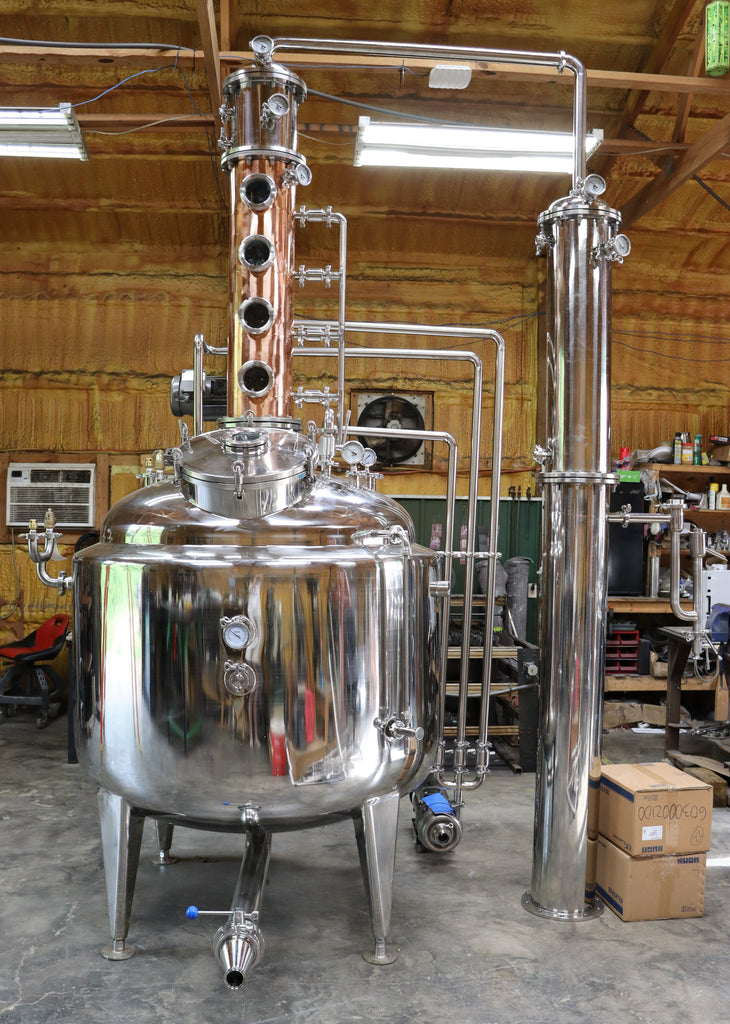
Commercial-scale distillation equipment is a different vendor universe from the hobbyist suppliers covered in Vols 3–7. Several established makers dominate the US and international craft distillery market.
8.1.2.1 Vendome Copper & Brass Works (Louisville, KY)
The legendary American craft-distillery still builder. Vendome was founded by Elmore Sherman in the early 20th century and is still run by the fourth generation of the Sherman family. Located in Louisville, Kentucky — bourbon country — and deeply embedded in the American whiskey tradition.
- Website:
https://vendomecopper.com/ - Production: custom-built batch and continuous stills, all custom-quoted
- Materials: copper, stainless steel, copper-clad stainless, full-copper construction depending on configuration
- Typical client size: 100–5,000+ gallon batch capacity
- Notable references: Rabbit Hole Distillery (Louisville), Chattanooga Whiskey, Blue Barren Distillery (Camden, ME), Krobar Craft Distillery (Paso Robles, CA), and many others
- Pricing: quote-only; a baseline 100-gallon Vendome batch still typically lands $80,000–$150,000; a 250-gallon hybrid pot/column system $150,000–$300,000
Why Vendome:
- Century of continuous craft-still building — the longest-established US vendor in the category
- Hand-built, fully custom — every still is designed for the specific distillery’s product, space, and process
- Bourbon-tradition design language — onion domes, lyne arms, swan necks, columns matched to traditional and modern bourbon production
- The status reference — many craft whiskey distillers describe their Vendome still as a foundational brand asset; the still itself appears on bottle labels and in marketing materials
Trade-offs:
- Long lead times — typical Vendome quote-to-delivery is 12–18 months; in busy periods longer
- High cost — among the most expensive options at any scale
- Configuration depth — first-time buyers spend months in conversation with Vendome before committing to a final design
8.1.2.2 StillDragon (Sebastian, FL) — Commercial Tier
The same modular-component philosophy from Vols 4–7 scales up to 100–500+ gallon commercial systems. StillDragon’s commercial offerings include the 25-gal DoubleDragon kettle (Vol 7 §7.4.1) and larger kettles up to 500 gallons, paired with 6”–12” diameter columns with 4–12 plates, full-size dephlegmators, and complete control automation.
- Website:
https://stilldragon.com/ - Production: modular components with assembled-build or contractor-assembled options
- Typical commercial system: $50,000–$200,000 for a 100–250 gal complete craft distillery setup
- Notable: hundreds of TTB-licensed distilleries operate StillDragon equipment
Why StillDragon at Tier-6:
- Modular flexibility — the same component architecture that worked at hobbyist scale (Vol 4 Path D, Vol 5 Path D, Vol 6 Path D, Vol 7 Path B) scales up consistently
- Active community at
stilldragon.org— thousands of operational distillery builds documented - Lower cost than Vendome for comparable functional capacity — 30–50% cheaper for similar batch volume
- Faster lead times — 3–6 months typical for a complete commercial system (vs Vendome’s 12–18)
Trade-offs:
- Less prestige in the bourbon-tradition market — Vendome’s name carries cultural weight that StillDragon doesn’t (yet)
- Stainless-default construction — copper-component upgrades are available but at significant additional cost
- You build the spec sheet — modular flexibility means more design decisions on you
8.1.2.3 Specific Mechanical Equipment Corp. (Saanichton, BC, Canada)
A major North American supplier of complete distillery systems with strong reputation in the craft whiskey, vodka, and gin markets.
- Website:
https://specific-mechanical.com/ - Production: complete turnkey distillery packages (50–10,000+ gallons)
- Materials: copper, stainless, copper-clad combinations
- Typical client size: 200–2,000 gallon batch operations
- Pricing: quote-only; complete craft distillery packages typically $100,000–$500,000
Why Specific Mechanical:
- Turnkey package approach — they design the whole production line (mash tun + fermenters + still + receiving + bottling) as one integrated system, not piece by piece
- Strong craft-distillery customer base in Canada and the US Pacific Northwest
- Engineering depth — full mechanical design, P&IDs (process and instrumentation diagrams), automation packages
8.1.2.4 Christian Carl Stills (Göppingen, Germany)
The premium European craft still maker. Carl has been building copper stills since 1869; they are widely considered the highest-quality craft distillery still maker in the world.
- Website:
https://www.christiancarl.com/ - Production: bespoke copper stills, batch and column
- Materials: full copper construction; legendary copper-craftsmanship quality
- Typical client size: 150–5,000+ gallons; many high-end gin and whiskey producers
- Pricing: quote-only; among the most expensive options globally
Why Carl:
- The premium reference — if Vendome is the American craft tradition reference, Carl is the European premium reference. Many of the world’s most awarded gin and whiskey distilleries use Carl stills.
- Full-copper construction — hand-hammered, brazed, finished to the highest standards in the industry
- Heritage value — Carl bottles their century-plus heritage into every still; this matters to certain market segments
Trade-offs:
- Premium pricing — typically 1.5–2.5× Vendome for comparable capacity
- Import logistics — shipping a multi-thousand-pound copper still from Germany to the US adds 8–12 weeks and significant freight cost
- Lead times — 18–24 months typical from order to delivery
8.1.2.5 Forsyths (Rothes, Scotland)
The Scotch whisky industry’s preferred still maker. Forsyths builds the stills for most major Scotch distilleries and a growing number of international craft whisky producers.
- Website:
https://www.forsyths.com/ - Production: traditional copper pot stills, lyne arms, condensers
- Style: Scotch-whisky-tradition design (onion-shaped, long lyne arms, worm-tub condensers)
- Typical client size: 500–10,000+ gallon batch capacity
- Pricing: quote-only; among the most expensive
Why Forsyths:
- The Scotch tradition reference — if you’re building a Scotch-style whisky distillery, Forsyths is the obvious choice
- Traditional construction — hand-shaped copper, traditional jointing methods, worm-tub condensers when requested
- Generational lifetime — Forsyths stills routinely operate for 50+ years in major distilleries
8.1.2.6 iStill (Heerenveen, Netherlands)
The modern automation-forward alternative. iStill builds fully-automated continuous and batch stills with PLC control, recipe management, automated cuts, and full data logging.
- Website:
https://www.istill.com/ - Production: pre-engineered standard models (50, 100, 250, 500, 2000 gallons) plus custom
- Materials: stainless steel construction with copper components in the vapor path where appropriate
- Pricing: more transparent than US/UK competitors; entry models around $50,000–$100,000
Why iStill:
- Automation built-in — touchscreen interface, recipe storage, automated heat-up/equilibration/cuts/shutdown, full data logging for QA and TTB compliance
- Faster operator training — the automation handles complex run procedures; new operators can run safely with less experience than traditional stills require
- Transparent pricing — published price ranges by model size; less mystery than US-market quote-only competitors
- Strong European base with growing US craft-distillery presence
Trade-offs:
- Less traditional appearance — iStill rigs look like industrial process equipment, not the romantic copper-and-brass image many distilleries cultivate for branding
- Vendor lock-in for automation — proprietary control software; harder to repair or modify without Istill support
- European base means import logistics for US buyers (though Istill has US partners)
8.1.2.7 The used market
A meaningful percentage of Tier-6 distillery startups buy used equipment from distilleries that have closed, expanded (and sold their starter rig), or upgraded. Common sources:
- Distillerytrail.com classifieds — established US distillery industry marketplace
- Used equipment from closed distilleries — distillery business failures unfortunately happen; their equipment sells at 30–60% of new prices
- Auctions — equipment auctions for closed distilleries occasionally appear (Heritage Global, etc.)
- Direct distillery contacts — networking within local craft distilling guilds turns up “we’re upgrading, want our 100-gal pot still?” opportunities
Used market advantages:
- 30–60% savings on equipment cost
- Faster availability (no manufacturing lead time)
- Equipment that’s been seasoned and de-bugged
Used market risks:
- No warranty
- May not match your specific process needs (designed for someone else’s recipe)
- Hidden issues (pinholes, weld failures, control-system age-out)
- Logistics of moving heavy equipment from seller’s location
For most Tier-6 startups, a mix of new and used works well — new still and fermenters (because these are the heart of your process and you want them dialed in for your specific recipes), used tanks and ancillary equipment (because these are commodity items that have decade-long lifespans).
8.1.3 The TTB DSP Licensing Process
This is the federal permit that makes Tier-6 legal. The TTB (Alcohol and Tobacco Tax and Trade Bureau, part of the US Treasury Department) issues the Distilled Spirits Plant (DSP) permit under authority of 27 CFR Part 19.
8.1.3.1 What a DSP permit authorizes
A DSP permit authorizes the holder to “produce, bottle, rectify, process, or store” beverage distilled spirits at a specific registered premises. The permit covers:
- Production — actual distillation of beverage alcohol
- Bottling — placing distilled spirits in retail containers
- Rectification — blending, infusing, or compounding spirits (gin botanical infusion, blended whiskey, flavored spirits, etc.)
- Processing — any other transformation of distilled spirits (cask finishing, proofing, etc.)
- Storage — holding distilled spirits in bond before tax payment
A single DSP permit covers all of these operations at the registered premises. If you operate from multiple physical locations, each requires its own DSP permit.
8.1.3.2 The application process
Filing system: TTB Permits Online (https://www.ttb.gov/online-services/applications). Electronic filing is strongly preferred over paper.
Application form: Form TTB F 5110.41 (Distilled Spirits Plant Permit Application).
Required documents (vary by business structure):
- Lease agreement or proof of property ownership for the DSP premises. The lease must explicitly authorize distilling operations by the lessee — generic commercial leases often don’t, and amendments are usually needed.
- Business structure documents — articles of incorporation, partnership agreements, LLC operating agreements
- Personnel information — owners, officers, key personnel; all subject to background checks
- Source of funds documentation — TTB wants to verify the legitimacy of startup capital
- Facility diagrams and equipment list — drawings of the premises showing where each piece of equipment is located, with specifications for each major item
- Bonded premises specification — designation of which physical area is the bonded production area (where excise tax has not yet been paid) vs. tax-paid storage area
- Operations plan — written description of what spirits you’ll produce, what process you’ll use, expected production volume
- Background information on owners — fingerprint cards in some jurisdictions, criminal history disclosure
Timeline: 2–6 months from application submission to permit issuance for a clean application. Errors, incomplete documentation, or background-check issues extend this significantly. Plan for 6–9 months from initial application work to operational permit in hand.
Fees: There is no federal fee to apply for or maintain a DSP permit. The TTB does not charge for the permit itself.
8.1.3.3 The bond requirement
Historically, DSP operators were required to file a substantial bond with TTB to secure payment of excise tax. The Craft Beverage Modernization Act (CBMA), made permanent in 2020, eliminated the bond requirement for distilleries whose annual excise tax liability is reasonably expected to be less than $50,000.
- No bond required: if you expect to remove less than ~3,700 proof gallons annually (at the $13.50 standard rate). At the $2.70 CBMA reduced rate, that threshold is ~18,500 proof gallons.
- Bond required: if your projected production exceeds the bond exemption threshold. Bond amount = annual excise tax liability up to $1,000,000.
For most small craft distillery startups, the bond exemption applies — you won’t hit $50K in federal excise tax in your first several years of operation. Confirm with your alcohol attorney.
8.1.3.4 Operations permit vs. dealer permit
The DSP permit is for production. If you also intend to sell spirits at retail (e.g., from a tasting room or directly to retail customers), you typically also need a Federal Basic Permit for retail sales — though small-distillery direct-sale rules vary by state.
For most craft distillery startups: get the DSP first, then add other permits as the business plan dictates.
8.1.3.5 Operational compliance after permit issuance
The DSP permit is not a one-time achievement. Ongoing compliance includes:
- Monthly Production and Storage Operations Reports to TTB (Form 5110.40)
- Quarterly federal excise tax payments (Form 5000.24)
- Inventory tracking — every proof gallon of spirit produced, stored, removed, or destroyed must be accounted for
- Annual physical inventory reconciliation
- Recordkeeping — TTB requires retention of all production, storage, and tax records for 3 years
- TTB audits — periodic inspections of premises and records by TTB officers; typically 1 audit every 3–5 years for small distilleries, more frequent for larger operations or operations with prior compliance issues
This compliance overhead is significant — most craft distilleries either hire a part-time bookkeeper with alcohol-industry experience or outsource to a compliance specialist like Park Street (https://parkstreet.com/) for $200–$1,000/month depending on volume.
8.1.3.6 Getting help with the application
Strongly recommended: hire an alcohol-beverage attorney for the DSP application. Common firms with established TTB practices:
- ClearBev Law (
https://clearbeveragelaw.com/) — TTB-specialized - McDermott Will & Emery alcohol practice
- Lehrman Beverage Law
- Local firms with TTB experience in your state
Typical legal cost for DSP application: $5,000–$15,000 depending on complexity (state-specific requirements, lease negotiation, business structure, etc.). This is real money but represents 1–3% of total startup cost for most craft distilleries and dramatically reduces the time-to-permit and the risk of application rejection.
8.1.4 State and Local Licensing
The federal DSP is necessary but not sufficient. Every US state also requires state-level distillery licensing, and most local jurisdictions impose additional zoning, building, and operating requirements.
8.1.4.1 State distillery licenses
All US states require a state distillery license. The structure and cost varies enormously:
- Some states (Kentucky, Tennessee, Colorado, Oregon, others) have well-established craft distillery licensing with reasonable fees and clear processes — these are “distillery-friendly” states
- Other states have more restrictive structures — limited license counts (some states issue a fixed number of distillery licenses), high fees, complex application processes, or specific restrictions on retail sales
- Three-tier states (most US states) require a clear separation between producers (distilleries), wholesalers (distributors), and retailers; “self-distribution” is allowed in some states but not all
- Control states (e.g., Pennsylvania, Utah) require all spirits to flow through state liquor authorities, complicating direct-to-retail sales
Cost ranges: $200–$5,000+ annually for the state distillery license alone. Plus state-specific fees, taxes, and bonds.
Timeline: state licenses can usually be obtained in parallel with the TTB DSP, though most states require evidence of TTB approval before issuing the state license. Total state-license timeline: 1–3 months after TTB DSP issuance.
8.1.4.2 Local zoning and operating permits
The local layer is often where projects unexpectedly stall:
- Zoning: distillery operations are typically allowed only in industrial, mixed-use, or specifically-permitted commercial zones. Verify zoning before signing a lease. A lease for premises that don’t permit distilling is a financial disaster.
- Conditional use permits: even in zones that allow distilleries, your specific operation may require a conditional use permit (CUP) — public hearings, neighbor notifications, planning commission approval. CUPs typically take 3–6 months.
- Building permits: any build-out of the facility (electrical, plumbing, fire suppression, ventilation) requires building permits from local authorities. Industrial alcohol production triggers more stringent fire and life-safety review than typical commercial buildings.
- Fire department review: distilleries store significant volumes of flammable ethanol; fire marshal approval of the storage layout, ventilation, fire suppression, and emergency egress is mandatory.
- Health department review: required in most jurisdictions for any food-grade production
- Wastewater permits: distillery wastewater (spent grain, backset, cleaning water) has high BOD/COD loads that may require pretreatment before discharge or hauled-waste agreements with treatment facilities
8.1.4.3 Tasting rooms and direct-to-consumer
A tasting room dramatically improves distillery economics — direct retail margin is 60–80% vs. 15–30% through distributor. But tasting rooms add another layer of state and local permitting:
- State liquor authority permit for on-premise consumption
- Local retail license
- Food service permit if you serve food
- Special event permits for tastings, festivals, etc.
Some states (Kentucky, Tennessee, Texas, etc.) actively encourage distillery tasting rooms; others (Pennsylvania, Utah) make them difficult or impossible. Research your state’s specific tasting-room law before committing to a site selection.
8.1.4.4 The state-by-state landscape (high-level)
Comprehensive state-by-state distillery licensing comparison is beyond this volume’s scope and changes frequently. Recommended starting resources:
- American Distilling Institute (
https://distilling.com/) — trade association with state-by-state regulatory tracking - Distilled Spirits Council (
https://distilledspirits.org/) — industry advocacy organization with state policy summaries - State craft distillers guilds — most states with active craft distilling have a guild that publishes member resources
8.1.5 Site Selection, Zoning, and Build-Out
The physical facility is the second-largest capital line item after equipment.
8.1.5.1 Site requirements
A minimum craft distillery footprint:
- Production floor: 1,000–3,000 sq ft for a 50–200 gallon batch operation (still, fermenters, mash tun, receiving tanks, work area)
- Storage: 500–2,000 sq ft for raw materials, packaging, and finished goods
- Bonded warehouse: if aging spirits, 500–5,000+ sq ft depending on barrel count and aging timeline
- Tasting room (optional): 500–2,000 sq ft for direct retail
- Office and admin: 200–500 sq ft
- Restrooms, utility, mechanical: 200–500 sq ft
Total typical footprint: 3,000–10,000+ sq ft for a small craft distillery; significantly more for larger operations or expanded tasting/event space.
Ceiling height: 14+ ft minimum for column stills; 18–25 ft for taller column installations. Standard commercial buildings are 10–12 ft — distilleries often need build-up modifications or specifically high-bay industrial spaces.
8.1.5.2 Utilities
Distillery utility loads exceed typical commercial buildings significantly:
- Electrical: 200–600+ amp main service for the still, fermenters, refrigeration, lighting; 480V three-phase strongly preferred over 240V single-phase at this scale
- Water: high flow-rate cold water supply for cooling (recirculating chiller or municipal supply); typical distillery uses 1,000–5,000 gallons per production day
- Sewer: capable of handling distillery wastewater volumes; some municipalities require pretreatment
- Gas: if using steam generation, you’ll need natural gas or propane supply sized for the boiler load
- HVAC: mechanical ventilation rated for ethanol vapor handling; exhaust fans rated for the building volume; possible explosion-proof electrical fixtures in classified areas
8.1.5.3 Build-out costs
Typical build-out budget for craft distillery facility: $50,000–$500,000+ depending on:
- Starting condition: raw shell vs. partially-built-out commercial space
- Tasting room scope: simple counter-and-stools ($20K) vs. full restaurant-style hospitality space ($200K+)
- Code compliance: modern facilities require less retrofit; older buildings may need extensive electrical and fire-system upgrades
- Locale: West Coast and Northeast US construction costs run 50–100% higher than Midwest and South
8.1.5.4 The lease-versus-purchase question
Lease pros: lower upfront capital; easier exit if business doesn’t work; landlord may pay for some build-out Lease cons: rent is a perpetual expense; landlord may not renew (catastrophic for an established distillery); restrictions on facility modifications
Purchase pros: equity build-up; full control of facility; ability to modify aggressively; no rent payments Purchase cons: large capital commitment; commercial mortgages typically require 25–30% down; you’re now in the commercial real estate business as well as the distillery business
Most craft distillery startups lease for the first 3–7 years, then purchase (often the property they’ve been leasing) once the business is established and lender-financeable.
8.1.6 Federal Certificate of Label Approval (COLA)
Before any bottle of distilled spirits can be sold in interstate commerce in the US, the label must be approved by TTB via the COLA process.
8.1.6.1 What COLA covers
The COLA process certifies that the label complies with federal regulations on distilled spirits labeling (27 CFR Part 5). The TTB reviews:
- Class and type designation (e.g., “Bourbon Whiskey,” “Vodka,” “Gin,” “Brandy”) — must conform to TTB’s definitions in 27 CFR Part 5 Subpart C
- Brand name — must not be misleading or prohibited
- Alcohol content statement — proof and/or ABV
- Name and address of bottler — must match the DSP permit
- Net contents — bottle volume statement
- Required warning statements — government warning, surgeon general statement (for some categories)
- Country of origin — for products produced or bottled outside the US
8.1.6.2 The application process
Filing system: COLAs Online (https://www.ttb.gov/alfd/certificate-of-label-aproval-cola).
Form: TTB Form 5100.31.
Required attachments:
- The label artwork (front, back, side as applicable; digital file format)
- Bottle and package images
- Formula approval if required (see §8.6.4)
Processing time: TTB targets 5–15 business days for COLA examination. Errors in the application (incorrect class designation, missing required statements, label that doesn’t match the artwork) extend this significantly.
Cost: no federal fee for COLA applications.
8.1.6.3 Pre-COLA formula approval
Some products require formula approval before the COLA can be issued. Categories that typically require formula approval:
- Flavored spirits (any spirit with added flavoring beyond base distillate)
- Liqueurs and cordials
- Specialty products (cask-finished, infused, fortified)
- Non-standard whiskies (single-malt rye, etc.)
- Anything with non-standard production processes
Formula approval requires submission of the production formula via TTB Formulas Online; processing time 30–60 days. Plan for this in your product launch timeline.
8.1.6.4 Labeling pitfalls
Common COLA rejection reasons:
- Class/type designation problems — calling something “whiskey” when the production method doesn’t meet TTB’s whiskey definition
- Misleading geographic claims — “Kentucky bourbon” requires production in Kentucky (this is now codified in federal regulation)
- Age statements — “aged 12 years” means the youngest spirit in the bottle is 12+ years old; misuse triggers rejection
- Health claims — “all-natural,” “antioxidant-rich,” “low-calorie” — all heavily restricted or prohibited for spirits
- Trademark conflicts — TTB doesn’t enforce trademarks but won’t approve labels with obvious conflicts with registered marks
- Missing required statements — government warning, alcohol content, net contents, etc.
Strongly recommend having labels reviewed by your alcohol-beverage attorney before COLA submission. A rejection means a re-application, redesign, and 2–6 weeks of delay; a clean first-submission saves significant time.
8.1.7 Federal Excise Tax (FET)
Distilled spirits removed for sale from a DSP premises are subject to federal excise tax.
8.1.7.1 The CBMA reduced rates (current as of late 2025)
Under the Craft Beverage Modernization Act (CBMA), made permanent in 2020, federal excise tax on distilled spirits operates on a tiered structure for each domestic producer per calendar year:
Table 1 — Under the Craft Beverage Modernization Act (CBMA), made permanent in 2020, federal excise tax on distilled spirits operates on a tiered structure for each domestic producer per calendar year
| Volume tier | Rate |
|---|---|
| First 100,000 proof gallons removed | $2.70 per proof gallon |
| Next 22,130,000 proof gallons (100K to 22.23M PG) | $13.34 per proof gallon |
| Above 22.23M PG (or for distillers not eligible for CBMA) | $13.50 per proof gallon |
A proof gallon is one US gallon of spirit at 100 proof (50% ABV). A gallon of 80-proof vodka = 0.8 proof gallons. A gallon of 100-proof bourbon = 1.0 proof gallons. A gallon of 50-proof liqueur = 0.5 proof gallons.
Practical implication: a small craft distillery producing 500 cases per year of 80-proof spirit (12 bottles per case × 0.75L per bottle ≈ 28L per case × 500 cases = 14,000 L = 3,700 gallons at 80 proof = ~2,960 proof gallons per year) faces a federal excise tax burden of:
2,960 PG × $2.70/PG = $7,992 per year
This is manageable — under the pre-CBMA flat rate of $13.50, the same production would have owed:
2,960 PG × $13.50/PG = $39,960 per year
The CBMA reduction is the single most important policy change for craft distillery economics in the past two decades. A small craft distillery’s federal tax burden was effectively cut by 80%.
8.1.7.2 When tax is owed
Federal excise tax is owed when distilled spirits are removed from the DSP bonded premises for non-export sale. Specifically:
- Bottled spirit released from bonded warehouse to tax-paid storage → tax owed
- Spirit transferred to another DSP under bond → no tax owed (the recipient is responsible)
- Spirit exported under bond → no tax owed
- Spirit destroyed under TTB supervision → no tax owed
- Spirit lost or stolen → tax may still be owed depending on circumstances
The practical management approach: hold spirit in bond until you have a confirmed buyer or sales channel, then remove and pay tax in batches.
8.1.7.3 Tax filing and payment
Form: Form 5000.24 (Excise Tax Return — Alcohol).
Frequency: quarterly for most small distilleries; monthly for larger operations.
Filing system: Pay.gov (electronic) or paper filing.
Late filing penalties: significant. Pay on time.
8.1.7.4 State excise taxes
In addition to federal FET, every US state imposes its own excise tax on distilled spirits sold in the state. State rates vary enormously:
- Lowest state rates: $1.50–$3.00 per gallon (some southern states)
- Mid-range: $5–$10 per gallon (most US states)
- Highest: $15–$30+ per gallon (Washington, Oregon, others)
State excise taxes are owed by the seller in the chain (typically the wholesaler/distributor in three-tier states, the distillery in direct-sale states). Plan for state excise tax as a 5–25% addition to the cost of selling your product in any state.
8.1.8 Commercial Insurance and Risk Management
A craft distillery has insurance needs significantly beyond typical commercial businesses.
8.1.8.1 Required coverage types
- General Liability — $1M–$2M minimum; covers visitor injuries, product liability, premises liability
- Product Liability — separate from general liability; covers consumption-related claims; $1M–$5M typical
- Property Insurance — covers building, equipment, raw materials, finished goods, work in progress; replacement cost basis
- Inland Marine — covers spirit-in-transit (between distillery and warehouses, distributors, etc.)
- Spirits-in-Storage — specialized coverage for aging spirits, which can represent the largest single asset on the books
- Business Interruption — replaces revenue if an insured event interrupts operations
- Workers Compensation — required by state law for any employees
- Cyber Liability — increasingly important for customer-data protection
- Pollution Liability — for any wastewater discharge or chemical storage incidents
- Liquor Liability (Dram Shop) — if operating a tasting room or serving spirits on premises, covers over-service-related claims
8.1.8.2 Specialized distillery insurance
A handful of insurance carriers specialize in craft distillery coverage:
- ProSight Specialty Insurance — major US craft distillery insurer
- Distillers Insurance Programs (various brokerages)
- Local commercial brokers with alcohol industry experience
Premiums vary widely by state, scale, and product mix. Typical first-year insurance budget: $5,000–$25,000+ for a small craft distillery.
8.1.8.3 Aging spirit valuation challenge
If you’re aging whiskey or brandy, your inventory grows in value over time as it ages. A barrel of new-make whiskey at fill might be worth $1,500; the same barrel at 6 years might be worth $5,000+ (in finished-spirit market value). Insurance coverage needs to scale with this growth — annual policy reviews and inventory updates are critical.
8.1.9 The Hobby-to-Commercial Transition Economics
Most Tier-6 distilleries are founded by Tier-5 hobbyists who decide to “go pro.” The economic reality is sobering.
8.1.9.1 The capital stack
Realistic startup capital for a small craft distillery:
Table 2 — Realistic startup capital for a small craft distillery
| Category | Range |
|---|---|
| Equipment | $50,000–$400,000 |
| Facility build-out | $50,000–$500,000 |
| Initial inventory (raw materials) | $20,000–$80,000 |
| Aging inventory (if applicable) | $20,000–$150,000 (the cost of grain + production for spirit you can’t sell for 2–4 years) |
| Licensing, legal, professional fees | $15,000–$50,000 |
| Working capital (18–36 months operating expenses) | $200,000–$500,000 |
| Branding, packaging, marketing | $20,000–$100,000 |
| Total realistic startup | $400,000–$1,800,000 |
Industry analysis suggests actual startup costs typically exceed initial estimates by 25–50%. Budget conservatively.
8.1.9.2 Time to profitability
For unaged spirits (vodka, gin, white rum): 18–36 months to operating profitability with modest production volume.
For aged spirits (whiskey, brandy, aged rum): 4–7 years to operating profitability — because you can’t sell the product until it’s aged, and you’re carrying the cost of production plus inventory for years before revenue.
This means craft whiskey distillery startups need 5–7 years of working capital, not the 18–36 months that some category startups can survive on. Many failed distillery launches simply ran out of money before their aged product could reach market.
8.1.9.3 Production economics
Approximate per-bottle economics for a 750 mL bottle of craft whiskey:
Table 3 — Approximate per-bottle economics for a 750 mL bottle of craft whiskey
| Line item | Cost per bottle |
|---|---|
| Raw materials (grain, yeast, etc.) | $1.00–$2.00 |
| Production labor | $1.50–$4.00 |
| Aging cost (4–6 year barrel costs allocated) | $4.00–$10.00 |
| Bottle, label, closure | $1.50–$3.00 |
| Federal excise tax ($2.70/PG @ 80 proof) | $0.43 |
| State excise tax (varies) | $0.50–$3.00 |
| Distribution markup (if through distributor) | 25–30% on top of producer price |
| Retail markup (typical) | 30–50% on top of distributor price |
| Producer cost per bottle | $9–$22 |
| Producer sell price (through distributor) | $18–$35 |
| Retail shelf price | $30–$60+ |
Margin analysis: producer net margin (after all costs) is typically 15–35% per bottle through distribution; 50–70% direct-to-consumer through tasting room. This is why tasting rooms are economically critical for small distilleries.
8.1.9.4 The hard truth about failure rates
Most craft distillery startups fail. Industry estimates suggest:
- 30–40% don’t make it past year 3
- 50–60% don’t make it past year 5
- Only 20–30% are still operating and profitable at year 10
Common failure modes:
- Undercapitalization (most common)
- Site selection problems (zoning, build-out cost overruns)
- Distribution failure (can’t get into stores or restaurants)
- Brand differentiation failure (in a crowded craft market, “another craft bourbon” isn’t enough)
- Founder burnout
- Family/partnership disputes
This isn’t to discourage anyone from pursuing the dream — it’s to say enter with eyes open. The successful 20–30% of craft distilleries built sustainable businesses; the rest didn’t. Plan to be in the successful tier by understanding the failure modes in advance.
8.1.9.5 The path that often works
A pattern that recurs in successful small craft distilleries:
- Tier-5 hobbyist for 2–5 years — develop a specific product expertise (your house bourbon recipe, your gin botanical formula, your aged-rum process)
- Document everything — batch logs, cuts data, taste evaluations, customer feedback (informal at this stage)
- Build the business plan slowly — talk to existing craft distillers, attend industry events (American Distilling Institute Conference, ADI Craft Spirits Convention), tour facilities, understand what works
- Find the right partner(s) — a co-founder with complementary skills (business operations, sales, marketing) often makes the difference between making it and not
- Start small at Tier-6 — 50–100 gallon initial capacity, single product line, lean operation. Most successful craft distilleries scale up over 5–10 years rather than launching at full size.
- Reinvest profitably — don’t take owner draws in years 1–3 if the business needs the capital to grow
8.1.10 Common Tier-6 Pitfalls
1. Underestimating startup capital. This is the #1 cause of craft distillery failure. Prevention: multiply your initial budget by 1.5× as a planning baseline; verify with industry-experienced advisors before committing.
2. Wrong site selection. Zoning issues, inadequate utility capacity, or restrictive lease terms can sink an otherwise-viable plan. Prevention: zoning verification BEFORE signing lease; engineering review of utility capacity; lease negotiated by alcohol-experienced commercial real estate attorney.
3. Underestimating compliance burden. Quarterly TTB reports, monthly inventory reconciliation, annual physical inventory, state tax filings, COLA renewals, ongoing label changes for new products — this is a part-time job all by itself. Prevention: either hire a compliance specialist from the start or budget 20+ hours per month of founder time for compliance.
4. Aging spirit cash flow shock. Whiskey distilleries spend $X per year producing and barreling spirit they can’t sell for 4–6 years. Many founders don’t fully internalize the cumulative cash impact until year 3. Prevention: detailed multi-year cash flow modeling; raise enough capital to survive the aging gap; consider unaged-spirits to bridge revenue (vodka, gin, white rum, white whiskey).
5. Distribution naïveté. “I’ll just sell to local restaurants and bars” sounds easy until you discover state distribution laws, distributor minimums, slotting fees, and the practical reality of getting a single placement at a single bar takes months of work. Prevention: talk to existing distillers about their distribution experience BEFORE investing in production capacity for a sales channel you can’t actually access.
6. Quality regression at scale. The recipe that produced excellent whiskey at Tier-5 5-gal scale doesn’t always scale linearly to Tier-6 100-gal scale. Ferment dynamics, cut transitions, equipment dynamics all change. Prevention: expect your first 6–12 months of Tier-6 production to be process-development; don’t release product to market until quality is confirmed.
7. Brand differentiation failure. “Craft bourbon” is a crowded category. If your product doesn’t have a clear, defensible story (origin, technique, recipe, founder narrative), it gets lost on the shelf. Prevention: brand work BEFORE equipment purchase; clear positioning statement; product line designed to support the brand story.
8. Partner / family disputes. Many craft distilleries are founded by partnerships or family teams. Disputes about strategy, money, time commitment, or roles destroy more distilleries than equipment failures. Prevention: clear written agreements (founder agreement, operating agreement, exit clauses) before launching; regular structured business reviews; external advisors who can mediate.
9. Trademark and IP problems. Your brand name, label artwork, recipe — all need legal protection. And you need to verify you’re not infringing on existing trademarks. Prevention: trademark searches before settling on a brand; trademark registration once approved; copyright registration for label artwork.
10. Insurance coverage gaps discovered after a claim. “I had insurance” is small comfort if the specific event that occurred isn’t covered, or coverage is inadequate for the loss. Prevention: annual coverage review with an alcohol-industry-experienced broker; specific scenario analysis (what if a barrel rickhouse burns? what if a consumer claims allergy? what if a tasting-room visitor injures themselves?).
8.1.11 Series Conclusion: The Complete Spectrum
This volume completes the Phase 3 distilling deep-dive. The spectrum we’ve traversed:
Table 4 — This volume completes the Phase 3 distilling deep-dive. The spectrum we've traversed
| Vol | Tier | Scale | Cost | Defining feature |
|---|---|---|---|---|
| 3 | 1 | 1–3 gal stovetop | $65–$1,350 | Entry; learn the craft |
| 4 | 2 | 10–15 gal bench | $1,000–$3,500 | Real capacity; two-run workflow |
| 5 | 3 | 5–15 gal column | $250–$2,500+ | Active rectification; neutral spirit |
| 6 | 4 | 5–8 gal hybrid | $500–$3,500+ | Physical-mode dual-purpose |
| 7 | 5 | 15–25 gal dedicated | $4,000–$15,000+ | Production cadence; single-spirit specialist |
| 8 | 6 | 50–500+ gal commercial | $400K–$1.8M+ | Legal, commercial, professional |
Two threads ran through all six tiers:
-
Copper quality matters — established in Vol 3 §3.2.4 and reinforced throughout. Real copper in the vapor path, especially the boiler and the still walls, produces materially better spirit through sulfur scrubbing chemistry. The quality lean toward US-built artisan copper construction held from Tier-1 budget upgrade through Tier-6 Vendome and Christian Carl premium builds.
-
The legal reality — Tier-1 through Tier-5 are federal felonies in the US absent a DSP permit, regardless of personal-use intent. The discretion practice is workable for low-visibility hobbyist operations; for any meaningful scale or commercial intent, the path to peace of mind runs through TTB licensing (Vol 8).
Where to go from here:
If you’re at Tier-1 or 2 and just getting started: focus on technique. The hardware will keep working; your skill at cuts, your understanding of cuts, your nose for spirit quality — these are the limiting factors. Vols 1–2 (history, chemistry, fermentation) are worth re-reading after every 5–10 spirit runs because the material lands differently with experience.
If you’re at Tier-3 or 4 and refining your craft: focus on consistency. Build a process you can reproduce. Document everything. The difference between a hobbyist who makes occasional excellent spirit and one who makes consistently good spirit is documentation discipline.
If you’re at Tier-5 and considering Tier-6: take the time you need. The path from “I’m a serious hobbyist with a great recipe” to “I’m a viable commercial distillery” is 3–7 years of preparation, capital raising, business planning, and skill development beyond what got you to Tier-5. Many great hobbyist distillers should stay hobbyist distillers; some have the business temperament, capital access, and skill profile to make Tier-6 work. Be honest with yourself about which you are.
If you’re at Tier-6 already: keep this volume as a reference for the regulatory and tax pieces that don’t change often but matter when they do. Stay engaged with the American Distilling Institute, your state craft distillers guild, and the broader craft beverage community — the regulatory environment continues to evolve, and the network is where opportunities and warnings travel fastest.
Final note on the spirit you make:
The chemistry that turns sugar into alcohol via yeast and copper into beautiful spirit via heat is the same at every tier. A great bottle of whiskey from a Tier-1 stovetop still and a great bottle of whiskey from a Vendome 200-gallon system are made the same way — the difference is scale, consistency, and commerce, not the underlying craft. Whatever tier you operate at, the spirit you make is the point. Make it well, share it generously (within whatever legal framework applies to you), and enjoy the process.
End of Vol 8. End of Phase 3 series.
The full series: Vol 1 (History + Chemistry) → Vol 2 (Fermentation) → Vol 3 (Tier-1 Kitchen Still) → Vol 4 (Tier-2 Bench Rig) → Vol 5 (Tier-3 Reflux Column) → Vol 6 (Tier-4 Dual-Mode Hybrid) → Vol 7 (Tier-5 Dedicated Rig) → Vol 8 (Tier-6 Craft Distillery + TTB Licensing).
Comments (0)