Brewing · Volume 10
Vol 10 — Tier 6: Nano-Brewery & Going Commercial
The first nine volumes built a brewer: history, ingredients, process, styles, and an equipment ladder from a stovetop extract kit to an automated electric system. This final volume is about a different kind of step — not bigger gear, but selling the beer you make. That moves you out of the hobby and into a regulated business, and it is governed less by brewing skill (you have that now) than by law, capital, and operations.
This is educational content, not legal, tax, or financial advice. Brewing law is federal and state, and it changes. Before you spend a dollar toward selling beer, consult a beverage-alcohol attorney and your state’s alcohol authority, and verify current TTB requirements directly.
10.1.1 What Tier-6 Means
Tier-6 begins the moment money changes hands for your beer. Recall the legal thread from Vol 1 §1.9: homebrewing is federally legal (up to 100 gal/adult/year, 200/household) — but selling any quantity is not, without federal and state authorization. That single fact is what separates Tier-6 from everything below it. (It is also the mirror image of distilling, which is a federal felony even to produce at home — a contrast worth keeping in mind.)
Scale at Tier-6 is typically a nano-brewery: a 1–3 barrel system (a barrel is 31 US gallons, so ~31–93 gallons per batch). That’s an order of magnitude above the homebrew tiers:
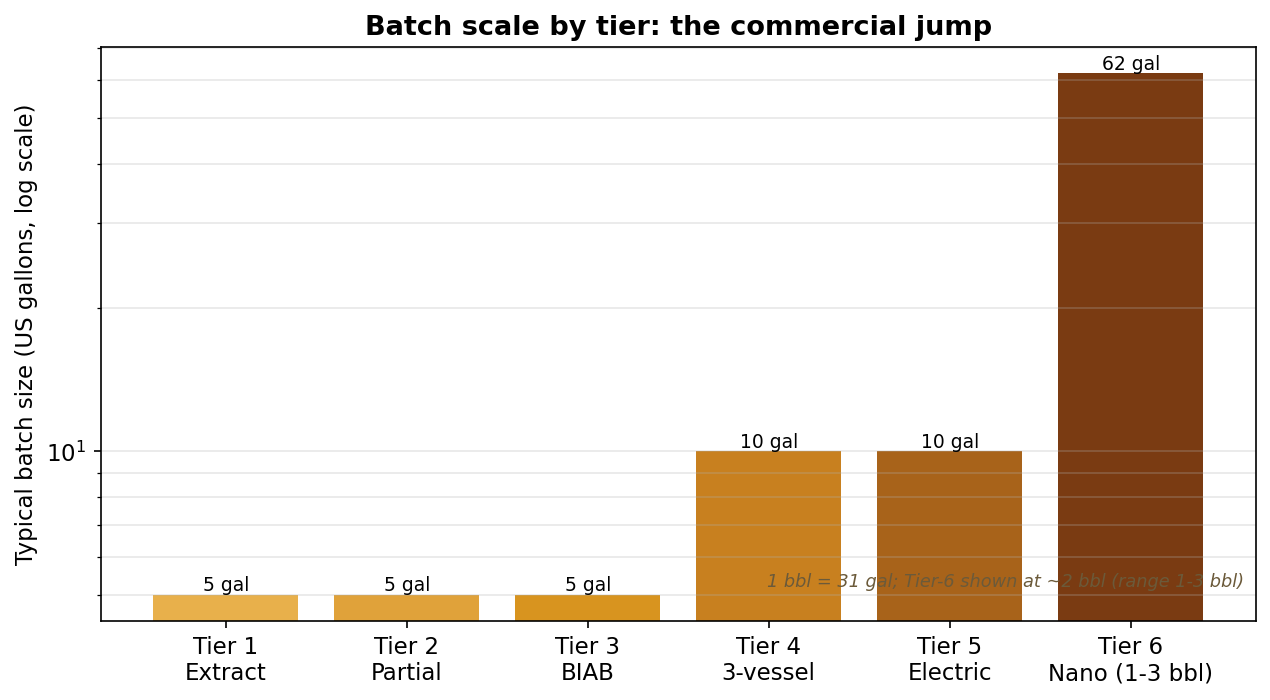
Most nano-brewers come up the very ladder this book describes — the homebrew-to-pro pipeline (Vol 1 §1.9). Your Tier-5 skills transfer directly; what’s new is everything around the brewing.
10.1.2 The Commercial Equipment Landscape
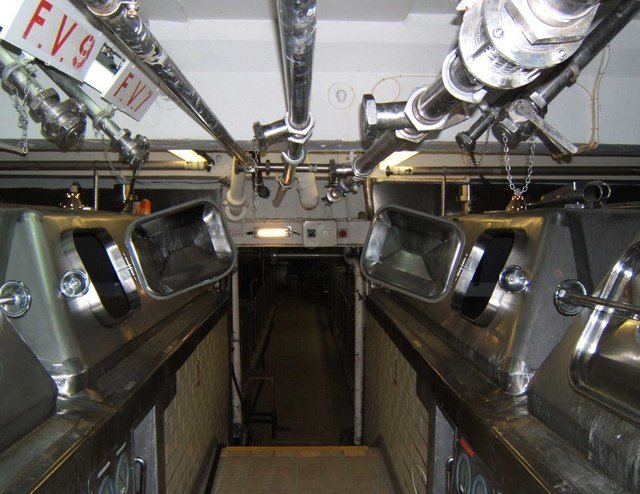
Commercial systems are bigger, stainless, and built for repeatability and cleaning. (Prices approximate, 2026.)
- 1–3 bbl brewhouses — from makers like Spike Brewing, SS Brewtech, Stout Tanks, Blichmann (pro), American Beer Equipment (ABE), Psycho Brew, and overseas builders (e.g. YoLong). A 1–3 bbl system runs roughly $25,000–85,000 depending on new-vs-used, automation, and vessel count; a turnkey 3-bbl is often $45,000+.
- Fermentation & brite tanks — jacketed conical fermenters and bright (serving) tanks, glycol-cooled.
- Glycol chiller — central cooling for fermentation and brite tanks.
- Packaging — kegs at scale, plus optional canning (mobile canning lines are common for nanos to avoid buying one).
- The used market — failed and upsizing breweries make used equipment plentiful; it’s how many nanos control startup cost.
10.1.3 The Federal Brewer’s Notice (TTB)
To brew beer for sale you must first qualify with the federal Alcohol and Tobacco Tax and Trade Bureau (TTB).
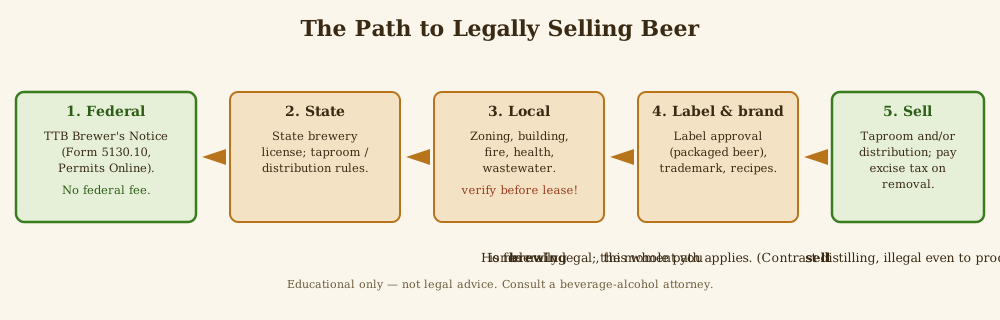
- The Brewer’s Notice. File TTB Form 5130.10, online via TTB Permits Online (recommended). There is no federal fee to apply for or maintain it. It covers your specific premises and the operations you’ll perform.
- Bond. Historically required; the PATH Act (2017) removed the bond requirement for brewers reasonably expecting under $50,000/year in federal excise tax — which covers essentially every nano. Confirm with TTB/your attorney.
- Federal excise tax (CBMA, current rates). Under the Craft Beverage Modernization Act (permanent since 2020), a small domestic brewer (producing ≤2 million barrels/year) pays $3.50 per barrel on the first 60,000 barrels, then $16/barrel up to 6 million, and $18/barrel above that. For a nano removing a few hundred barrels a year, that’s the $3.50/bbl rate — a small line item. (Verify current rates with TTB; this is not tax advice.)
- Ongoing compliance. A Brewer’s Report of Operations and excise-tax returns on a schedule (annual/quarterly/semi-monthly depending on volume), plus recordkeeping. Budget real time (or a bookkeeper) for it.
10.1.4 State & Local Licensing
The federal Brewer’s Notice is necessary but not sufficient.
- State brewery license. Every state licenses breweries, with its own fees, classes, and rules — and the three-tier system (producer → distributor → retailer) shapes how you can sell. Self-distribution and taproom rights vary enormously by state; some states are very brewery-friendly, others restrictive.
- Local zoning & permits. Breweries are usually allowed only in certain zones; expect conditional-use permits, building/electrical/plumbing permits, fire-marshal review, health-department approval, and wastewater requirements (brewery effluent is high-strength). Verify zoning before signing any lease — a lease for premises that can’t be permitted is a financial disaster.
10.1.5 Recipe Scale-Up & Quality Control
Scaling your award-winning homebrew recipe to a commercial system is not a simple multiplication:
- Recalculate, don’t just multiply. Mash efficiency, hop utilization, evaporation rate, and water volumes all change with the equipment (Vol 3 §3.10). Expect your first commercial batches to be process development, dialing the recipe back to target on the new system.
- Consistency is the product. Customers expect the same beer every time. This is the repeatability thread at commercial stakes: documented processes, controlled fermentation, and measurement.
- Quality control. Even a nano benefits from basic QC — gravity and pH on every batch, a sensory panel (even just trained staff), attention to dissolved oxygen at packaging (the enemy of shelf life), and clean-in-place discipline.
10.1.6 The Business Economics
The brewing is the easy part; the business is where most nanos succeed or fail.
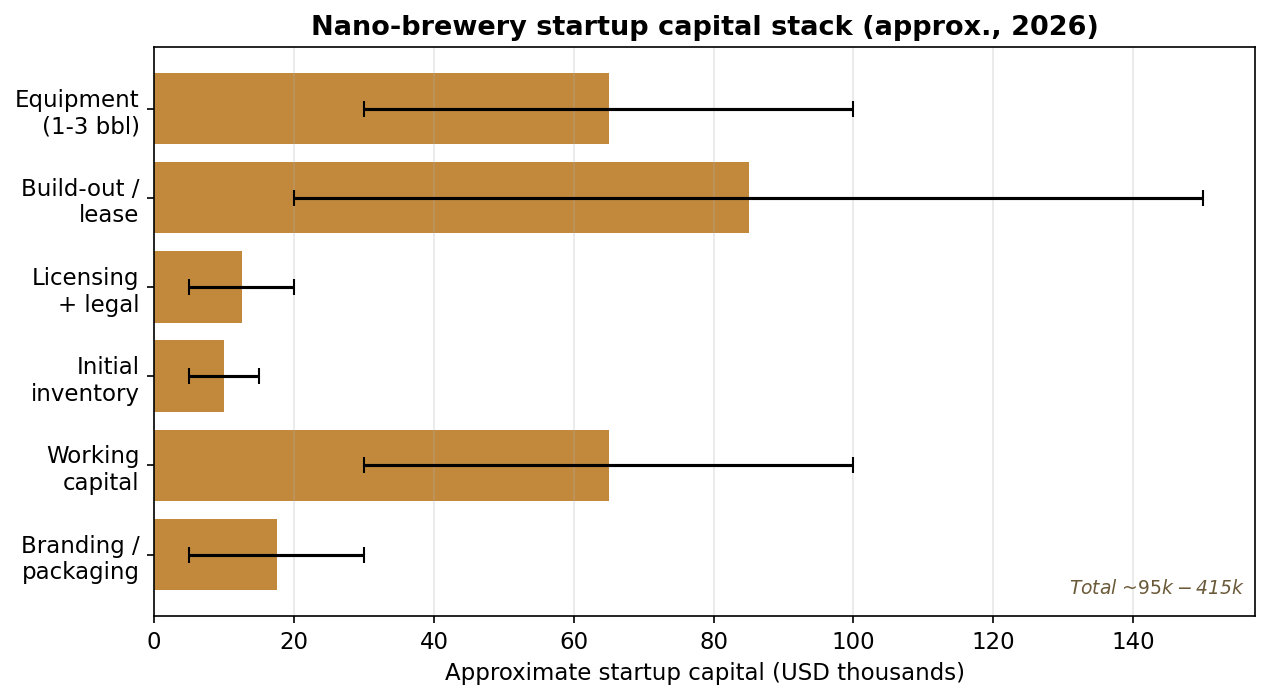
- The capital stack. Equipment is only one slice; facility build-out, working capital, licensing/legal, initial inventory, and branding typically add up to a total realistic startup of ~$250,000–500,000 for a nano with a taproom (less for a bare-bones, used-equipment, alternating-proprietorship start). Plan 6–12 months of operating cash.
- Taproom vs. distribution. A taproom sells your beer at near-retail margin (you keep most of the pint price) and is the economic engine of most successful nanos. Distribution (through the three-tier system) moves volume but at a fraction of the margin. Most nanos are taproom-first.
- The hard truth. Many craft breweries fail — undercapitalization is the leading cause. The path that tends to work: spend years at Tier-5 perfecting a few signature beers, start small (1–3 bbl, taproom-first, used equipment), keep the day job until cash flow is real, and grow deliberately.
10.1.7 Common Pitfalls and How to Avoid Them
- Undercapitalization. The #1 killer. Prevention: budget conservatively, add a 20–40% contingency, and secure working capital before opening.
- Zoning/lease traps. Prevention: verify zoning and permitting before signing a lease; use an attorney experienced in alcohol/commercial real estate.
- Underestimating compliance. TTB + state reporting and tax filings are a recurring job. Prevention: budget the hours or hire help from day one.
- Distribution naïveté. “I’ll just sell to local bars” runs into distributor minimums and three-tier law. Prevention: lean on the taproom; understand your state’s distribution rules first.
- Quality regression at scale. A great 5-gallon recipe can stumble at 3 bbl. Prevention: treat early commercial batches as R&D; don’t sell until the beer is right and consistent.
- Brand differentiation. “Another local IPA” gets lost. Prevention: a clear story and identity before you open.
10.1.8 Series Conclusion: The Complete Spectrum
This completes the brewing deep-dive. The ladder we’ve climbed:
Table 1 — This completes the brewing deep-dive. The ladder we've climbed
| Tier | Vol | Scale | Approx. cost | Defining feature |
|---|---|---|---|---|
| 1 | 5 | 5 gal stovetop | $190–215 | Extract + steeping; learn the craft |
| 2 | 6 | 5 gal, full boil | $380–580 | Partial mash; full boil; temperature control |
| 3 | 7 | 5 gal | < $100 incremental | All-grain BIAB; cheapest ingredients |
| 4 | 8 | 10+ gal | $400–3,500 | Dedicated 3-vessel; repeatable, no bag |
| 5 | 9 | ~10 gal | $700–3,000+ | Electric/automated; pro-style fermentation |
| 6 | 10 | 1–3 bbl (31–93 gal) | $250K–500K | Legal & commercial — selling beer |
Two threads ran through all six tiers:
- Sanitation and process control define quality — at every tier, from a stovetop extract batch to a commercial brewhouse. Brewers make wort; yeast makes beer (Vol 2 §2.4). Better equipment buys capacity, repeatability, and convenience — not, by itself, better beer.
- The legal line sits at Tier-6 — homebrewing is federally legal at every hobby tier (1–5); the moment you sell, you need a federal Brewer’s Notice and state licensing (the inverse of distilling, illegal even to produce at home — Vol 1 §1.9).
Where to go from here:
- Just starting (Tier 1–2): focus on sanitation and fermentation temperature; re-read Vols 2–3 after a few batches — they land differently with experience.
- Refining (Tier 3–4): focus on consistency and documentation; a measured, repeatable process is what separates occasional excellence from reliable quality.
- Considering going pro (Tier 5 → 6): be honest with yourself. Many superb homebrewers should stay homebrewers; the leap to Tier-6 is a business undertaking — capital, compliance, operations, sales — that has little to do with how good your beer is. The successful nanos plan for years.
A final note. The chemistry that turns malt, hops, yeast, and water into beer is the same at every tier — a Sumerian brewing bappir, a monk lagering in a cellar, you on a Tier-3 BIAB rig, and a nano-brewery on a 3-bbl system are all doing the same thing. Whatever tier you brew at, the beer is the point. Make it clean, make it yours, share it generously (within the law that applies to you), and enjoy the craft.
End of Vol 10. End of the Brewing deep-dive — Vols 1–10, history to commerce.
Cross-references: the homebrew-legalization history is Vol 1 §1.9; the recipe math behind scale-up is Vol 3 §3.10; the Tier-5 skills you bring to commercial brewing are Vol 9; the parallel commercial/legal volume for distilling is Distilling Vol 8.
Comments (0)